
Suhl
Kirchengemeinde Suhl, Kirchgasse 6, 98527 Suhl, Deutschland
Main Church St. Mary | Photos & History
The Main Church St. Mary in Suhl is much more than just a historical house of worship. It stands in the center of the city, above the market, and combines late Gothic origins with an extraordinarily rich Rococo decoration. This very mix makes it so exciting for visitors: Here, architectural history, religious tradition, craftsmanship, and a very unique spatial character come together. Those searching for Main Church St. Mary Suhl, for photos or background information, quickly encounter a church that is considered the oldest church in the city and is also one of the few Protestant Rococo churches north of the Main River. This makes it attractive for architecture enthusiasts as well as for people who want to experience a quiet, atmospheric, and historically significant sight in Suhl. The church is regularly used, is open for services, and also offers concerts, exhibitions, and guided tours. Practical points such as barrier-free access, opening hours, and orientation in the city center are clearly regulated. Therefore, anyone wanting to get to know Suhl from its cultural side should definitely include Main Church St. Mary in their plans. ([kirchengemeinde-suhl.de](https://www.kirchengemeinde-suhl.de/wo-wir-sind/hauptkirche-st-marien/?utm_source=openai))
Photos and First Impressions of Main Church St. Mary in Suhl
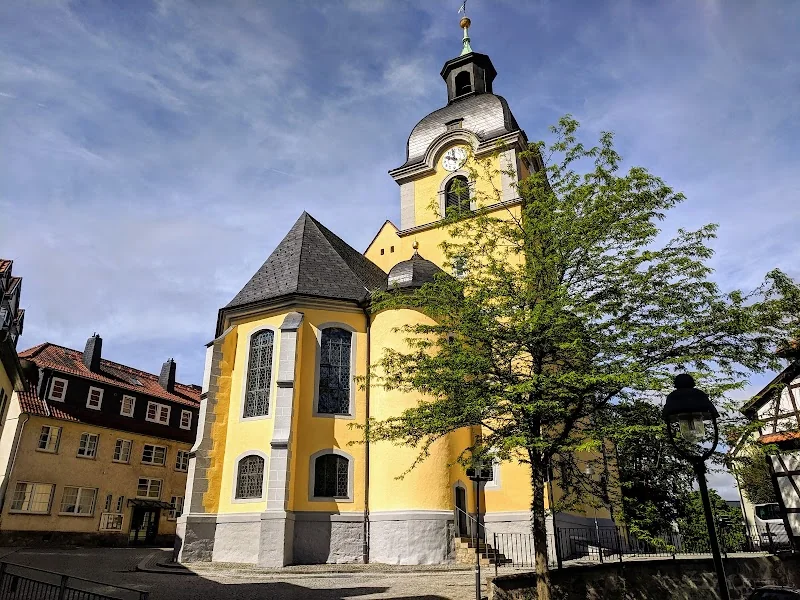
Even the first glance at Main Church St. Mary shows why it is one of the most prominent historical sites in Suhl. The Suhl architectural history describes the church as a building with late Baroque and Rococo character, located above the market, radiating a very clear historical presence from the outside. Particularly interesting are the preserved parts of the predecessor buildings, the construction inscriptions, and the stone reliefs on the exterior facade. The western part was designed as a showcase side, and in the gable triangle appears a pelican motif, symbolically representing sacrifice and care. Such details make the church particularly appealing for photography and architectural observation because it is not only beautiful but also narrative. The late Gothic remnants, the tower with its characteristic cap, and the later Baroque modifications create an image that does not appear smooth or interchangeable but has grown and is multifaceted. Those looking for photos of Main Church St. Mary will find not just a single facade but various layers of history in a single building. The location in the urban space also contributes significantly to the effect: The church stands visibly above the old center and shapes the silhouette of the city center. Thus, during a visit, one quickly gets the impression that this church is not just a monument but a vibrant focal point of Suhl's city history. ([suhl-tourismus.de](https://www.suhl-tourismus.de/wp-content/uploads/2024/12/Erlebnis-Baugeschichte-Suhl.pdf))
Particularly strong is the inner impression. The official church community describes Main Church St. Mary as a lovingly renovated city church with original Rococo furnishings. The interior is characterized by a cheerful-festive design that clearly differs from sober modern church spaces. Galleries, stucco ornaments, color accents, and the harmonious arrangement of pulpit, altar, and organ make the space feel closed yet very lively. Therefore, those entering the church do not experience an arbitrary sacred space but a consciously composed overall picture. This is of great value, especially for visitors looking for church photos, interior shots, or a special atmosphere. Because Main Church St. Mary provides motifs that are both artistically and historically interesting: detailed stucco work, wooden works with gilding, and a spatial effect that connects light, color, and form. This uniqueness makes the church a destination that one does not just quickly check off but contemplates in peace. The first impression is therefore not just beautiful but multifaceted, calm, and impressive at the same time. ([kirchengemeinde-suhl.de](https://www.kirchengemeinde-suhl.de/wo-wir-sind/hauptkirche-st-marien/?utm_source=openai))
History of the Oldest Church in Suhl
The history of Main Church St. Mary goes back a long way and is closely linked to the development of Suhl. In the Suhl architectural history, a first house of worship is mentioned on the church hill as early as 1366. The later late Gothic church was built between 1487 and 1491; this construction phase marks the beginning of the history of the church site visible today. After later fires, only parts of the outer walls and individual building components of this early construction remained. This makes it clear that the church does not consist of a single act of construction but of several layers of destruction, reconstruction, and renewal. The year 1753 was particularly formative when the church burned down again. After that, reconstruction began in 1757, which was completed in 1761 with the consecration of the hall church. The tower was completed in 1769. This sequence is important because it explains why the space today is so strongly influenced by Rococo while still carrying many traces of its older history. Main Church St. Mary is therefore not only a building from the 18th century but a grown historical ensemble with late Gothic roots. This historical depth is precisely what makes it appealing and explains why it occupies such a central position in Suhl. ([suhl-tourismus.de](https://www.suhl-tourismus.de/wp-content/uploads/2024/12/Erlebnis-Baugeschichte-Suhl.pdf))
The church community additionally emphasizes that the church burned down three times: in 1590, in 1634 during the Thirty Years' War, and in 1753. These fires are not mere footnotes but the key to the church's current appearance. After each of these cuts, the church was further developed, and with the reconstruction after 1757, a space emerged that closely integrates Protestant liturgy and Baroque representation. This was significant for the city of Suhl because it brought together religious identity, civic will, and craftsmanship. The sources also mention the involved Suhl builders Kober, Steigleder, and Gerbig, as well as the construction scribe L. A. Hoffmann and master mason J. P. Kober. The precise elaboration of the architectural history shows how strongly the building is connected to local craftsmanship. This is particularly interesting for visitors because the church does not appear as an imported work of art but as a result of regional building and design traditions. Thus, when viewing Main Church St. Mary, one sees not just a sacred space but a piece of city history that visibly makes destruction, reconstruction, and artistic refinement over several centuries. ([kirchengemeinde-suhl.de](https://www.kirchengemeinde-suhl.de/wo-wir-sind/hauptkirche-st-marien/?utm_source=openai))
The historical significance extends beyond Suhl. The church community describes Main Church St. Mary as one of the most important monuments of Protestant Rococo churches in Germany and as one of the few Rococo churches north of the Main. This is a strong unique selling point because Rococo in church construction is more often associated with southern German regions. It is all the more remarkable that Suhl has an example with this church that represents an exception in the region. For the city, this is identity-forming: Main Church St. Mary is not just a church but a symbol of cultural continuity and historical depth. The location above the market further emphasizes this significance because the church visibly rises in the old city center and thus shapes the development of the city. The architectural history in the Suhl old town ensemble also shows how closely church, marketplace, and urban development are interconnected. Therefore, Main Church St. Mary is relevant not only for believers but also for anyone wanting to understand Suhl as a historical city. ([kirchengemeinde-suhl.de](https://www.kirchengemeinde-suhl.de/wo-wir-sind/hauptkirche-st-marien/?utm_source=openai))
Rococo Furnishings, Pulpit Altar, and Wagner Organ
The special centerpiece of Main Church St. Mary is undoubtedly the furnishings of the interior. The church community describes it as original Rococo furnishings, and this is felt in the spatial effect: Everything is designed for movement, lightness, and festive harmony. At the center stands the pulpit altar, which connects the altar, pulpit, and the organ into a dynamic unity. This is particularly typical for Protestant church spaces but is here made visible in a rarely dense and artistically formulated way. The pillars are marbled, and the figures are adorned with polished chalk and gold leaf. Mentioned are Moses with the tablets of the Ten Commandments and John the Baptist with the lamb as a symbol for Christ. Additionally, there are a reading desk, baptismal font, and crystal chandelier as part of the original furnishings. The gallery railings feature shell work and angel heads, and the stucco ornaments are covered with silver leaf and partially gilded again. This abundance of details makes it clear that Main Church St. Mary is not a reduced preaching hall but a consciously designed space that stages faith, art, and symbolism. Those taking interior photos or interested in sacred art will discover a lot here. ([kirchengemeinde-suhl.de](https://www.kirchengemeinde-suhl.de/wo-wir-sind/hauptkirche-st-marien/?utm_source=openai))
Particularly important for the perception of the church is the organ. According to the church community, it was built by Johann Michael Wagner from Schmiedefeld am Rennsteig between 1757 and 1762. It has two manuals, pedals, 29 registers, and about 3000 pipes, making it a significant historical instrument. The organ case features sounding pipes and is accompanied by coats of arms, including the Henneberg coat of arms and the coat of arms of the city of Suhl. The organ was renewed in 1971/72 by the organ building company Schönefeld from Stadtilm. Thus, it is not a museum object behind glass but a living sound body that is still maintained and used today. The combination of historical casing and renewed technology is typical for many church organs, but here it is particularly relevant because the organ forms the visual and acoustic center of the space. In the church music work of the community, it plays a noticeable role, and concert announcements regularly refer to the Wagner organ. For visitors, this is a decisive reason to not only view the church but also to experience it. Because in St. Mary, the historical furnishings are not understood as decoration but as part of a functioning liturgical and musical whole. ([kirchengemeinde-suhl.de](https://www.kirchengemeinde-suhl.de/wo-wir-sind/hauptkirche-st-marien/?utm_source=openai))
Another noteworthy point is the exterior and interior inscriptions as well as the rediscovered wall paintings. During the renovation from 1969 to 1974, wall and ceiling paintings from the 17th century in the sacristy came to light. This complements the image of a church where not only the visible but also the rediscovered historical is significant. The exterior facade received its current coloring in the 1970s, and on the north and south sides, there are reliefs with biblical motifs. Such elements are not mere embellishments but contribute to the theological readability of the building. The church thus tells not only with words but with forms, colors, and signs. Therefore, those visiting Main Church St. Mary encounter a space where the Protestant house of worship, the craftsmanship of the region, and the Rococo style form a very strong unity. This is why it is equally relevant for inquiries about history, photos, organ, and furnishings. ([kirchengemeinde-suhl.de](https://www.kirchengemeinde-suhl.de/wo-wir-sind/hauptkirche-st-marien/?utm_source=openai))
Services, Concerts, and Tours
Main Church St. Mary is not only a monument but an active church location. According to the church community, services are regularly held here, usually on Sundays and holidays at 9:30 AM in rotation with the Cross Church. This shows that the church is still integrated into community practice and is not just occasionally open for visitors. Therefore, anyone wishing to combine a visit with a service will find a place with reliable usage. At the same time, the church's profile indicates that events such as concerts and exhibitions take place. This is precisely what makes Main Church interesting for a broader audience: It is a liturgical space, a cultural place, and a historical monument at the same time. In the news and church music of the community, musical formats are regularly announced, including organ concerts and programs with the Wagner organ. This fits very well with the acoustic character of the space because the organ in Main Church is not only a historical instrument but part of the living present. Thus, a usage is created that does not separate tradition and culture but brings them together. For visitors, this means: An appointment in Main Church can be a quiet tour, but also a concert evening or a spiritual experience. ([kirchengemeinde-suhl.de](https://www.kirchengemeinde-suhl.de/wo-wir-sind/hauptkirche-st-marien/?utm_source=openai))
Guided tours are also possible. The church community points out that tours are offered upon request and a printed church guide is available. This is particularly valuable for anyone wanting to understand the details of the architectural history, the symbolism of the interior, or the peculiarities of the furnishings in more detail. Because Main Church St. Mary unfolds its effect not only through external beauty but especially through the explanation of its motifs and contexts. Those coming with a guide will get the history of the fires, the reconstruction, the stucco work, the reliefs, and the organ placed in a comprehensible context. Especially in a Rococo church, this is important because many details might otherwise be easily overlooked. The induction hearing system, the barrier-free facilities, and the possibility to use a prayer space in the church also show that the community consciously designs the place to be open and accessible. Thus, Main Church St. Mary is not just a photo stop but a place for deep engagement with history, faith, and culture. ([kirchengemeinde-suhl.de](https://www.kirchengemeinde-suhl.de/wo-wir-sind/hauptkirche-st-marien/?utm_source=openai))
The musical significance should also not be underestimated. Main Church is closely linked to the musical life of the city, and the organ concerts make this clear. In the church community's news, concerts are repeatedly announced that take place in Main Church or in rotation with other Suhl churches. This keeps the space acoustically present and is perceived by locals and guests as a lively sound place. For visitors searching for concerts in Suhl, organ in Suhl, or church music events, Main Church is thus a relevant point of contact. Especially in connection with the historical Wagner organ, a strong connection between instrument, space, and repertoire arises. Also, those simply seeking the tranquility of a place where art and spirituality come together will find it here. Main Church St. Mary exemplifies a church that is not only managed but actively used. This gives it its special aura in today's Suhl. ([kirchengemeinde-suhl.de](https://www.kirchengemeinde-suhl.de/wo-wir-sind/hauptkirche-st-marien/?utm_source=openai))
Accessibility, Opening Hours, and Practical Information
For practical planning, Main Church St. Mary is pleasantly uncomplicated. The Suhl tourism site mentions a barrier-free access via a ground-level side entrance. The church community adds that the church is equipped for people with disabilities and has an inductive hearing system. Additionally, there is a public toilet within 100 meters. These are important pieces of information as they facilitate the visit for different target groups: for older guests, families, people with mobility restrictions, or visitors who prefer clear orientation. The opening hours are also well described: From May to October, the church is open from Monday to Saturday. Therefore, anyone planning a visit has good chances of experiencing the building outside of a service, especially in the warm months. The regular services complement this offer. Thus, Main Church St. Mary is perceived not as a secluded museum but as an open building in the urban space. This is particularly valuable for a historical church because it retains its lively character. ([suhl-tourismus.de](https://www.suhl-tourismus.de/hauptkirche-st-marien/))
Getting to Suhl is also uncomplicated, which further facilitates the visit. The tourist information describes Suhl as a city with short distances in the green heart of Germany, close to the Rennsteig and easily accessible by car, train, or bus. For the city center, parking spaces and parking garages are mentioned, as well as a central bus stop. Therefore, anyone wishing to visit Main Church St. Mary can easily combine the trip with a city stroll. This makes sense because there are other sights and cultural destinations nearby. At the same time, the route through the city center remains manageable, allowing for a good combination of church, market, museum, and other places. For inquiries about parking in Suhl, directions to Suhl, or opening hours of Main Church St. Mary, these are exactly the practical factors that make for a good visitor experience. Especially for a visit to a historical church, it is pleasant when orientation, access, and infrastructure are in place. In Suhl, this is given, and Main Church St. Mary benefits from its central location in the urban structure. ([suhl-tourismus.de](https://www.suhl-tourismus.de/anreise-nach-suhl/?utm_source=openai))
Planning is also aided by looking at the seasonal character of the place. Since the church is primarily open on weekdays from May to October, it is particularly suitable for visits in spring, summer, and early autumn. During this time, the combination of city tour, church visit, and other destinations in Suhl can be implemented most pleasantly. Those specifically wanting to take photos often find better conditions for exterior views and detail shots in daylight during these months. For interior shots or quiet visits, times outside of peak visitor hours are also recommended. Since regular services and events take place, it is always worthwhile to check the church notices in advance. Overall, Main Church St. Mary is thus a very well-planned destination: open, central, historically significant, and practically accessible. This makes it attractive not only for special interests but also in everyday life. ([kirchengemeinde-suhl.de](https://www.kirchengemeinde-suhl.de/wo-wir-sind/hauptkirche-st-marien/?utm_source=openai))
Location in the Suhl Old Town and Surroundings
The location of Main Church St. Mary is one of its greatest strengths. It stands above the market and thus shapes the historical city center of Suhl. The Suhl architectural history describes the church as a building on the church hill, while the tourist information places it in close proximity to the old city center. This means: The church is not an isolated monument on the edge but part of the urban fabric. Those moving through Suhl experience here the connection of market, old town, church space, and urban history in a compact area. This is precisely what makes a visit so attractive. One can use the church as a starting point for a tour through the historical center and discover other places of cultural life along the way. These include, for example, the marketplace, the town hall, the Congress Centrum Suhl, and other destinations that shape the cityscape. Main Church thus acts as a calm anchor amidst a lively urban space. For tourists and locals, this is a great advantage because history here is not only told but also spatially experienced. ([suhl-tourismus.de](https://www.suhl-tourismus.de/wp-content/uploads/2024/12/Erlebnis-Baugeschichte-Suhl.pdf))
The surroundings support this impression. Suhl itself is described by the tourism site as a city with short distances that mediates between nature, culture, and urban center. Proximity to the Rennsteig, the location in the Thuringian Forest, and the status as a state-recognized recreation area give the city additional recreational value. For the visit to Main Church St. Mary, this means that one can easily combine the cultural program with a walk, a city exploration, or further visits. Those interested in church photos also benefit from the attractive integration into the old town. The church does not appear sterile and isolated but is embedded in a historical environment that adds depth to it. This connection between urban space and sacred architecture makes the place exciting. One senses that Suhl has its own historical core, in which Main Church St. Mary plays a central role. ([suhl-tourismus.de](https://www.suhl-tourismus.de/hauptkirche-st-marien/))
For an SEO-oriented view, the surroundings are also important. People searching for Main Church St. Mary Suhl, St. Mary Church Suhl, history, photos, service, or Rococo church usually want not just a name but an experiential image. This experiential image is provided by the location: historical church, city center, market, culture, short distances, and a calm atmosphere in the heart of the city. This makes Main Church St. Mary interesting for both day visitors and cultural travelers. It is not a loud event center but a place with presence, history, and active use. In Suhl, it thus takes on a dual function: it is a monument and a community place, a sight and a living space. By visiting the church, one learns not just about a building but a piece of identity-forming Suhl. ([kirchengemeinde-suhl.de](https://www.kirchengemeinde-suhl.de/wo-wir-sind/hauptkirche-st-marien/?utm_source=openai))
Sources:
- Church Community Suhl – Main Church St. Mary ([kirchengemeinde-suhl.de](https://www.kirchengemeinde-suhl.de/wo-wir-sind/hauptkirche-st-marien/?utm_source=openai))
- Suhl Tourism – Main Church St. Mary ([suhl-tourismus.de](https://www.suhl-tourismus.de/hauptkirche-st-marien/))
- Suhl Tourism – Experience Architectural History Suhl (PDF) ([suhl-tourismus.de](https://www.suhl-tourismus.de/wp-content/uploads/2024/12/Erlebnis-Baugeschichte-Suhl.pdf))
- Church Community Suhl – Church Music and News about Concerts ([kirchengemeinde-suhl.de](https://www.kirchengemeinde-suhl.de/kirchenmusik/orgeln-in-suhl/?utm_source=openai))
- Suhl Tourism – Getting to Suhl and City Center Information ([suhl-tourismus.de](https://www.suhl-tourismus.de/anreise-nach-suhl/?utm_source=openai))
Show moreShow less
Main Church St. Mary | Photos & History
The Main Church St. Mary in Suhl is much more than just a historical house of worship. It stands in the center of the city, above the market, and combines late Gothic origins with an extraordinarily rich Rococo decoration. This very mix makes it so exciting for visitors: Here, architectural history, religious tradition, craftsmanship, and a very unique spatial character come together. Those searching for Main Church St. Mary Suhl, for photos or background information, quickly encounter a church that is considered the oldest church in the city and is also one of the few Protestant Rococo churches north of the Main River. This makes it attractive for architecture enthusiasts as well as for people who want to experience a quiet, atmospheric, and historically significant sight in Suhl. The church is regularly used, is open for services, and also offers concerts, exhibitions, and guided tours. Practical points such as barrier-free access, opening hours, and orientation in the city center are clearly regulated. Therefore, anyone wanting to get to know Suhl from its cultural side should definitely include Main Church St. Mary in their plans. ([kirchengemeinde-suhl.de](https://www.kirchengemeinde-suhl.de/wo-wir-sind/hauptkirche-st-marien/?utm_source=openai))
Photos and First Impressions of Main Church St. Mary in Suhl
Even the first glance at Main Church St. Mary shows why it is one of the most prominent historical sites in Suhl. The Suhl architectural history describes the church as a building with late Baroque and Rococo character, located above the market, radiating a very clear historical presence from the outside. Particularly interesting are the preserved parts of the predecessor buildings, the construction inscriptions, and the stone reliefs on the exterior facade. The western part was designed as a showcase side, and in the gable triangle appears a pelican motif, symbolically representing sacrifice and care. Such details make the church particularly appealing for photography and architectural observation because it is not only beautiful but also narrative. The late Gothic remnants, the tower with its characteristic cap, and the later Baroque modifications create an image that does not appear smooth or interchangeable but has grown and is multifaceted. Those looking for photos of Main Church St. Mary will find not just a single facade but various layers of history in a single building. The location in the urban space also contributes significantly to the effect: The church stands visibly above the old center and shapes the silhouette of the city center. Thus, during a visit, one quickly gets the impression that this church is not just a monument but a vibrant focal point of Suhl's city history. ([suhl-tourismus.de](https://www.suhl-tourismus.de/wp-content/uploads/2024/12/Erlebnis-Baugeschichte-Suhl.pdf))
Particularly strong is the inner impression. The official church community describes Main Church St. Mary as a lovingly renovated city church with original Rococo furnishings. The interior is characterized by a cheerful-festive design that clearly differs from sober modern church spaces. Galleries, stucco ornaments, color accents, and the harmonious arrangement of pulpit, altar, and organ make the space feel closed yet very lively. Therefore, those entering the church do not experience an arbitrary sacred space but a consciously composed overall picture. This is of great value, especially for visitors looking for church photos, interior shots, or a special atmosphere. Because Main Church St. Mary provides motifs that are both artistically and historically interesting: detailed stucco work, wooden works with gilding, and a spatial effect that connects light, color, and form. This uniqueness makes the church a destination that one does not just quickly check off but contemplates in peace. The first impression is therefore not just beautiful but multifaceted, calm, and impressive at the same time. ([kirchengemeinde-suhl.de](https://www.kirchengemeinde-suhl.de/wo-wir-sind/hauptkirche-st-marien/?utm_source=openai))
History of the Oldest Church in Suhl
The history of Main Church St. Mary goes back a long way and is closely linked to the development of Suhl. In the Suhl architectural history, a first house of worship is mentioned on the church hill as early as 1366. The later late Gothic church was built between 1487 and 1491; this construction phase marks the beginning of the history of the church site visible today. After later fires, only parts of the outer walls and individual building components of this early construction remained. This makes it clear that the church does not consist of a single act of construction but of several layers of destruction, reconstruction, and renewal. The year 1753 was particularly formative when the church burned down again. After that, reconstruction began in 1757, which was completed in 1761 with the consecration of the hall church. The tower was completed in 1769. This sequence is important because it explains why the space today is so strongly influenced by Rococo while still carrying many traces of its older history. Main Church St. Mary is therefore not only a building from the 18th century but a grown historical ensemble with late Gothic roots. This historical depth is precisely what makes it appealing and explains why it occupies such a central position in Suhl. ([suhl-tourismus.de](https://www.suhl-tourismus.de/wp-content/uploads/2024/12/Erlebnis-Baugeschichte-Suhl.pdf))
The church community additionally emphasizes that the church burned down three times: in 1590, in 1634 during the Thirty Years' War, and in 1753. These fires are not mere footnotes but the key to the church's current appearance. After each of these cuts, the church was further developed, and with the reconstruction after 1757, a space emerged that closely integrates Protestant liturgy and Baroque representation. This was significant for the city of Suhl because it brought together religious identity, civic will, and craftsmanship. The sources also mention the involved Suhl builders Kober, Steigleder, and Gerbig, as well as the construction scribe L. A. Hoffmann and master mason J. P. Kober. The precise elaboration of the architectural history shows how strongly the building is connected to local craftsmanship. This is particularly interesting for visitors because the church does not appear as an imported work of art but as a result of regional building and design traditions. Thus, when viewing Main Church St. Mary, one sees not just a sacred space but a piece of city history that visibly makes destruction, reconstruction, and artistic refinement over several centuries. ([kirchengemeinde-suhl.de](https://www.kirchengemeinde-suhl.de/wo-wir-sind/hauptkirche-st-marien/?utm_source=openai))
The historical significance extends beyond Suhl. The church community describes Main Church St. Mary as one of the most important monuments of Protestant Rococo churches in Germany and as one of the few Rococo churches north of the Main. This is a strong unique selling point because Rococo in church construction is more often associated with southern German regions. It is all the more remarkable that Suhl has an example with this church that represents an exception in the region. For the city, this is identity-forming: Main Church St. Mary is not just a church but a symbol of cultural continuity and historical depth. The location above the market further emphasizes this significance because the church visibly rises in the old city center and thus shapes the development of the city. The architectural history in the Suhl old town ensemble also shows how closely church, marketplace, and urban development are interconnected. Therefore, Main Church St. Mary is relevant not only for believers but also for anyone wanting to understand Suhl as a historical city. ([kirchengemeinde-suhl.de](https://www.kirchengemeinde-suhl.de/wo-wir-sind/hauptkirche-st-marien/?utm_source=openai))
Rococo Furnishings, Pulpit Altar, and Wagner Organ
The special centerpiece of Main Church St. Mary is undoubtedly the furnishings of the interior. The church community describes it as original Rococo furnishings, and this is felt in the spatial effect: Everything is designed for movement, lightness, and festive harmony. At the center stands the pulpit altar, which connects the altar, pulpit, and the organ into a dynamic unity. This is particularly typical for Protestant church spaces but is here made visible in a rarely dense and artistically formulated way. The pillars are marbled, and the figures are adorned with polished chalk and gold leaf. Mentioned are Moses with the tablets of the Ten Commandments and John the Baptist with the lamb as a symbol for Christ. Additionally, there are a reading desk, baptismal font, and crystal chandelier as part of the original furnishings. The gallery railings feature shell work and angel heads, and the stucco ornaments are covered with silver leaf and partially gilded again. This abundance of details makes it clear that Main Church St. Mary is not a reduced preaching hall but a consciously designed space that stages faith, art, and symbolism. Those taking interior photos or interested in sacred art will discover a lot here. ([kirchengemeinde-suhl.de](https://www.kirchengemeinde-suhl.de/wo-wir-sind/hauptkirche-st-marien/?utm_source=openai))
Particularly important for the perception of the church is the organ. According to the church community, it was built by Johann Michael Wagner from Schmiedefeld am Rennsteig between 1757 and 1762. It has two manuals, pedals, 29 registers, and about 3000 pipes, making it a significant historical instrument. The organ case features sounding pipes and is accompanied by coats of arms, including the Henneberg coat of arms and the coat of arms of the city of Suhl. The organ was renewed in 1971/72 by the organ building company Schönefeld from Stadtilm. Thus, it is not a museum object behind glass but a living sound body that is still maintained and used today. The combination of historical casing and renewed technology is typical for many church organs, but here it is particularly relevant because the organ forms the visual and acoustic center of the space. In the church music work of the community, it plays a noticeable role, and concert announcements regularly refer to the Wagner organ. For visitors, this is a decisive reason to not only view the church but also to experience it. Because in St. Mary, the historical furnishings are not understood as decoration but as part of a functioning liturgical and musical whole. ([kirchengemeinde-suhl.de](https://www.kirchengemeinde-suhl.de/wo-wir-sind/hauptkirche-st-marien/?utm_source=openai))
Another noteworthy point is the exterior and interior inscriptions as well as the rediscovered wall paintings. During the renovation from 1969 to 1974, wall and ceiling paintings from the 17th century in the sacristy came to light. This complements the image of a church where not only the visible but also the rediscovered historical is significant. The exterior facade received its current coloring in the 1970s, and on the north and south sides, there are reliefs with biblical motifs. Such elements are not mere embellishments but contribute to the theological readability of the building. The church thus tells not only with words but with forms, colors, and signs. Therefore, those visiting Main Church St. Mary encounter a space where the Protestant house of worship, the craftsmanship of the region, and the Rococo style form a very strong unity. This is why it is equally relevant for inquiries about history, photos, organ, and furnishings. ([kirchengemeinde-suhl.de](https://www.kirchengemeinde-suhl.de/wo-wir-sind/hauptkirche-st-marien/?utm_source=openai))
Services, Concerts, and Tours
Main Church St. Mary is not only a monument but an active church location. According to the church community, services are regularly held here, usually on Sundays and holidays at 9:30 AM in rotation with the Cross Church. This shows that the church is still integrated into community practice and is not just occasionally open for visitors. Therefore, anyone wishing to combine a visit with a service will find a place with reliable usage. At the same time, the church's profile indicates that events such as concerts and exhibitions take place. This is precisely what makes Main Church interesting for a broader audience: It is a liturgical space, a cultural place, and a historical monument at the same time. In the news and church music of the community, musical formats are regularly announced, including organ concerts and programs with the Wagner organ. This fits very well with the acoustic character of the space because the organ in Main Church is not only a historical instrument but part of the living present. Thus, a usage is created that does not separate tradition and culture but brings them together. For visitors, this means: An appointment in Main Church can be a quiet tour, but also a concert evening or a spiritual experience. ([kirchengemeinde-suhl.de](https://www.kirchengemeinde-suhl.de/wo-wir-sind/hauptkirche-st-marien/?utm_source=openai))
Guided tours are also possible. The church community points out that tours are offered upon request and a printed church guide is available. This is particularly valuable for anyone wanting to understand the details of the architectural history, the symbolism of the interior, or the peculiarities of the furnishings in more detail. Because Main Church St. Mary unfolds its effect not only through external beauty but especially through the explanation of its motifs and contexts. Those coming with a guide will get the history of the fires, the reconstruction, the stucco work, the reliefs, and the organ placed in a comprehensible context. Especially in a Rococo church, this is important because many details might otherwise be easily overlooked. The induction hearing system, the barrier-free facilities, and the possibility to use a prayer space in the church also show that the community consciously designs the place to be open and accessible. Thus, Main Church St. Mary is not just a photo stop but a place for deep engagement with history, faith, and culture. ([kirchengemeinde-suhl.de](https://www.kirchengemeinde-suhl.de/wo-wir-sind/hauptkirche-st-marien/?utm_source=openai))
The musical significance should also not be underestimated. Main Church is closely linked to the musical life of the city, and the organ concerts make this clear. In the church community's news, concerts are repeatedly announced that take place in Main Church or in rotation with other Suhl churches. This keeps the space acoustically present and is perceived by locals and guests as a lively sound place. For visitors searching for concerts in Suhl, organ in Suhl, or church music events, Main Church is thus a relevant point of contact. Especially in connection with the historical Wagner organ, a strong connection between instrument, space, and repertoire arises. Also, those simply seeking the tranquility of a place where art and spirituality come together will find it here. Main Church St. Mary exemplifies a church that is not only managed but actively used. This gives it its special aura in today's Suhl. ([kirchengemeinde-suhl.de](https://www.kirchengemeinde-suhl.de/wo-wir-sind/hauptkirche-st-marien/?utm_source=openai))
Accessibility, Opening Hours, and Practical Information
For practical planning, Main Church St. Mary is pleasantly uncomplicated. The Suhl tourism site mentions a barrier-free access via a ground-level side entrance. The church community adds that the church is equipped for people with disabilities and has an inductive hearing system. Additionally, there is a public toilet within 100 meters. These are important pieces of information as they facilitate the visit for different target groups: for older guests, families, people with mobility restrictions, or visitors who prefer clear orientation. The opening hours are also well described: From May to October, the church is open from Monday to Saturday. Therefore, anyone planning a visit has good chances of experiencing the building outside of a service, especially in the warm months. The regular services complement this offer. Thus, Main Church St. Mary is perceived not as a secluded museum but as an open building in the urban space. This is particularly valuable for a historical church because it retains its lively character. ([suhl-tourismus.de](https://www.suhl-tourismus.de/hauptkirche-st-marien/))
Getting to Suhl is also uncomplicated, which further facilitates the visit. The tourist information describes Suhl as a city with short distances in the green heart of Germany, close to the Rennsteig and easily accessible by car, train, or bus. For the city center, parking spaces and parking garages are mentioned, as well as a central bus stop. Therefore, anyone wishing to visit Main Church St. Mary can easily combine the trip with a city stroll. This makes sense because there are other sights and cultural destinations nearby. At the same time, the route through the city center remains manageable, allowing for a good combination of church, market, museum, and other places. For inquiries about parking in Suhl, directions to Suhl, or opening hours of Main Church St. Mary, these are exactly the practical factors that make for a good visitor experience. Especially for a visit to a historical church, it is pleasant when orientation, access, and infrastructure are in place. In Suhl, this is given, and Main Church St. Mary benefits from its central location in the urban structure. ([suhl-tourismus.de](https://www.suhl-tourismus.de/anreise-nach-suhl/?utm_source=openai))
Planning is also aided by looking at the seasonal character of the place. Since the church is primarily open on weekdays from May to October, it is particularly suitable for visits in spring, summer, and early autumn. During this time, the combination of city tour, church visit, and other destinations in Suhl can be implemented most pleasantly. Those specifically wanting to take photos often find better conditions for exterior views and detail shots in daylight during these months. For interior shots or quiet visits, times outside of peak visitor hours are also recommended. Since regular services and events take place, it is always worthwhile to check the church notices in advance. Overall, Main Church St. Mary is thus a very well-planned destination: open, central, historically significant, and practically accessible. This makes it attractive not only for special interests but also in everyday life. ([kirchengemeinde-suhl.de](https://www.kirchengemeinde-suhl.de/wo-wir-sind/hauptkirche-st-marien/?utm_source=openai))
Location in the Suhl Old Town and Surroundings
The location of Main Church St. Mary is one of its greatest strengths. It stands above the market and thus shapes the historical city center of Suhl. The Suhl architectural history describes the church as a building on the church hill, while the tourist information places it in close proximity to the old city center. This means: The church is not an isolated monument on the edge but part of the urban fabric. Those moving through Suhl experience here the connection of market, old town, church space, and urban history in a compact area. This is precisely what makes a visit so attractive. One can use the church as a starting point for a tour through the historical center and discover other places of cultural life along the way. These include, for example, the marketplace, the town hall, the Congress Centrum Suhl, and other destinations that shape the cityscape. Main Church thus acts as a calm anchor amidst a lively urban space. For tourists and locals, this is a great advantage because history here is not only told but also spatially experienced. ([suhl-tourismus.de](https://www.suhl-tourismus.de/wp-content/uploads/2024/12/Erlebnis-Baugeschichte-Suhl.pdf))
The surroundings support this impression. Suhl itself is described by the tourism site as a city with short distances that mediates between nature, culture, and urban center. Proximity to the Rennsteig, the location in the Thuringian Forest, and the status as a state-recognized recreation area give the city additional recreational value. For the visit to Main Church St. Mary, this means that one can easily combine the cultural program with a walk, a city exploration, or further visits. Those interested in church photos also benefit from the attractive integration into the old town. The church does not appear sterile and isolated but is embedded in a historical environment that adds depth to it. This connection between urban space and sacred architecture makes the place exciting. One senses that Suhl has its own historical core, in which Main Church St. Mary plays a central role. ([suhl-tourismus.de](https://www.suhl-tourismus.de/hauptkirche-st-marien/))
For an SEO-oriented view, the surroundings are also important. People searching for Main Church St. Mary Suhl, St. Mary Church Suhl, history, photos, service, or Rococo church usually want not just a name but an experiential image. This experiential image is provided by the location: historical church, city center, market, culture, short distances, and a calm atmosphere in the heart of the city. This makes Main Church St. Mary interesting for both day visitors and cultural travelers. It is not a loud event center but a place with presence, history, and active use. In Suhl, it thus takes on a dual function: it is a monument and a community place, a sight and a living space. By visiting the church, one learns not just about a building but a piece of identity-forming Suhl. ([kirchengemeinde-suhl.de](https://www.kirchengemeinde-suhl.de/wo-wir-sind/hauptkirche-st-marien/?utm_source=openai))
Sources:
- Church Community Suhl – Main Church St. Mary ([kirchengemeinde-suhl.de](https://www.kirchengemeinde-suhl.de/wo-wir-sind/hauptkirche-st-marien/?utm_source=openai))
- Suhl Tourism – Main Church St. Mary ([suhl-tourismus.de](https://www.suhl-tourismus.de/hauptkirche-st-marien/))
- Suhl Tourism – Experience Architectural History Suhl (PDF) ([suhl-tourismus.de](https://www.suhl-tourismus.de/wp-content/uploads/2024/12/Erlebnis-Baugeschichte-Suhl.pdf))
- Church Community Suhl – Church Music and News about Concerts ([kirchengemeinde-suhl.de](https://www.kirchengemeinde-suhl.de/kirchenmusik/orgeln-in-suhl/?utm_source=openai))
- Suhl Tourism – Getting to Suhl and City Center Information ([suhl-tourismus.de](https://www.suhl-tourismus.de/anreise-nach-suhl/?utm_source=openai))
Main Church St. Mary | Photos & History
The Main Church St. Mary in Suhl is much more than just a historical house of worship. It stands in the center of the city, above the market, and combines late Gothic origins with an extraordinarily rich Rococo decoration. This very mix makes it so exciting for visitors: Here, architectural history, religious tradition, craftsmanship, and a very unique spatial character come together. Those searching for Main Church St. Mary Suhl, for photos or background information, quickly encounter a church that is considered the oldest church in the city and is also one of the few Protestant Rococo churches north of the Main River. This makes it attractive for architecture enthusiasts as well as for people who want to experience a quiet, atmospheric, and historically significant sight in Suhl. The church is regularly used, is open for services, and also offers concerts, exhibitions, and guided tours. Practical points such as barrier-free access, opening hours, and orientation in the city center are clearly regulated. Therefore, anyone wanting to get to know Suhl from its cultural side should definitely include Main Church St. Mary in their plans. ([kirchengemeinde-suhl.de](https://www.kirchengemeinde-suhl.de/wo-wir-sind/hauptkirche-st-marien/?utm_source=openai))
Photos and First Impressions of Main Church St. Mary in Suhl
Even the first glance at Main Church St. Mary shows why it is one of the most prominent historical sites in Suhl. The Suhl architectural history describes the church as a building with late Baroque and Rococo character, located above the market, radiating a very clear historical presence from the outside. Particularly interesting are the preserved parts of the predecessor buildings, the construction inscriptions, and the stone reliefs on the exterior facade. The western part was designed as a showcase side, and in the gable triangle appears a pelican motif, symbolically representing sacrifice and care. Such details make the church particularly appealing for photography and architectural observation because it is not only beautiful but also narrative. The late Gothic remnants, the tower with its characteristic cap, and the later Baroque modifications create an image that does not appear smooth or interchangeable but has grown and is multifaceted. Those looking for photos of Main Church St. Mary will find not just a single facade but various layers of history in a single building. The location in the urban space also contributes significantly to the effect: The church stands visibly above the old center and shapes the silhouette of the city center. Thus, during a visit, one quickly gets the impression that this church is not just a monument but a vibrant focal point of Suhl's city history. ([suhl-tourismus.de](https://www.suhl-tourismus.de/wp-content/uploads/2024/12/Erlebnis-Baugeschichte-Suhl.pdf))
Particularly strong is the inner impression. The official church community describes Main Church St. Mary as a lovingly renovated city church with original Rococo furnishings. The interior is characterized by a cheerful-festive design that clearly differs from sober modern church spaces. Galleries, stucco ornaments, color accents, and the harmonious arrangement of pulpit, altar, and organ make the space feel closed yet very lively. Therefore, those entering the church do not experience an arbitrary sacred space but a consciously composed overall picture. This is of great value, especially for visitors looking for church photos, interior shots, or a special atmosphere. Because Main Church St. Mary provides motifs that are both artistically and historically interesting: detailed stucco work, wooden works with gilding, and a spatial effect that connects light, color, and form. This uniqueness makes the church a destination that one does not just quickly check off but contemplates in peace. The first impression is therefore not just beautiful but multifaceted, calm, and impressive at the same time. ([kirchengemeinde-suhl.de](https://www.kirchengemeinde-suhl.de/wo-wir-sind/hauptkirche-st-marien/?utm_source=openai))
History of the Oldest Church in Suhl
The history of Main Church St. Mary goes back a long way and is closely linked to the development of Suhl. In the Suhl architectural history, a first house of worship is mentioned on the church hill as early as 1366. The later late Gothic church was built between 1487 and 1491; this construction phase marks the beginning of the history of the church site visible today. After later fires, only parts of the outer walls and individual building components of this early construction remained. This makes it clear that the church does not consist of a single act of construction but of several layers of destruction, reconstruction, and renewal. The year 1753 was particularly formative when the church burned down again. After that, reconstruction began in 1757, which was completed in 1761 with the consecration of the hall church. The tower was completed in 1769. This sequence is important because it explains why the space today is so strongly influenced by Rococo while still carrying many traces of its older history. Main Church St. Mary is therefore not only a building from the 18th century but a grown historical ensemble with late Gothic roots. This historical depth is precisely what makes it appealing and explains why it occupies such a central position in Suhl. ([suhl-tourismus.de](https://www.suhl-tourismus.de/wp-content/uploads/2024/12/Erlebnis-Baugeschichte-Suhl.pdf))
The church community additionally emphasizes that the church burned down three times: in 1590, in 1634 during the Thirty Years' War, and in 1753. These fires are not mere footnotes but the key to the church's current appearance. After each of these cuts, the church was further developed, and with the reconstruction after 1757, a space emerged that closely integrates Protestant liturgy and Baroque representation. This was significant for the city of Suhl because it brought together religious identity, civic will, and craftsmanship. The sources also mention the involved Suhl builders Kober, Steigleder, and Gerbig, as well as the construction scribe L. A. Hoffmann and master mason J. P. Kober. The precise elaboration of the architectural history shows how strongly the building is connected to local craftsmanship. This is particularly interesting for visitors because the church does not appear as an imported work of art but as a result of regional building and design traditions. Thus, when viewing Main Church St. Mary, one sees not just a sacred space but a piece of city history that visibly makes destruction, reconstruction, and artistic refinement over several centuries. ([kirchengemeinde-suhl.de](https://www.kirchengemeinde-suhl.de/wo-wir-sind/hauptkirche-st-marien/?utm_source=openai))
The historical significance extends beyond Suhl. The church community describes Main Church St. Mary as one of the most important monuments of Protestant Rococo churches in Germany and as one of the few Rococo churches north of the Main. This is a strong unique selling point because Rococo in church construction is more often associated with southern German regions. It is all the more remarkable that Suhl has an example with this church that represents an exception in the region. For the city, this is identity-forming: Main Church St. Mary is not just a church but a symbol of cultural continuity and historical depth. The location above the market further emphasizes this significance because the church visibly rises in the old city center and thus shapes the development of the city. The architectural history in the Suhl old town ensemble also shows how closely church, marketplace, and urban development are interconnected. Therefore, Main Church St. Mary is relevant not only for believers but also for anyone wanting to understand Suhl as a historical city. ([kirchengemeinde-suhl.de](https://www.kirchengemeinde-suhl.de/wo-wir-sind/hauptkirche-st-marien/?utm_source=openai))
Rococo Furnishings, Pulpit Altar, and Wagner Organ
The special centerpiece of Main Church St. Mary is undoubtedly the furnishings of the interior. The church community describes it as original Rococo furnishings, and this is felt in the spatial effect: Everything is designed for movement, lightness, and festive harmony. At the center stands the pulpit altar, which connects the altar, pulpit, and the organ into a dynamic unity. This is particularly typical for Protestant church spaces but is here made visible in a rarely dense and artistically formulated way. The pillars are marbled, and the figures are adorned with polished chalk and gold leaf. Mentioned are Moses with the tablets of the Ten Commandments and John the Baptist with the lamb as a symbol for Christ. Additionally, there are a reading desk, baptismal font, and crystal chandelier as part of the original furnishings. The gallery railings feature shell work and angel heads, and the stucco ornaments are covered with silver leaf and partially gilded again. This abundance of details makes it clear that Main Church St. Mary is not a reduced preaching hall but a consciously designed space that stages faith, art, and symbolism. Those taking interior photos or interested in sacred art will discover a lot here. ([kirchengemeinde-suhl.de](https://www.kirchengemeinde-suhl.de/wo-wir-sind/hauptkirche-st-marien/?utm_source=openai))
Particularly important for the perception of the church is the organ. According to the church community, it was built by Johann Michael Wagner from Schmiedefeld am Rennsteig between 1757 and 1762. It has two manuals, pedals, 29 registers, and about 3000 pipes, making it a significant historical instrument. The organ case features sounding pipes and is accompanied by coats of arms, including the Henneberg coat of arms and the coat of arms of the city of Suhl. The organ was renewed in 1971/72 by the organ building company Schönefeld from Stadtilm. Thus, it is not a museum object behind glass but a living sound body that is still maintained and used today. The combination of historical casing and renewed technology is typical for many church organs, but here it is particularly relevant because the organ forms the visual and acoustic center of the space. In the church music work of the community, it plays a noticeable role, and concert announcements regularly refer to the Wagner organ. For visitors, this is a decisive reason to not only view the church but also to experience it. Because in St. Mary, the historical furnishings are not understood as decoration but as part of a functioning liturgical and musical whole. ([kirchengemeinde-suhl.de](https://www.kirchengemeinde-suhl.de/wo-wir-sind/hauptkirche-st-marien/?utm_source=openai))
Another noteworthy point is the exterior and interior inscriptions as well as the rediscovered wall paintings. During the renovation from 1969 to 1974, wall and ceiling paintings from the 17th century in the sacristy came to light. This complements the image of a church where not only the visible but also the rediscovered historical is significant. The exterior facade received its current coloring in the 1970s, and on the north and south sides, there are reliefs with biblical motifs. Such elements are not mere embellishments but contribute to the theological readability of the building. The church thus tells not only with words but with forms, colors, and signs. Therefore, those visiting Main Church St. Mary encounter a space where the Protestant house of worship, the craftsmanship of the region, and the Rococo style form a very strong unity. This is why it is equally relevant for inquiries about history, photos, organ, and furnishings. ([kirchengemeinde-suhl.de](https://www.kirchengemeinde-suhl.de/wo-wir-sind/hauptkirche-st-marien/?utm_source=openai))
Services, Concerts, and Tours
Main Church St. Mary is not only a monument but an active church location. According to the church community, services are regularly held here, usually on Sundays and holidays at 9:30 AM in rotation with the Cross Church. This shows that the church is still integrated into community practice and is not just occasionally open for visitors. Therefore, anyone wishing to combine a visit with a service will find a place with reliable usage. At the same time, the church's profile indicates that events such as concerts and exhibitions take place. This is precisely what makes Main Church interesting for a broader audience: It is a liturgical space, a cultural place, and a historical monument at the same time. In the news and church music of the community, musical formats are regularly announced, including organ concerts and programs with the Wagner organ. This fits very well with the acoustic character of the space because the organ in Main Church is not only a historical instrument but part of the living present. Thus, a usage is created that does not separate tradition and culture but brings them together. For visitors, this means: An appointment in Main Church can be a quiet tour, but also a concert evening or a spiritual experience. ([kirchengemeinde-suhl.de](https://www.kirchengemeinde-suhl.de/wo-wir-sind/hauptkirche-st-marien/?utm_source=openai))
Guided tours are also possible. The church community points out that tours are offered upon request and a printed church guide is available. This is particularly valuable for anyone wanting to understand the details of the architectural history, the symbolism of the interior, or the peculiarities of the furnishings in more detail. Because Main Church St. Mary unfolds its effect not only through external beauty but especially through the explanation of its motifs and contexts. Those coming with a guide will get the history of the fires, the reconstruction, the stucco work, the reliefs, and the organ placed in a comprehensible context. Especially in a Rococo church, this is important because many details might otherwise be easily overlooked. The induction hearing system, the barrier-free facilities, and the possibility to use a prayer space in the church also show that the community consciously designs the place to be open and accessible. Thus, Main Church St. Mary is not just a photo stop but a place for deep engagement with history, faith, and culture. ([kirchengemeinde-suhl.de](https://www.kirchengemeinde-suhl.de/wo-wir-sind/hauptkirche-st-marien/?utm_source=openai))
The musical significance should also not be underestimated. Main Church is closely linked to the musical life of the city, and the organ concerts make this clear. In the church community's news, concerts are repeatedly announced that take place in Main Church or in rotation with other Suhl churches. This keeps the space acoustically present and is perceived by locals and guests as a lively sound place. For visitors searching for concerts in Suhl, organ in Suhl, or church music events, Main Church is thus a relevant point of contact. Especially in connection with the historical Wagner organ, a strong connection between instrument, space, and repertoire arises. Also, those simply seeking the tranquility of a place where art and spirituality come together will find it here. Main Church St. Mary exemplifies a church that is not only managed but actively used. This gives it its special aura in today's Suhl. ([kirchengemeinde-suhl.de](https://www.kirchengemeinde-suhl.de/wo-wir-sind/hauptkirche-st-marien/?utm_source=openai))
Accessibility, Opening Hours, and Practical Information
For practical planning, Main Church St. Mary is pleasantly uncomplicated. The Suhl tourism site mentions a barrier-free access via a ground-level side entrance. The church community adds that the church is equipped for people with disabilities and has an inductive hearing system. Additionally, there is a public toilet within 100 meters. These are important pieces of information as they facilitate the visit for different target groups: for older guests, families, people with mobility restrictions, or visitors who prefer clear orientation. The opening hours are also well described: From May to October, the church is open from Monday to Saturday. Therefore, anyone planning a visit has good chances of experiencing the building outside of a service, especially in the warm months. The regular services complement this offer. Thus, Main Church St. Mary is perceived not as a secluded museum but as an open building in the urban space. This is particularly valuable for a historical church because it retains its lively character. ([suhl-tourismus.de](https://www.suhl-tourismus.de/hauptkirche-st-marien/))
Getting to Suhl is also uncomplicated, which further facilitates the visit. The tourist information describes Suhl as a city with short distances in the green heart of Germany, close to the Rennsteig and easily accessible by car, train, or bus. For the city center, parking spaces and parking garages are mentioned, as well as a central bus stop. Therefore, anyone wishing to visit Main Church St. Mary can easily combine the trip with a city stroll. This makes sense because there are other sights and cultural destinations nearby. At the same time, the route through the city center remains manageable, allowing for a good combination of church, market, museum, and other places. For inquiries about parking in Suhl, directions to Suhl, or opening hours of Main Church St. Mary, these are exactly the practical factors that make for a good visitor experience. Especially for a visit to a historical church, it is pleasant when orientation, access, and infrastructure are in place. In Suhl, this is given, and Main Church St. Mary benefits from its central location in the urban structure. ([suhl-tourismus.de](https://www.suhl-tourismus.de/anreise-nach-suhl/?utm_source=openai))
Planning is also aided by looking at the seasonal character of the place. Since the church is primarily open on weekdays from May to October, it is particularly suitable for visits in spring, summer, and early autumn. During this time, the combination of city tour, church visit, and other destinations in Suhl can be implemented most pleasantly. Those specifically wanting to take photos often find better conditions for exterior views and detail shots in daylight during these months. For interior shots or quiet visits, times outside of peak visitor hours are also recommended. Since regular services and events take place, it is always worthwhile to check the church notices in advance. Overall, Main Church St. Mary is thus a very well-planned destination: open, central, historically significant, and practically accessible. This makes it attractive not only for special interests but also in everyday life. ([kirchengemeinde-suhl.de](https://www.kirchengemeinde-suhl.de/wo-wir-sind/hauptkirche-st-marien/?utm_source=openai))
Location in the Suhl Old Town and Surroundings
The location of Main Church St. Mary is one of its greatest strengths. It stands above the market and thus shapes the historical city center of Suhl. The Suhl architectural history describes the church as a building on the church hill, while the tourist information places it in close proximity to the old city center. This means: The church is not an isolated monument on the edge but part of the urban fabric. Those moving through Suhl experience here the connection of market, old town, church space, and urban history in a compact area. This is precisely what makes a visit so attractive. One can use the church as a starting point for a tour through the historical center and discover other places of cultural life along the way. These include, for example, the marketplace, the town hall, the Congress Centrum Suhl, and other destinations that shape the cityscape. Main Church thus acts as a calm anchor amidst a lively urban space. For tourists and locals, this is a great advantage because history here is not only told but also spatially experienced. ([suhl-tourismus.de](https://www.suhl-tourismus.de/wp-content/uploads/2024/12/Erlebnis-Baugeschichte-Suhl.pdf))
The surroundings support this impression. Suhl itself is described by the tourism site as a city with short distances that mediates between nature, culture, and urban center. Proximity to the Rennsteig, the location in the Thuringian Forest, and the status as a state-recognized recreation area give the city additional recreational value. For the visit to Main Church St. Mary, this means that one can easily combine the cultural program with a walk, a city exploration, or further visits. Those interested in church photos also benefit from the attractive integration into the old town. The church does not appear sterile and isolated but is embedded in a historical environment that adds depth to it. This connection between urban space and sacred architecture makes the place exciting. One senses that Suhl has its own historical core, in which Main Church St. Mary plays a central role. ([suhl-tourismus.de](https://www.suhl-tourismus.de/hauptkirche-st-marien/))
For an SEO-oriented view, the surroundings are also important. People searching for Main Church St. Mary Suhl, St. Mary Church Suhl, history, photos, service, or Rococo church usually want not just a name but an experiential image. This experiential image is provided by the location: historical church, city center, market, culture, short distances, and a calm atmosphere in the heart of the city. This makes Main Church St. Mary interesting for both day visitors and cultural travelers. It is not a loud event center but a place with presence, history, and active use. In Suhl, it thus takes on a dual function: it is a monument and a community place, a sight and a living space. By visiting the church, one learns not just about a building but a piece of identity-forming Suhl. ([kirchengemeinde-suhl.de](https://www.kirchengemeinde-suhl.de/wo-wir-sind/hauptkirche-st-marien/?utm_source=openai))
Sources:
- Church Community Suhl – Main Church St. Mary ([kirchengemeinde-suhl.de](https://www.kirchengemeinde-suhl.de/wo-wir-sind/hauptkirche-st-marien/?utm_source=openai))
- Suhl Tourism – Main Church St. Mary ([suhl-tourismus.de](https://www.suhl-tourismus.de/hauptkirche-st-marien/))
- Suhl Tourism – Experience Architectural History Suhl (PDF) ([suhl-tourismus.de](https://www.suhl-tourismus.de/wp-content/uploads/2024/12/Erlebnis-Baugeschichte-Suhl.pdf))
- Church Community Suhl – Church Music and News about Concerts ([kirchengemeinde-suhl.de](https://www.kirchengemeinde-suhl.de/kirchenmusik/orgeln-in-suhl/?utm_source=openai))
- Suhl Tourism – Getting to Suhl and City Center Information ([suhl-tourismus.de](https://www.suhl-tourismus.de/anreise-nach-suhl/?utm_source=openai))
Upcoming Events
No events found
Frequently Asked Questions
Reviews
Naturliebhaber
26. September 2023
You should check it out if you're in the city.
JS14
24. September 2019
Pretty church. Definitely worth a look inside.
Uwe Boehm
14. October 2019
Very beautiful church
Bodo Erdmann
13. February 2019
There are nice concerts here.
Michal
6. January 2025
No comment