
Zella-Mehlis
Parkweg 12, 98544 Zella-Mehlis, Deutschland
War Memorial Zella-Mehlis | Monument & Lerchenberg
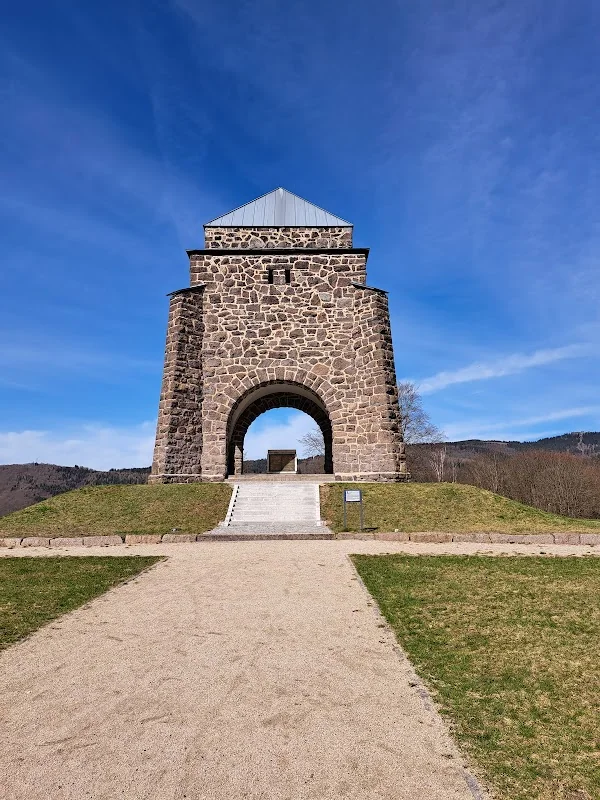
The War Memorial in Zella-Mehlis is one of the most prominent memorial sites in the city, uniquely combining historical significance with a strong landscape impact. It stands on the Lerchenberg, the green hill that the city itself describes as a defining center and viewpoint. Thus, the monument is not only a place of quiet remembrance but also a visible symbol in the urban landscape that shapes the identity of Zella-Mehlis. The Tourist Information explicitly lists it as a sight to see on the Lerchenberg, and the municipal pages also show that the hill remains an important place for public perception, events, and visits. Therefore, those approaching the memorial experience not just a war monument but a place where city history, culture of remembrance, and the special location of the Lerchenberg combine into an impressive overall picture. For inquiries related to War Memorial, Lerchenberg, memorial site, monument 1935, and Zella-Mehlis, this is one of the central points of contact in the region. ([tourismus.zella-mehlis.de](https://tourismus.zella-mehlis.de/service-touristinfo-zm/a-z))
History and Construction of the War Memorial on the Lerchenberg
The creation of the War Memorial is closely linked to the remembrance of World War I. According to the Tourist Information, the war claimed the lives of 315 men from Zella St. Blasii and Mehlis. The desire to commemorate this loss in a dignified monument was already discussed in the city council in the 1920s but could not be implemented initially due to a lack of funds. Only in 1934 did the construction of the monumental memorial made of porphyry stone begin, and the inauguration took place on November 24, 1935. This timeline is important because it shows that the monument did not arise spontaneously but was the result of a long municipal struggle for form, financing, and appropriate remembrance. This delay makes the site historically interesting: it documents not only the mourning after the war but also the way a city sought a visible form of remembrance over the years. The construction was supported by the city of Zella-Mehlis, and the architect Martin Schwarz from Arnstadt is named. Thus, the memorial is also a testament to urban building culture of the 1930s, consciously conceived as monumental and intended to have a clear place in the city's structure. ([tourismus.zella-mehlis.de](https://tourismus.zella-mehlis.de/images/Prospekte_neu/Flyer-AlteEcken_WEB.pdf))
For the classification of the monument, it is particularly important that it is not just any memorial but a deliberately set monument for the fallen of World War I. The wording of the Tourist Information and the municipal flyer shows that the monument was planned as a regionally visible place of remembrance. In the historical context of Zella-St. Blasii and Mehlis, it has a dual significance: it not only commemorates war and loss but also the shared history of the two places from which the present city of Zella-Mehlis emerged. It is precisely in this connection of local identity and overarching war commemoration that the strength of the site lies. Therefore, the War Memorial is not just a historical relic but a consciously built symbol for collective remembrance. It belongs to the monuments that arose from a concrete urban experience and remain understandable to this day because they carry a clear message: loss must not become invisible, and remembrance needs a dignified, lasting space. ([tourismus.zella-mehlis.de](https://tourismus.zella-mehlis.de/images/Prospekte_neu/Flyer-AlteEcken_WEB.pdf))
What the Monument Remembers: 315 Names, 1914-1918, and the History of the City
The War Memorial speaks with its simple yet powerful dedication a clear language: it commemorates the men from Zella St. Blasii and Mehlis who fell in World War I. The number 315, mentioned in the tourist materials, makes the magnitude of the loss visible and anchors the memorial directly in the history of the city. This place is therefore an important anchor for visitors searching for terms like war memorial, memorial, commemoration, or World War I. It shows that the consequences of the war were not only felt on battlefields but also deeply affected the communities. In a city with a strong historical self-awareness and clearly recognizable local history, such a monument takes on a special role because it transforms the memory of individual fates into a common, public symbol. This is still understandable today: the monument is not an abstract structure but a concrete place that encapsulates mourning, loss, and historical responsibility. Therefore, those visiting the Lerchenberg see not just a viewpoint but enter a space where the city visibly preserves its history. This combination of war remembrance and local self-affirmation is central to the significance of the monument. ([tourismus.zella-mehlis.de](https://tourismus.zella-mehlis.de/images/Prospekte_neu/Flyer-AlteEcken_WEB.pdf))
Additionally, the memorial continues to play a role in the city's culture of remembrance today. The site has not remained in the past but is still perceived and used as a memorial. Especially on days of public remembrance, such as the Day of Mourning, the city again places the monument in the spotlight. This keeps the original function of the monument alive: it is not merely a historical object but a place where collective remembrance is continually re-enacted. For SEO relevance, this is particularly interesting because inquiries cover not only the historical facts but also the question of how a monument is integrated today. The War Memorial Zella-Mehlis is therefore both a historical site, a memorial, and part of the current city identity. It links war remembrance with the desire for dignified commemoration, thus creating a calm counterpoint to the everyday paths around the Lerchenberg. It is precisely this mix of historical depth and contemporary significance that makes the memorial relevant for visitors as well as search engines. ([zella-mehlis.de](https://zella-mehlis.de/blog/gedenken-zum-volkstrauertag))
Architecture, Material, and the Impact of the 20-Meter High Memorial
Architecturally, the War Memorial is remarkable because it was deliberately designed to be monumental. The Tourist Information describes it as a 20-meter high memorial made of porphyry stone; the municipal flyer also highlights the extraordinary impact of its form, size, and location. Architect Martin Schwarz designed the monument so that it visibly shapes the Lerchenberg and thus the cityscape. This combination of height, material, and location makes the site so memorable. Porphyry stone gives the structure a rugged, natural appearance that fits well with a memorial that emphasizes dignity and permanence rather than decorative excess. The height of 20 meters is not just a technical specification but part of the message: the monument should be visible, dominate the hill, and serve as an urban symbol. The description by the Tourist Information even emphasizes that the memorial dominates the Lerchenberg and thus the entire cityscape. This conscious elevation shows that the building was intended from the beginning as a landmark. Therefore, the monument is not just a historical object but also a successful example of how architecture can make remembrance visible. ([tourismus.zella-mehlis.de](https://tourismus.zella-mehlis.de/images/Prospekte_neu/Flyer-AlteEcken_WEB.pdf))
The impact of the monument arises not only from its size but also from its location on the height of the Lerchenberg. A monument of this kind only functions fully when its surroundings are taken into account. This is precisely the case here: the hill, the unobstructed view, and the exposed position make the memorial appear as a conscious counterpoint to the valley city. It appears dignified but not oppressive; present but not aggressive. This balance is important because war memorials often stand between admonition and local connectedness. The Zella-Mehlis memorial achieves this balance with a clear, robust design language. It belongs to the structures that can be perceived from afar, and whose significance deepens as one approaches. Those interested in architectural history will find here not only a monument to look at but a well-readable example of the monumental culture of remembrance of the 1930s. For visitors, this is particularly exciting because the impact of the site is not only historical but also immediately spatially experienceable: the building stands freely, stands out from its surroundings, and is almost staged by the Lerchenberg as a viewpoint and memorial at the same time. ([tourismus.zella-mehlis.de](https://tourismus.zella-mehlis.de/images/Prospekte_neu/Flyer-AlteEcken_WEB.pdf))
The Lerchenberg as a Viewpoint and Place of Remembrance
The Lerchenberg is much more than just the location of the War Memorial. The city describes it as a green hill in the center of Zella-Mehlis, offering a magnificent panoramic view and significantly shaping the cityscape. This characteristic makes the site so interesting: it is simultaneously landscape, viewpoint, historical space, and part of the tourist offering. In the Tourist Information, the monument is listed as an attraction on the Lerchenberg, and in the general city information, the hill is highlighted as a special eye-catcher. This creates a tension between nature and history that visitors can experience directly. Those visiting the hill perceive the city from an elevated perspective and simultaneously see how strongly the site is connected to remembrance. Therefore, the War Memorial does not stand in isolation but in an environment that enhances its impact. For search terms like Lerchenberg Zella-Mehlis, viewpoint, monument, or circular path, this combination is crucial. The hill is a place for quiet walks, for lingering, and for consciously perceiving the city panorama. The presence of such a memorial makes the site even denser and more meaningful. ([tourismus.zella-mehlis.de](https://tourismus.zella-mehlis.de/))
From a practical perspective, the Lerchenberg is also interesting because it is integrated into the city and leisure landscape of Zella-Mehlis. The tourist pages refer to the Lerchenberg as part of the local attractions and mention it in connection with paths, tours, and the barrier-free exploration of the city. This shows that the hill is not just a monument site but a space that can be integrated into movement through the city. For visitors, this means: one can easily combine the War Memorial with a walk or a short exploration of the Lerchenberg. Here, the focus is less on classic sightseeing and more on a conscious experience of place and history. This mix is particularly attractive because it brings together different interests: those seeking historical monuments find a significant memorial; those who appreciate views and city landscapes find an elevated location with a wide view; those seeking tranquility find a place with a dignified atmosphere. In this way, the Lerchenberg becomes an ideal destination for a short but content-rich visit. ([tourismus.zella-mehlis.de](https://tourismus.zella-mehlis.de/service-touristinfo-zm/reisen-fuer-alle-barrierefrei?utm_source=openai))
Commemoration Today: Day of Mourning, New Year's Eve, and Public Significance
That the War Memorial is not just a historical monument is particularly evident in its current use in public life. The city of Zella-Mehlis has invited several times to the memorial for the Day of Mourning in recent years. In a municipal contribution, it is explicitly described that Mayor Torsten Widder invited representatives from public life and the population to remember and mourn at this site. This is a strong sign that the site continues to be understood as a shared space for remembrance. A monument does not live solely from its construction period but from the occasions it continues to bear today. At the War Memorial, this is precisely what happens: the historical dedication is confirmed and renewed through modern forms of commemoration. This keeps the monument for the city more than just a relic of the past. It is an active part of the public memory, where a city society gathers to remember, mourn, and keep responsibility visible. ([zella-mehlis.de](https://zella-mehlis.de/blog/gedenken-zum-volkstrauertag))
Additionally, a recent contribution from the city shows that the area around the monument is also used for special communal events. For the turn of the year 2025/2026, a central fireworks display was again organized at the monument on the Lerchenberg, supported by sponsors, donations, and local engagement. This circumstance is interesting because it shows the multifaceted nature of the site: it is not only a quiet memorial but also a meeting point for the city community. This does not mean that commemoration takes a back seat; rather, it becomes clear that the Lerchenberg unites various urban functions. This connection of dignity and public liveliness is typical for places deeply rooted in local identity. For visitors, this means that the War Memorial is not perceived as an isolated object but as part of a vibrant urban space. Therefore, those searching for contemporary relevance find it clearly confirmed here: the monument remains in public consciousness, is regularly integrated into municipal occasions, and is thus effective even in the present. ([zella-mehlis.de](https://zella-mehlis.de/blog/silvesterfeuerwerk-auf-dem-lerchenberg-das-erwartet-die-besucher-und-was-sie-beachten-sollten))
Visiting the War Memorial: Orientation, Tour, and Useful Tips
For a visit, it is especially important to know that the War Memorial on the Lerchenberg is an open-air monument and is listed by the city as an attraction. The location is given as Parkweg 12, and the tourist description also refers to the Lerchenberg itself as the actual site of the monument. Those planning a visit should therefore expect less a classic indoor space and more a historical site outdoors, which is excellent for a short stop, a walk, or a combination with other city views. Because the monument is closely linked to the Lerchenberg, the visit is particularly recommended when one wants to connect the view over Zella-Mehlis with the historical context. This makes the site interesting for travelers who pay less attention to individual buildings and more to urban images, landscapes of remembrance, and meaningful viewpoints. The tourist pages also show that the Lerchenberg is integrated into various exploration concepts, such as tours and the overview of attractions. Thus, the War Memorial is not an isolated point on the map but part of a small, well-readable city experience. ([my.trip.com](https://my.trip.com/travel-guide/attraction/zella-mehlis/kriegerehrenmal-143784129?utm_source=openai))
For SEO purposes, those searching for terms like war memorial, memorial, Lerchenberg, memorial site, or Zella-Mehlis will find a location that serves multiple search intentions very well: historical classification, concrete location, architectural uniqueness, and current significance. This combination makes the War Memorial so strong for content and visit planning. It is visible, easy to classify, and thematically clear. For a successful site visit, it is advisable to combine the visit with some time for the view over the city, as the location of the monument constitutes a significant part of its impact. Those who experience the site respectfully perceive not only a monument but also the atmosphere of a place that is firmly anchored in the city's memory. The War Memorial Zella-Mehlis demonstrates how strongly a single site can bundle history, landscape, and today's city identity. For this reason, it remains a relevant and meaningful reference point for visitors, residents, and search engines alike. ([tourismus.zella-mehlis.de](https://tourismus.zella-mehlis.de/))
Sources:
Show moreShow less
War Memorial Zella-Mehlis | Monument & Lerchenberg
The War Memorial in Zella-Mehlis is one of the most prominent memorial sites in the city, uniquely combining historical significance with a strong landscape impact. It stands on the Lerchenberg, the green hill that the city itself describes as a defining center and viewpoint. Thus, the monument is not only a place of quiet remembrance but also a visible symbol in the urban landscape that shapes the identity of Zella-Mehlis. The Tourist Information explicitly lists it as a sight to see on the Lerchenberg, and the municipal pages also show that the hill remains an important place for public perception, events, and visits. Therefore, those approaching the memorial experience not just a war monument but a place where city history, culture of remembrance, and the special location of the Lerchenberg combine into an impressive overall picture. For inquiries related to War Memorial, Lerchenberg, memorial site, monument 1935, and Zella-Mehlis, this is one of the central points of contact in the region. ([tourismus.zella-mehlis.de](https://tourismus.zella-mehlis.de/service-touristinfo-zm/a-z))
History and Construction of the War Memorial on the Lerchenberg
The creation of the War Memorial is closely linked to the remembrance of World War I. According to the Tourist Information, the war claimed the lives of 315 men from Zella St. Blasii and Mehlis. The desire to commemorate this loss in a dignified monument was already discussed in the city council in the 1920s but could not be implemented initially due to a lack of funds. Only in 1934 did the construction of the monumental memorial made of porphyry stone begin, and the inauguration took place on November 24, 1935. This timeline is important because it shows that the monument did not arise spontaneously but was the result of a long municipal struggle for form, financing, and appropriate remembrance. This delay makes the site historically interesting: it documents not only the mourning after the war but also the way a city sought a visible form of remembrance over the years. The construction was supported by the city of Zella-Mehlis, and the architect Martin Schwarz from Arnstadt is named. Thus, the memorial is also a testament to urban building culture of the 1930s, consciously conceived as monumental and intended to have a clear place in the city's structure. ([tourismus.zella-mehlis.de](https://tourismus.zella-mehlis.de/images/Prospekte_neu/Flyer-AlteEcken_WEB.pdf))
For the classification of the monument, it is particularly important that it is not just any memorial but a deliberately set monument for the fallen of World War I. The wording of the Tourist Information and the municipal flyer shows that the monument was planned as a regionally visible place of remembrance. In the historical context of Zella-St. Blasii and Mehlis, it has a dual significance: it not only commemorates war and loss but also the shared history of the two places from which the present city of Zella-Mehlis emerged. It is precisely in this connection of local identity and overarching war commemoration that the strength of the site lies. Therefore, the War Memorial is not just a historical relic but a consciously built symbol for collective remembrance. It belongs to the monuments that arose from a concrete urban experience and remain understandable to this day because they carry a clear message: loss must not become invisible, and remembrance needs a dignified, lasting space. ([tourismus.zella-mehlis.de](https://tourismus.zella-mehlis.de/images/Prospekte_neu/Flyer-AlteEcken_WEB.pdf))
What the Monument Remembers: 315 Names, 1914-1918, and the History of the City
The War Memorial speaks with its simple yet powerful dedication a clear language: it commemorates the men from Zella St. Blasii and Mehlis who fell in World War I. The number 315, mentioned in the tourist materials, makes the magnitude of the loss visible and anchors the memorial directly in the history of the city. This place is therefore an important anchor for visitors searching for terms like war memorial, memorial, commemoration, or World War I. It shows that the consequences of the war were not only felt on battlefields but also deeply affected the communities. In a city with a strong historical self-awareness and clearly recognizable local history, such a monument takes on a special role because it transforms the memory of individual fates into a common, public symbol. This is still understandable today: the monument is not an abstract structure but a concrete place that encapsulates mourning, loss, and historical responsibility. Therefore, those visiting the Lerchenberg see not just a viewpoint but enter a space where the city visibly preserves its history. This combination of war remembrance and local self-affirmation is central to the significance of the monument. ([tourismus.zella-mehlis.de](https://tourismus.zella-mehlis.de/images/Prospekte_neu/Flyer-AlteEcken_WEB.pdf))
Additionally, the memorial continues to play a role in the city's culture of remembrance today. The site has not remained in the past but is still perceived and used as a memorial. Especially on days of public remembrance, such as the Day of Mourning, the city again places the monument in the spotlight. This keeps the original function of the monument alive: it is not merely a historical object but a place where collective remembrance is continually re-enacted. For SEO relevance, this is particularly interesting because inquiries cover not only the historical facts but also the question of how a monument is integrated today. The War Memorial Zella-Mehlis is therefore both a historical site, a memorial, and part of the current city identity. It links war remembrance with the desire for dignified commemoration, thus creating a calm counterpoint to the everyday paths around the Lerchenberg. It is precisely this mix of historical depth and contemporary significance that makes the memorial relevant for visitors as well as search engines. ([zella-mehlis.de](https://zella-mehlis.de/blog/gedenken-zum-volkstrauertag))
Architecture, Material, and the Impact of the 20-Meter High Memorial
Architecturally, the War Memorial is remarkable because it was deliberately designed to be monumental. The Tourist Information describes it as a 20-meter high memorial made of porphyry stone; the municipal flyer also highlights the extraordinary impact of its form, size, and location. Architect Martin Schwarz designed the monument so that it visibly shapes the Lerchenberg and thus the cityscape. This combination of height, material, and location makes the site so memorable. Porphyry stone gives the structure a rugged, natural appearance that fits well with a memorial that emphasizes dignity and permanence rather than decorative excess. The height of 20 meters is not just a technical specification but part of the message: the monument should be visible, dominate the hill, and serve as an urban symbol. The description by the Tourist Information even emphasizes that the memorial dominates the Lerchenberg and thus the entire cityscape. This conscious elevation shows that the building was intended from the beginning as a landmark. Therefore, the monument is not just a historical object but also a successful example of how architecture can make remembrance visible. ([tourismus.zella-mehlis.de](https://tourismus.zella-mehlis.de/images/Prospekte_neu/Flyer-AlteEcken_WEB.pdf))
The impact of the monument arises not only from its size but also from its location on the height of the Lerchenberg. A monument of this kind only functions fully when its surroundings are taken into account. This is precisely the case here: the hill, the unobstructed view, and the exposed position make the memorial appear as a conscious counterpoint to the valley city. It appears dignified but not oppressive; present but not aggressive. This balance is important because war memorials often stand between admonition and local connectedness. The Zella-Mehlis memorial achieves this balance with a clear, robust design language. It belongs to the structures that can be perceived from afar, and whose significance deepens as one approaches. Those interested in architectural history will find here not only a monument to look at but a well-readable example of the monumental culture of remembrance of the 1930s. For visitors, this is particularly exciting because the impact of the site is not only historical but also immediately spatially experienceable: the building stands freely, stands out from its surroundings, and is almost staged by the Lerchenberg as a viewpoint and memorial at the same time. ([tourismus.zella-mehlis.de](https://tourismus.zella-mehlis.de/images/Prospekte_neu/Flyer-AlteEcken_WEB.pdf))
The Lerchenberg as a Viewpoint and Place of Remembrance
The Lerchenberg is much more than just the location of the War Memorial. The city describes it as a green hill in the center of Zella-Mehlis, offering a magnificent panoramic view and significantly shaping the cityscape. This characteristic makes the site so interesting: it is simultaneously landscape, viewpoint, historical space, and part of the tourist offering. In the Tourist Information, the monument is listed as an attraction on the Lerchenberg, and in the general city information, the hill is highlighted as a special eye-catcher. This creates a tension between nature and history that visitors can experience directly. Those visiting the hill perceive the city from an elevated perspective and simultaneously see how strongly the site is connected to remembrance. Therefore, the War Memorial does not stand in isolation but in an environment that enhances its impact. For search terms like Lerchenberg Zella-Mehlis, viewpoint, monument, or circular path, this combination is crucial. The hill is a place for quiet walks, for lingering, and for consciously perceiving the city panorama. The presence of such a memorial makes the site even denser and more meaningful. ([tourismus.zella-mehlis.de](https://tourismus.zella-mehlis.de/))
From a practical perspective, the Lerchenberg is also interesting because it is integrated into the city and leisure landscape of Zella-Mehlis. The tourist pages refer to the Lerchenberg as part of the local attractions and mention it in connection with paths, tours, and the barrier-free exploration of the city. This shows that the hill is not just a monument site but a space that can be integrated into movement through the city. For visitors, this means: one can easily combine the War Memorial with a walk or a short exploration of the Lerchenberg. Here, the focus is less on classic sightseeing and more on a conscious experience of place and history. This mix is particularly attractive because it brings together different interests: those seeking historical monuments find a significant memorial; those who appreciate views and city landscapes find an elevated location with a wide view; those seeking tranquility find a place with a dignified atmosphere. In this way, the Lerchenberg becomes an ideal destination for a short but content-rich visit. ([tourismus.zella-mehlis.de](https://tourismus.zella-mehlis.de/service-touristinfo-zm/reisen-fuer-alle-barrierefrei?utm_source=openai))
Commemoration Today: Day of Mourning, New Year's Eve, and Public Significance
That the War Memorial is not just a historical monument is particularly evident in its current use in public life. The city of Zella-Mehlis has invited several times to the memorial for the Day of Mourning in recent years. In a municipal contribution, it is explicitly described that Mayor Torsten Widder invited representatives from public life and the population to remember and mourn at this site. This is a strong sign that the site continues to be understood as a shared space for remembrance. A monument does not live solely from its construction period but from the occasions it continues to bear today. At the War Memorial, this is precisely what happens: the historical dedication is confirmed and renewed through modern forms of commemoration. This keeps the monument for the city more than just a relic of the past. It is an active part of the public memory, where a city society gathers to remember, mourn, and keep responsibility visible. ([zella-mehlis.de](https://zella-mehlis.de/blog/gedenken-zum-volkstrauertag))
Additionally, a recent contribution from the city shows that the area around the monument is also used for special communal events. For the turn of the year 2025/2026, a central fireworks display was again organized at the monument on the Lerchenberg, supported by sponsors, donations, and local engagement. This circumstance is interesting because it shows the multifaceted nature of the site: it is not only a quiet memorial but also a meeting point for the city community. This does not mean that commemoration takes a back seat; rather, it becomes clear that the Lerchenberg unites various urban functions. This connection of dignity and public liveliness is typical for places deeply rooted in local identity. For visitors, this means that the War Memorial is not perceived as an isolated object but as part of a vibrant urban space. Therefore, those searching for contemporary relevance find it clearly confirmed here: the monument remains in public consciousness, is regularly integrated into municipal occasions, and is thus effective even in the present. ([zella-mehlis.de](https://zella-mehlis.de/blog/silvesterfeuerwerk-auf-dem-lerchenberg-das-erwartet-die-besucher-und-was-sie-beachten-sollten))
Visiting the War Memorial: Orientation, Tour, and Useful Tips
For a visit, it is especially important to know that the War Memorial on the Lerchenberg is an open-air monument and is listed by the city as an attraction. The location is given as Parkweg 12, and the tourist description also refers to the Lerchenberg itself as the actual site of the monument. Those planning a visit should therefore expect less a classic indoor space and more a historical site outdoors, which is excellent for a short stop, a walk, or a combination with other city views. Because the monument is closely linked to the Lerchenberg, the visit is particularly recommended when one wants to connect the view over Zella-Mehlis with the historical context. This makes the site interesting for travelers who pay less attention to individual buildings and more to urban images, landscapes of remembrance, and meaningful viewpoints. The tourist pages also show that the Lerchenberg is integrated into various exploration concepts, such as tours and the overview of attractions. Thus, the War Memorial is not an isolated point on the map but part of a small, well-readable city experience. ([my.trip.com](https://my.trip.com/travel-guide/attraction/zella-mehlis/kriegerehrenmal-143784129?utm_source=openai))
For SEO purposes, those searching for terms like war memorial, memorial, Lerchenberg, memorial site, or Zella-Mehlis will find a location that serves multiple search intentions very well: historical classification, concrete location, architectural uniqueness, and current significance. This combination makes the War Memorial so strong for content and visit planning. It is visible, easy to classify, and thematically clear. For a successful site visit, it is advisable to combine the visit with some time for the view over the city, as the location of the monument constitutes a significant part of its impact. Those who experience the site respectfully perceive not only a monument but also the atmosphere of a place that is firmly anchored in the city's memory. The War Memorial Zella-Mehlis demonstrates how strongly a single site can bundle history, landscape, and today's city identity. For this reason, it remains a relevant and meaningful reference point for visitors, residents, and search engines alike. ([tourismus.zella-mehlis.de](https://tourismus.zella-mehlis.de/))
Sources:
War Memorial Zella-Mehlis | Monument & Lerchenberg
The War Memorial in Zella-Mehlis is one of the most prominent memorial sites in the city, uniquely combining historical significance with a strong landscape impact. It stands on the Lerchenberg, the green hill that the city itself describes as a defining center and viewpoint. Thus, the monument is not only a place of quiet remembrance but also a visible symbol in the urban landscape that shapes the identity of Zella-Mehlis. The Tourist Information explicitly lists it as a sight to see on the Lerchenberg, and the municipal pages also show that the hill remains an important place for public perception, events, and visits. Therefore, those approaching the memorial experience not just a war monument but a place where city history, culture of remembrance, and the special location of the Lerchenberg combine into an impressive overall picture. For inquiries related to War Memorial, Lerchenberg, memorial site, monument 1935, and Zella-Mehlis, this is one of the central points of contact in the region. ([tourismus.zella-mehlis.de](https://tourismus.zella-mehlis.de/service-touristinfo-zm/a-z))
History and Construction of the War Memorial on the Lerchenberg
The creation of the War Memorial is closely linked to the remembrance of World War I. According to the Tourist Information, the war claimed the lives of 315 men from Zella St. Blasii and Mehlis. The desire to commemorate this loss in a dignified monument was already discussed in the city council in the 1920s but could not be implemented initially due to a lack of funds. Only in 1934 did the construction of the monumental memorial made of porphyry stone begin, and the inauguration took place on November 24, 1935. This timeline is important because it shows that the monument did not arise spontaneously but was the result of a long municipal struggle for form, financing, and appropriate remembrance. This delay makes the site historically interesting: it documents not only the mourning after the war but also the way a city sought a visible form of remembrance over the years. The construction was supported by the city of Zella-Mehlis, and the architect Martin Schwarz from Arnstadt is named. Thus, the memorial is also a testament to urban building culture of the 1930s, consciously conceived as monumental and intended to have a clear place in the city's structure. ([tourismus.zella-mehlis.de](https://tourismus.zella-mehlis.de/images/Prospekte_neu/Flyer-AlteEcken_WEB.pdf))
For the classification of the monument, it is particularly important that it is not just any memorial but a deliberately set monument for the fallen of World War I. The wording of the Tourist Information and the municipal flyer shows that the monument was planned as a regionally visible place of remembrance. In the historical context of Zella-St. Blasii and Mehlis, it has a dual significance: it not only commemorates war and loss but also the shared history of the two places from which the present city of Zella-Mehlis emerged. It is precisely in this connection of local identity and overarching war commemoration that the strength of the site lies. Therefore, the War Memorial is not just a historical relic but a consciously built symbol for collective remembrance. It belongs to the monuments that arose from a concrete urban experience and remain understandable to this day because they carry a clear message: loss must not become invisible, and remembrance needs a dignified, lasting space. ([tourismus.zella-mehlis.de](https://tourismus.zella-mehlis.de/images/Prospekte_neu/Flyer-AlteEcken_WEB.pdf))
What the Monument Remembers: 315 Names, 1914-1918, and the History of the City
The War Memorial speaks with its simple yet powerful dedication a clear language: it commemorates the men from Zella St. Blasii and Mehlis who fell in World War I. The number 315, mentioned in the tourist materials, makes the magnitude of the loss visible and anchors the memorial directly in the history of the city. This place is therefore an important anchor for visitors searching for terms like war memorial, memorial, commemoration, or World War I. It shows that the consequences of the war were not only felt on battlefields but also deeply affected the communities. In a city with a strong historical self-awareness and clearly recognizable local history, such a monument takes on a special role because it transforms the memory of individual fates into a common, public symbol. This is still understandable today: the monument is not an abstract structure but a concrete place that encapsulates mourning, loss, and historical responsibility. Therefore, those visiting the Lerchenberg see not just a viewpoint but enter a space where the city visibly preserves its history. This combination of war remembrance and local self-affirmation is central to the significance of the monument. ([tourismus.zella-mehlis.de](https://tourismus.zella-mehlis.de/images/Prospekte_neu/Flyer-AlteEcken_WEB.pdf))
Additionally, the memorial continues to play a role in the city's culture of remembrance today. The site has not remained in the past but is still perceived and used as a memorial. Especially on days of public remembrance, such as the Day of Mourning, the city again places the monument in the spotlight. This keeps the original function of the monument alive: it is not merely a historical object but a place where collective remembrance is continually re-enacted. For SEO relevance, this is particularly interesting because inquiries cover not only the historical facts but also the question of how a monument is integrated today. The War Memorial Zella-Mehlis is therefore both a historical site, a memorial, and part of the current city identity. It links war remembrance with the desire for dignified commemoration, thus creating a calm counterpoint to the everyday paths around the Lerchenberg. It is precisely this mix of historical depth and contemporary significance that makes the memorial relevant for visitors as well as search engines. ([zella-mehlis.de](https://zella-mehlis.de/blog/gedenken-zum-volkstrauertag))
Architecture, Material, and the Impact of the 20-Meter High Memorial
Architecturally, the War Memorial is remarkable because it was deliberately designed to be monumental. The Tourist Information describes it as a 20-meter high memorial made of porphyry stone; the municipal flyer also highlights the extraordinary impact of its form, size, and location. Architect Martin Schwarz designed the monument so that it visibly shapes the Lerchenberg and thus the cityscape. This combination of height, material, and location makes the site so memorable. Porphyry stone gives the structure a rugged, natural appearance that fits well with a memorial that emphasizes dignity and permanence rather than decorative excess. The height of 20 meters is not just a technical specification but part of the message: the monument should be visible, dominate the hill, and serve as an urban symbol. The description by the Tourist Information even emphasizes that the memorial dominates the Lerchenberg and thus the entire cityscape. This conscious elevation shows that the building was intended from the beginning as a landmark. Therefore, the monument is not just a historical object but also a successful example of how architecture can make remembrance visible. ([tourismus.zella-mehlis.de](https://tourismus.zella-mehlis.de/images/Prospekte_neu/Flyer-AlteEcken_WEB.pdf))
The impact of the monument arises not only from its size but also from its location on the height of the Lerchenberg. A monument of this kind only functions fully when its surroundings are taken into account. This is precisely the case here: the hill, the unobstructed view, and the exposed position make the memorial appear as a conscious counterpoint to the valley city. It appears dignified but not oppressive; present but not aggressive. This balance is important because war memorials often stand between admonition and local connectedness. The Zella-Mehlis memorial achieves this balance with a clear, robust design language. It belongs to the structures that can be perceived from afar, and whose significance deepens as one approaches. Those interested in architectural history will find here not only a monument to look at but a well-readable example of the monumental culture of remembrance of the 1930s. For visitors, this is particularly exciting because the impact of the site is not only historical but also immediately spatially experienceable: the building stands freely, stands out from its surroundings, and is almost staged by the Lerchenberg as a viewpoint and memorial at the same time. ([tourismus.zella-mehlis.de](https://tourismus.zella-mehlis.de/images/Prospekte_neu/Flyer-AlteEcken_WEB.pdf))
The Lerchenberg as a Viewpoint and Place of Remembrance
The Lerchenberg is much more than just the location of the War Memorial. The city describes it as a green hill in the center of Zella-Mehlis, offering a magnificent panoramic view and significantly shaping the cityscape. This characteristic makes the site so interesting: it is simultaneously landscape, viewpoint, historical space, and part of the tourist offering. In the Tourist Information, the monument is listed as an attraction on the Lerchenberg, and in the general city information, the hill is highlighted as a special eye-catcher. This creates a tension between nature and history that visitors can experience directly. Those visiting the hill perceive the city from an elevated perspective and simultaneously see how strongly the site is connected to remembrance. Therefore, the War Memorial does not stand in isolation but in an environment that enhances its impact. For search terms like Lerchenberg Zella-Mehlis, viewpoint, monument, or circular path, this combination is crucial. The hill is a place for quiet walks, for lingering, and for consciously perceiving the city panorama. The presence of such a memorial makes the site even denser and more meaningful. ([tourismus.zella-mehlis.de](https://tourismus.zella-mehlis.de/))
From a practical perspective, the Lerchenberg is also interesting because it is integrated into the city and leisure landscape of Zella-Mehlis. The tourist pages refer to the Lerchenberg as part of the local attractions and mention it in connection with paths, tours, and the barrier-free exploration of the city. This shows that the hill is not just a monument site but a space that can be integrated into movement through the city. For visitors, this means: one can easily combine the War Memorial with a walk or a short exploration of the Lerchenberg. Here, the focus is less on classic sightseeing and more on a conscious experience of place and history. This mix is particularly attractive because it brings together different interests: those seeking historical monuments find a significant memorial; those who appreciate views and city landscapes find an elevated location with a wide view; those seeking tranquility find a place with a dignified atmosphere. In this way, the Lerchenberg becomes an ideal destination for a short but content-rich visit. ([tourismus.zella-mehlis.de](https://tourismus.zella-mehlis.de/service-touristinfo-zm/reisen-fuer-alle-barrierefrei?utm_source=openai))
Commemoration Today: Day of Mourning, New Year's Eve, and Public Significance
That the War Memorial is not just a historical monument is particularly evident in its current use in public life. The city of Zella-Mehlis has invited several times to the memorial for the Day of Mourning in recent years. In a municipal contribution, it is explicitly described that Mayor Torsten Widder invited representatives from public life and the population to remember and mourn at this site. This is a strong sign that the site continues to be understood as a shared space for remembrance. A monument does not live solely from its construction period but from the occasions it continues to bear today. At the War Memorial, this is precisely what happens: the historical dedication is confirmed and renewed through modern forms of commemoration. This keeps the monument for the city more than just a relic of the past. It is an active part of the public memory, where a city society gathers to remember, mourn, and keep responsibility visible. ([zella-mehlis.de](https://zella-mehlis.de/blog/gedenken-zum-volkstrauertag))
Additionally, a recent contribution from the city shows that the area around the monument is also used for special communal events. For the turn of the year 2025/2026, a central fireworks display was again organized at the monument on the Lerchenberg, supported by sponsors, donations, and local engagement. This circumstance is interesting because it shows the multifaceted nature of the site: it is not only a quiet memorial but also a meeting point for the city community. This does not mean that commemoration takes a back seat; rather, it becomes clear that the Lerchenberg unites various urban functions. This connection of dignity and public liveliness is typical for places deeply rooted in local identity. For visitors, this means that the War Memorial is not perceived as an isolated object but as part of a vibrant urban space. Therefore, those searching for contemporary relevance find it clearly confirmed here: the monument remains in public consciousness, is regularly integrated into municipal occasions, and is thus effective even in the present. ([zella-mehlis.de](https://zella-mehlis.de/blog/silvesterfeuerwerk-auf-dem-lerchenberg-das-erwartet-die-besucher-und-was-sie-beachten-sollten))
Visiting the War Memorial: Orientation, Tour, and Useful Tips
For a visit, it is especially important to know that the War Memorial on the Lerchenberg is an open-air monument and is listed by the city as an attraction. The location is given as Parkweg 12, and the tourist description also refers to the Lerchenberg itself as the actual site of the monument. Those planning a visit should therefore expect less a classic indoor space and more a historical site outdoors, which is excellent for a short stop, a walk, or a combination with other city views. Because the monument is closely linked to the Lerchenberg, the visit is particularly recommended when one wants to connect the view over Zella-Mehlis with the historical context. This makes the site interesting for travelers who pay less attention to individual buildings and more to urban images, landscapes of remembrance, and meaningful viewpoints. The tourist pages also show that the Lerchenberg is integrated into various exploration concepts, such as tours and the overview of attractions. Thus, the War Memorial is not an isolated point on the map but part of a small, well-readable city experience. ([my.trip.com](https://my.trip.com/travel-guide/attraction/zella-mehlis/kriegerehrenmal-143784129?utm_source=openai))
For SEO purposes, those searching for terms like war memorial, memorial, Lerchenberg, memorial site, or Zella-Mehlis will find a location that serves multiple search intentions very well: historical classification, concrete location, architectural uniqueness, and current significance. This combination makes the War Memorial so strong for content and visit planning. It is visible, easy to classify, and thematically clear. For a successful site visit, it is advisable to combine the visit with some time for the view over the city, as the location of the monument constitutes a significant part of its impact. Those who experience the site respectfully perceive not only a monument but also the atmosphere of a place that is firmly anchored in the city's memory. The War Memorial Zella-Mehlis demonstrates how strongly a single site can bundle history, landscape, and today's city identity. For this reason, it remains a relevant and meaningful reference point for visitors, residents, and search engines alike. ([tourismus.zella-mehlis.de](https://tourismus.zella-mehlis.de/))
Sources:
Frequently Asked Questions
Reviews
No reviews found