
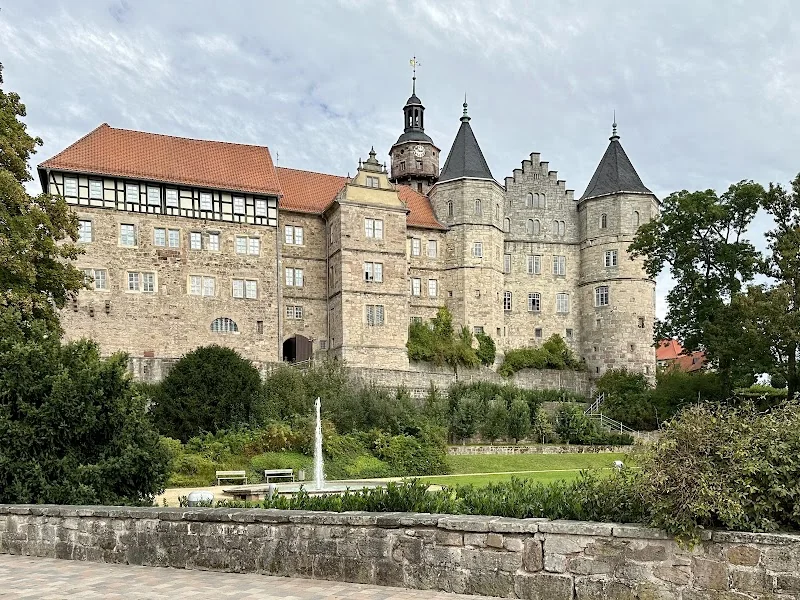
Burgstraße 6, Schleusingen
Burgstraße 6, 98553 Schleusingen, Germany
Natural History Museum Castle Bertholdsburg | Tickets & Parking
The Natural History Museum Castle Bertholdsburg in Schleusingen is more than a classic museum in a castle: It is a place where natural history, geology, regional history, and architecture combine into a single visitor experience. Anyone entering the Bertholdsburg moves through rooms where the history of the Henneberg family, the development of South Thuringia, and the fascination with fossils, minerals, and historical everyday objects merge together. The building is considered a prominent landmark of the city, and even from the outside, the four-wing complex with its towers and the mighty main tower is hard to overlook. Inside, three permanent exhibitions, a viewing tower, changing special exhibitions, and a museum tour await, extending over the north, east, and west wings of the complex. At the same time, the museum is self-guided, allowing visitors to discover the content at their own pace. This mix makes the location attractive for families, history enthusiasts, school classes, nature fans, and travelers looking for a real destination with substance in South Thuringia. ([museum-schleusingen.de](https://www.museum-schleusingen.de/seite/338092/museumsgeschichte.html))
Opening Hours, Admission Prices, and Tickets
The planning of a visit begins here quite practically with the current opening hours and prices. The museum is open from Tuesday to Friday from 9:00 AM to 5:00 PM, and on Saturdays, Sundays, and public holidays from 10:00 AM to 6:00 PM. Admission ends one hour before closing, which is helpful for daily planning if you want to not only walk through the exhibitions but also include the tower. Different times apply for special holidays: On December 24, the house is closed, while on December 25, 26, and 31, as well as January 1, it is open from 1:00 PM to 6:00 PM. Price-wise, the museum remains pleasantly family-friendly: Adults pay 6.00 euros, reduced tickets are 4.00 euros, and families pay 14.00 euros. Those who wish to climb the viewing tower pay an additional 2.00 euros for adults or 1.50 euros reduced. Groups are also considered, as reduced rates apply from ten people. This makes the museum well-calculated for both a spontaneous day trip and a planned cultural stop on a Thuringia trip. ([museum-schleusingen.de](https://www.museum-schleusingen.de/))
Particularly interesting is the museum for those who do not need a rigid guided tour but prefer to explore independently. The house is designed as a self-guided museum: Information about the exhibits is accessible through signs, panels, and graphics, without the visit being tied to a fixed program. However, if someone still wants a brief orientation, they can book an introduction that provides an overview of the history of the Bertholdsburg and the current exhibitions in about five to ten minutes. Additionally, there are thematic guided tours for groups on minerals, 300 million years of Thuringia, castle and regional history, as well as special exhibitions. This mix of independent discovery and optional mediation makes the location versatile: Families can move at their own pace, school classes can receive a compact introduction upon request, and groups benefit from clearly calculable prices. Thus, the museum combines a classic museum atmosphere with a very flexible visiting model that adapts to different age groups and interests. ([museum-schleusingen.de](https://www.museum-schleusingen.de/seite/338363/f%C3%BChrungen.html))
Directions, Parking, and Practical Tips on Site
The Bertholdsburg is located in the middle of Schleusingen, and access is possible by car as well as by bus and train. According to museum information, access by car is via the A73 motorway, exit Schleusingen. Public transport is also well described: A bus stop is nearby, and the museum location is accessible via several lines; from Suhl train station, buses continue to Schleusingen. This short, clear route guidance is important for day visitors, as it facilitates planning for both family outings and travel groups. Those arriving by car will find parking directly in front of the museum on Kirchstraße or at the market, although there is a parking duration of two hours there. Buses can be parked directly next to the museum on Burgstraße. This makes the location also well usable for organized groups without having to plan long walks. Additionally, the Foundation for Thuringian Castles and Gardens names a bus stop and a train station as important infrastructure features for the area. ([museum-schleusingen.de](https://www.museum-schleusingen.de/seite/645580))
It is also practical for visitors that the castle garden and the castle complex not only serve as a backdrop but also round off the entire experience. The foundation describes the garden area as open year-round; thus, a museum visit can be combined with a short stay outdoors in good weather. For orientation on the grounds, it is also helpful that the main access and the pathways in the vicinity of the castle are continually being improved. During construction and restoration work, access is adjusted accordingly, currently via Burgstraße. Those planning an outing to the location should always check whether paths may change at short notice due to work on the castle garden or individual buildings. Practically, this means: arrive early, pay attention to the parking duration at the market, and plan the bus parking space next to the museum for group visits. This way, the visit remains relaxed, and the focus can be on the actual experience: the castle, the museum, and the view over Schleusingen. ([thueringerschloesser.de](https://www.thueringerschloesser.de/umfeld-am-brunnenhaus-von-schloss-bertholdsburg-wird-neugestaltet/?utm_source=openai))
Minerals, Dinosaurs, and 300 Million Years of Thuringia
The natural history exhibitions are one of the biggest reasons why the Natural History Museum Castle Bertholdsburg attracts so many different visitors. The mineral exhibition was opened in 1990 and covers about 250 m². It is divided into several thematic areas, including the historical Franke room as a geological local museum from 1934, the gemstone cabinet with a regionally significant ducal collection, the explanation of the minerals themselves, as well as the geological features of Thuringia and historical mining. According to the museum description, minerals and rocks from Thuringia are shown here, as well as topics on gold, silver, copper, cobalt, uranium, iron, manganese, river and heavy spar, and salts. This makes the exhibition not only visually appealing but also surprisingly broad in terms of expertise. Those who like sparkling crystals, rocks in rare shapes, or the connection between mining and landscape development will find a very condensed introduction to the regional earth history here. ([museum-schleusingen.de](https://www.museum-schleusingen.de/seite/338054/minerale.html))
Even more impressive is the tour in the exhibition '300 Million Years of Thuringia'. On about 800 m², Thuringian landscapes are presented from their geological roots to the present. The exhibition showcases nearly 1,000 fossils in 40 display cases, along with about 400 original models of prehistoric animals and plants in 25 landscape dioramas. Highlights include the 5 to 6 meter long skeleton reconstructions of the dinosaurs Liliensternus and Plateosaurus from the Middle Keuper of the Great Gleichberg near Römhild. Additionally, there are live fish and ancient crustaceans in several aquariums, as well as a sensually designed presentation of forests, waters, and meadows. This is not a dry teaching museum, but a vivid journey through time from the Rotliegend period through Muschelkalk, Buntsandstein, and Keuper to the Holocene. Those looking for a museum that explains geological connections with strong images and tangible originals will find a highly convincing answer here. ([museum-schleusingen.de](https://www.museum-schleusingen.de/seite/338055/300-millionen-jahre-th%C3%BCringen.html))
Castle and Regional History in the Bertholdsburg
The historical department is closely linked to the history of the house itself. The Bertholdsburg was built between 1226 and 1232 along the trade route Nuremberg-Erfurt-Leipzig and later became the residence of the Henneberg line Henneberg-Schleusingen. The museum describes the castle as the most significant secular building in the South Thuringian region and as a widely visible landmark of Schleusingen. Over the following centuries, the complex was expanded and rebuilt until it was developed into a four-wing Renaissance castle in the 16th century. With the death of Georg Ernst von Henneberg-Schleusingen in 1583, the castle and city fell to the Saxon Wettins and later to Prussia, resulting in the loss of its status as a residence. This development is particularly exciting for visitors because it explains why the Bertholdsburg today does not appear like many baroque-altered castles but has largely preserved its Renaissance character. The architecture thus tells not only of representative aspirations but also of political change and the surprisingly well-preserved character of the complex. ([museum-schleusingen.de](https://www.museum-schleusingen.de/seite/338092/museumsgeschichte.html))
Inside, the regional history complements the architectural history of the castle in a particularly vivid way. The collection includes about 3,000 regionally relevant objects and focuses on the County of Henneberg(-Schleusingen), the history of the city of Schleusingen, and the surroundings of the Henneberg region. Among other things, coins, archaeological finds from the Bertholdsburg and the region, furniture, paintings, glass, ceramics, weapons, historical documents, and selected workshops such as paper making, printing, or carpentry are on display. Particularly noteworthy is the Henneberg coin treasure, which consists of silver coins from the 13th to 16th centuries and makes the coin and rule history of the region tangible. In individual rooms, visitors also encounter historical interiors, including a vaulted room with secco paintings of the Hercules story from around 1600. This creates a dense historical narrative space where great politics, local everyday history, and art history stand side by side. ([museum-schleusingen.de](https://www.museum-schleusingen.de/seite/338042/historisches-museum-und-regionalgeschichtliche-sammlungen.html))
Viewing Tower, Castle Rooms, and Special Experiences
The viewing tower is one of the strongest experiences on site because it adds a real perspective shift to the museum visit. The large main tower in the courtyard was once a watchtower and is now the highest viewpoint in the city. After 128 steps, one reaches the platform at about 40 meters high, from which one can overlook Schleusingen, the Thuringian Forest, and its foreland. The tower is not only a viewpoint but also a small piece of history: The entrance portal dates from the early Renaissance, work was done on it in 1538, and in 1618 the tower received the still visible sandstone coat of arms of the County of Henneberg-Schleusingen. Inside, one can also discover the historical clockwork and a kestrel's habitat. Those looking for a museum with a clear dramatic increase will find an ideal conclusion to the tour here: first exhibitions, then castle rooms, and finally the landscape at the top. ([museum-schleusingen.de](https://www.museum-schleusingen.de/seite/338060/aussichtsturm.html))
The most significant preserved interiors also contribute to the special atmosphere. On the first floor of the north wing, visitors can find a hall with a floral stucco ceiling and a vaulted room with yellow and black secco paintings from around 1600. The large-format scenes of the Hercules story are among the largest secular image cycles in Central Germany and give the castle an extraordinary art historical depth. Such rooms make the Bertholdsburg not only a museum carrier but also a monument that is part of the program itself. Those who walk attentively through the complex experience not only display cases and panels but also real castle architecture with preserved details from the Renaissance and early modern period. This is precisely what distinguishes the location from many other houses: Here, the building itself is a core of the experience. It is historical, representative, and at the same time functionally integrated into the museum use. ([thueringerschloesser.de](https://www.thueringerschloesser.de/objekt/schloss-bertholdsburg/))
Guided Tours, Special Exhibitions, and Rental
The museum is officially designed as a self-guided house, but additional mediation offers are available upon request. A brief introduction provides an overview of the history of the Bertholdsburg and the current exhibitions in five to ten minutes. Those who want to delve deeper can book thematic guided tours, such as on minerals, 300 million years of Thuringia, castle and regional history, or special exhibitions. The maximum group size is limited to 25 people due to narrow rooms and corridors. This is particularly relevant for mediation and group service, as it allows for well-planned program points for school classes, clubs, or travel groups. The museum thus combines independence with professional accompaniment without overloading the tour. This balance is particularly valuable for a location in a historic castle: Visitors can discover spontaneously while organized groups still receive reliable formats. ([museum-schleusingen.de](https://www.museum-schleusingen.de/seite/338363/f%C3%BChrungen.html))
In addition, there are special exhibitions and the event use of the facility. Annually, about two special exhibitions are shown in three rooms next to the foyer on around 140 m², with themes relating to natural history, history, and art. The Bertholdsburg thus remains not only a place for permanent exhibitions but is constantly evolving and responding to regional anniversaries, research questions, and current museum topics. For events, it is particularly important that the Foundation for Thuringian Castles and Gardens rents out the Prince's Hall and the castle courtyard: The Prince's Hall offers up to 80 seats for concerts, readings, receptions, and lectures, while the castle courtyard accommodates about 300 seats for concerts, theater, and festivals. Additionally, weddings can be held in the Prince's Hall. Thus, the Bertholdsburg is not only a destination but also a true event location with a historical framework, clear capacities, and an atmosphere that is unmatched in Thuringia. ([museum-schleusingen.de](https://www.museum-schleusingen.de/seite/338051/sonderausstellung.html))
Sources:
- Natural History Museum Castle Bertholdsburg Schleusingen - Official Website
- Natural History Museum Castle Bertholdsburg Schleusingen - Castle and Museum History
- Natural History Museum Castle Bertholdsburg Schleusingen - Minerals
- Natural History Museum Castle Bertholdsburg Schleusingen - 300 Million Years of Thuringia
- Natural History Museum Castle Bertholdsburg Schleusingen - Viewing Tower
- Natural History Museum Castle Bertholdsburg Schleusingen - Guided Tours
- Natural History Museum Castle Bertholdsburg Schleusingen - Rental
- Foundation for Thuringian Castles and Gardens - Castle Bertholdsburg with Garden
Show moreShow less
Natural History Museum Castle Bertholdsburg | Tickets & Parking
The Natural History Museum Castle Bertholdsburg in Schleusingen is more than a classic museum in a castle: It is a place where natural history, geology, regional history, and architecture combine into a single visitor experience. Anyone entering the Bertholdsburg moves through rooms where the history of the Henneberg family, the development of South Thuringia, and the fascination with fossils, minerals, and historical everyday objects merge together. The building is considered a prominent landmark of the city, and even from the outside, the four-wing complex with its towers and the mighty main tower is hard to overlook. Inside, three permanent exhibitions, a viewing tower, changing special exhibitions, and a museum tour await, extending over the north, east, and west wings of the complex. At the same time, the museum is self-guided, allowing visitors to discover the content at their own pace. This mix makes the location attractive for families, history enthusiasts, school classes, nature fans, and travelers looking for a real destination with substance in South Thuringia. ([museum-schleusingen.de](https://www.museum-schleusingen.de/seite/338092/museumsgeschichte.html))
Opening Hours, Admission Prices, and Tickets
The planning of a visit begins here quite practically with the current opening hours and prices. The museum is open from Tuesday to Friday from 9:00 AM to 5:00 PM, and on Saturdays, Sundays, and public holidays from 10:00 AM to 6:00 PM. Admission ends one hour before closing, which is helpful for daily planning if you want to not only walk through the exhibitions but also include the tower. Different times apply for special holidays: On December 24, the house is closed, while on December 25, 26, and 31, as well as January 1, it is open from 1:00 PM to 6:00 PM. Price-wise, the museum remains pleasantly family-friendly: Adults pay 6.00 euros, reduced tickets are 4.00 euros, and families pay 14.00 euros. Those who wish to climb the viewing tower pay an additional 2.00 euros for adults or 1.50 euros reduced. Groups are also considered, as reduced rates apply from ten people. This makes the museum well-calculated for both a spontaneous day trip and a planned cultural stop on a Thuringia trip. ([museum-schleusingen.de](https://www.museum-schleusingen.de/))
Particularly interesting is the museum for those who do not need a rigid guided tour but prefer to explore independently. The house is designed as a self-guided museum: Information about the exhibits is accessible through signs, panels, and graphics, without the visit being tied to a fixed program. However, if someone still wants a brief orientation, they can book an introduction that provides an overview of the history of the Bertholdsburg and the current exhibitions in about five to ten minutes. Additionally, there are thematic guided tours for groups on minerals, 300 million years of Thuringia, castle and regional history, as well as special exhibitions. This mix of independent discovery and optional mediation makes the location versatile: Families can move at their own pace, school classes can receive a compact introduction upon request, and groups benefit from clearly calculable prices. Thus, the museum combines a classic museum atmosphere with a very flexible visiting model that adapts to different age groups and interests. ([museum-schleusingen.de](https://www.museum-schleusingen.de/seite/338363/f%C3%BChrungen.html))
Directions, Parking, and Practical Tips on Site
The Bertholdsburg is located in the middle of Schleusingen, and access is possible by car as well as by bus and train. According to museum information, access by car is via the A73 motorway, exit Schleusingen. Public transport is also well described: A bus stop is nearby, and the museum location is accessible via several lines; from Suhl train station, buses continue to Schleusingen. This short, clear route guidance is important for day visitors, as it facilitates planning for both family outings and travel groups. Those arriving by car will find parking directly in front of the museum on Kirchstraße or at the market, although there is a parking duration of two hours there. Buses can be parked directly next to the museum on Burgstraße. This makes the location also well usable for organized groups without having to plan long walks. Additionally, the Foundation for Thuringian Castles and Gardens names a bus stop and a train station as important infrastructure features for the area. ([museum-schleusingen.de](https://www.museum-schleusingen.de/seite/645580))
It is also practical for visitors that the castle garden and the castle complex not only serve as a backdrop but also round off the entire experience. The foundation describes the garden area as open year-round; thus, a museum visit can be combined with a short stay outdoors in good weather. For orientation on the grounds, it is also helpful that the main access and the pathways in the vicinity of the castle are continually being improved. During construction and restoration work, access is adjusted accordingly, currently via Burgstraße. Those planning an outing to the location should always check whether paths may change at short notice due to work on the castle garden or individual buildings. Practically, this means: arrive early, pay attention to the parking duration at the market, and plan the bus parking space next to the museum for group visits. This way, the visit remains relaxed, and the focus can be on the actual experience: the castle, the museum, and the view over Schleusingen. ([thueringerschloesser.de](https://www.thueringerschloesser.de/umfeld-am-brunnenhaus-von-schloss-bertholdsburg-wird-neugestaltet/?utm_source=openai))
Minerals, Dinosaurs, and 300 Million Years of Thuringia
The natural history exhibitions are one of the biggest reasons why the Natural History Museum Castle Bertholdsburg attracts so many different visitors. The mineral exhibition was opened in 1990 and covers about 250 m². It is divided into several thematic areas, including the historical Franke room as a geological local museum from 1934, the gemstone cabinet with a regionally significant ducal collection, the explanation of the minerals themselves, as well as the geological features of Thuringia and historical mining. According to the museum description, minerals and rocks from Thuringia are shown here, as well as topics on gold, silver, copper, cobalt, uranium, iron, manganese, river and heavy spar, and salts. This makes the exhibition not only visually appealing but also surprisingly broad in terms of expertise. Those who like sparkling crystals, rocks in rare shapes, or the connection between mining and landscape development will find a very condensed introduction to the regional earth history here. ([museum-schleusingen.de](https://www.museum-schleusingen.de/seite/338054/minerale.html))
Even more impressive is the tour in the exhibition '300 Million Years of Thuringia'. On about 800 m², Thuringian landscapes are presented from their geological roots to the present. The exhibition showcases nearly 1,000 fossils in 40 display cases, along with about 400 original models of prehistoric animals and plants in 25 landscape dioramas. Highlights include the 5 to 6 meter long skeleton reconstructions of the dinosaurs Liliensternus and Plateosaurus from the Middle Keuper of the Great Gleichberg near Römhild. Additionally, there are live fish and ancient crustaceans in several aquariums, as well as a sensually designed presentation of forests, waters, and meadows. This is not a dry teaching museum, but a vivid journey through time from the Rotliegend period through Muschelkalk, Buntsandstein, and Keuper to the Holocene. Those looking for a museum that explains geological connections with strong images and tangible originals will find a highly convincing answer here. ([museum-schleusingen.de](https://www.museum-schleusingen.de/seite/338055/300-millionen-jahre-th%C3%BCringen.html))
Castle and Regional History in the Bertholdsburg
The historical department is closely linked to the history of the house itself. The Bertholdsburg was built between 1226 and 1232 along the trade route Nuremberg-Erfurt-Leipzig and later became the residence of the Henneberg line Henneberg-Schleusingen. The museum describes the castle as the most significant secular building in the South Thuringian region and as a widely visible landmark of Schleusingen. Over the following centuries, the complex was expanded and rebuilt until it was developed into a four-wing Renaissance castle in the 16th century. With the death of Georg Ernst von Henneberg-Schleusingen in 1583, the castle and city fell to the Saxon Wettins and later to Prussia, resulting in the loss of its status as a residence. This development is particularly exciting for visitors because it explains why the Bertholdsburg today does not appear like many baroque-altered castles but has largely preserved its Renaissance character. The architecture thus tells not only of representative aspirations but also of political change and the surprisingly well-preserved character of the complex. ([museum-schleusingen.de](https://www.museum-schleusingen.de/seite/338092/museumsgeschichte.html))
Inside, the regional history complements the architectural history of the castle in a particularly vivid way. The collection includes about 3,000 regionally relevant objects and focuses on the County of Henneberg(-Schleusingen), the history of the city of Schleusingen, and the surroundings of the Henneberg region. Among other things, coins, archaeological finds from the Bertholdsburg and the region, furniture, paintings, glass, ceramics, weapons, historical documents, and selected workshops such as paper making, printing, or carpentry are on display. Particularly noteworthy is the Henneberg coin treasure, which consists of silver coins from the 13th to 16th centuries and makes the coin and rule history of the region tangible. In individual rooms, visitors also encounter historical interiors, including a vaulted room with secco paintings of the Hercules story from around 1600. This creates a dense historical narrative space where great politics, local everyday history, and art history stand side by side. ([museum-schleusingen.de](https://www.museum-schleusingen.de/seite/338042/historisches-museum-und-regionalgeschichtliche-sammlungen.html))
Viewing Tower, Castle Rooms, and Special Experiences
The viewing tower is one of the strongest experiences on site because it adds a real perspective shift to the museum visit. The large main tower in the courtyard was once a watchtower and is now the highest viewpoint in the city. After 128 steps, one reaches the platform at about 40 meters high, from which one can overlook Schleusingen, the Thuringian Forest, and its foreland. The tower is not only a viewpoint but also a small piece of history: The entrance portal dates from the early Renaissance, work was done on it in 1538, and in 1618 the tower received the still visible sandstone coat of arms of the County of Henneberg-Schleusingen. Inside, one can also discover the historical clockwork and a kestrel's habitat. Those looking for a museum with a clear dramatic increase will find an ideal conclusion to the tour here: first exhibitions, then castle rooms, and finally the landscape at the top. ([museum-schleusingen.de](https://www.museum-schleusingen.de/seite/338060/aussichtsturm.html))
The most significant preserved interiors also contribute to the special atmosphere. On the first floor of the north wing, visitors can find a hall with a floral stucco ceiling and a vaulted room with yellow and black secco paintings from around 1600. The large-format scenes of the Hercules story are among the largest secular image cycles in Central Germany and give the castle an extraordinary art historical depth. Such rooms make the Bertholdsburg not only a museum carrier but also a monument that is part of the program itself. Those who walk attentively through the complex experience not only display cases and panels but also real castle architecture with preserved details from the Renaissance and early modern period. This is precisely what distinguishes the location from many other houses: Here, the building itself is a core of the experience. It is historical, representative, and at the same time functionally integrated into the museum use. ([thueringerschloesser.de](https://www.thueringerschloesser.de/objekt/schloss-bertholdsburg/))
Guided Tours, Special Exhibitions, and Rental
The museum is officially designed as a self-guided house, but additional mediation offers are available upon request. A brief introduction provides an overview of the history of the Bertholdsburg and the current exhibitions in five to ten minutes. Those who want to delve deeper can book thematic guided tours, such as on minerals, 300 million years of Thuringia, castle and regional history, or special exhibitions. The maximum group size is limited to 25 people due to narrow rooms and corridors. This is particularly relevant for mediation and group service, as it allows for well-planned program points for school classes, clubs, or travel groups. The museum thus combines independence with professional accompaniment without overloading the tour. This balance is particularly valuable for a location in a historic castle: Visitors can discover spontaneously while organized groups still receive reliable formats. ([museum-schleusingen.de](https://www.museum-schleusingen.de/seite/338363/f%C3%BChrungen.html))
In addition, there are special exhibitions and the event use of the facility. Annually, about two special exhibitions are shown in three rooms next to the foyer on around 140 m², with themes relating to natural history, history, and art. The Bertholdsburg thus remains not only a place for permanent exhibitions but is constantly evolving and responding to regional anniversaries, research questions, and current museum topics. For events, it is particularly important that the Foundation for Thuringian Castles and Gardens rents out the Prince's Hall and the castle courtyard: The Prince's Hall offers up to 80 seats for concerts, readings, receptions, and lectures, while the castle courtyard accommodates about 300 seats for concerts, theater, and festivals. Additionally, weddings can be held in the Prince's Hall. Thus, the Bertholdsburg is not only a destination but also a true event location with a historical framework, clear capacities, and an atmosphere that is unmatched in Thuringia. ([museum-schleusingen.de](https://www.museum-schleusingen.de/seite/338051/sonderausstellung.html))
Sources:
- Natural History Museum Castle Bertholdsburg Schleusingen - Official Website
- Natural History Museum Castle Bertholdsburg Schleusingen - Castle and Museum History
- Natural History Museum Castle Bertholdsburg Schleusingen - Minerals
- Natural History Museum Castle Bertholdsburg Schleusingen - 300 Million Years of Thuringia
- Natural History Museum Castle Bertholdsburg Schleusingen - Viewing Tower
- Natural History Museum Castle Bertholdsburg Schleusingen - Guided Tours
- Natural History Museum Castle Bertholdsburg Schleusingen - Rental
- Foundation for Thuringian Castles and Gardens - Castle Bertholdsburg with Garden
Natural History Museum Castle Bertholdsburg | Tickets & Parking
The Natural History Museum Castle Bertholdsburg in Schleusingen is more than a classic museum in a castle: It is a place where natural history, geology, regional history, and architecture combine into a single visitor experience. Anyone entering the Bertholdsburg moves through rooms where the history of the Henneberg family, the development of South Thuringia, and the fascination with fossils, minerals, and historical everyday objects merge together. The building is considered a prominent landmark of the city, and even from the outside, the four-wing complex with its towers and the mighty main tower is hard to overlook. Inside, three permanent exhibitions, a viewing tower, changing special exhibitions, and a museum tour await, extending over the north, east, and west wings of the complex. At the same time, the museum is self-guided, allowing visitors to discover the content at their own pace. This mix makes the location attractive for families, history enthusiasts, school classes, nature fans, and travelers looking for a real destination with substance in South Thuringia. ([museum-schleusingen.de](https://www.museum-schleusingen.de/seite/338092/museumsgeschichte.html))
Opening Hours, Admission Prices, and Tickets
The planning of a visit begins here quite practically with the current opening hours and prices. The museum is open from Tuesday to Friday from 9:00 AM to 5:00 PM, and on Saturdays, Sundays, and public holidays from 10:00 AM to 6:00 PM. Admission ends one hour before closing, which is helpful for daily planning if you want to not only walk through the exhibitions but also include the tower. Different times apply for special holidays: On December 24, the house is closed, while on December 25, 26, and 31, as well as January 1, it is open from 1:00 PM to 6:00 PM. Price-wise, the museum remains pleasantly family-friendly: Adults pay 6.00 euros, reduced tickets are 4.00 euros, and families pay 14.00 euros. Those who wish to climb the viewing tower pay an additional 2.00 euros for adults or 1.50 euros reduced. Groups are also considered, as reduced rates apply from ten people. This makes the museum well-calculated for both a spontaneous day trip and a planned cultural stop on a Thuringia trip. ([museum-schleusingen.de](https://www.museum-schleusingen.de/))
Particularly interesting is the museum for those who do not need a rigid guided tour but prefer to explore independently. The house is designed as a self-guided museum: Information about the exhibits is accessible through signs, panels, and graphics, without the visit being tied to a fixed program. However, if someone still wants a brief orientation, they can book an introduction that provides an overview of the history of the Bertholdsburg and the current exhibitions in about five to ten minutes. Additionally, there are thematic guided tours for groups on minerals, 300 million years of Thuringia, castle and regional history, as well as special exhibitions. This mix of independent discovery and optional mediation makes the location versatile: Families can move at their own pace, school classes can receive a compact introduction upon request, and groups benefit from clearly calculable prices. Thus, the museum combines a classic museum atmosphere with a very flexible visiting model that adapts to different age groups and interests. ([museum-schleusingen.de](https://www.museum-schleusingen.de/seite/338363/f%C3%BChrungen.html))
Directions, Parking, and Practical Tips on Site
The Bertholdsburg is located in the middle of Schleusingen, and access is possible by car as well as by bus and train. According to museum information, access by car is via the A73 motorway, exit Schleusingen. Public transport is also well described: A bus stop is nearby, and the museum location is accessible via several lines; from Suhl train station, buses continue to Schleusingen. This short, clear route guidance is important for day visitors, as it facilitates planning for both family outings and travel groups. Those arriving by car will find parking directly in front of the museum on Kirchstraße or at the market, although there is a parking duration of two hours there. Buses can be parked directly next to the museum on Burgstraße. This makes the location also well usable for organized groups without having to plan long walks. Additionally, the Foundation for Thuringian Castles and Gardens names a bus stop and a train station as important infrastructure features for the area. ([museum-schleusingen.de](https://www.museum-schleusingen.de/seite/645580))
It is also practical for visitors that the castle garden and the castle complex not only serve as a backdrop but also round off the entire experience. The foundation describes the garden area as open year-round; thus, a museum visit can be combined with a short stay outdoors in good weather. For orientation on the grounds, it is also helpful that the main access and the pathways in the vicinity of the castle are continually being improved. During construction and restoration work, access is adjusted accordingly, currently via Burgstraße. Those planning an outing to the location should always check whether paths may change at short notice due to work on the castle garden or individual buildings. Practically, this means: arrive early, pay attention to the parking duration at the market, and plan the bus parking space next to the museum for group visits. This way, the visit remains relaxed, and the focus can be on the actual experience: the castle, the museum, and the view over Schleusingen. ([thueringerschloesser.de](https://www.thueringerschloesser.de/umfeld-am-brunnenhaus-von-schloss-bertholdsburg-wird-neugestaltet/?utm_source=openai))
Minerals, Dinosaurs, and 300 Million Years of Thuringia
The natural history exhibitions are one of the biggest reasons why the Natural History Museum Castle Bertholdsburg attracts so many different visitors. The mineral exhibition was opened in 1990 and covers about 250 m². It is divided into several thematic areas, including the historical Franke room as a geological local museum from 1934, the gemstone cabinet with a regionally significant ducal collection, the explanation of the minerals themselves, as well as the geological features of Thuringia and historical mining. According to the museum description, minerals and rocks from Thuringia are shown here, as well as topics on gold, silver, copper, cobalt, uranium, iron, manganese, river and heavy spar, and salts. This makes the exhibition not only visually appealing but also surprisingly broad in terms of expertise. Those who like sparkling crystals, rocks in rare shapes, or the connection between mining and landscape development will find a very condensed introduction to the regional earth history here. ([museum-schleusingen.de](https://www.museum-schleusingen.de/seite/338054/minerale.html))
Even more impressive is the tour in the exhibition '300 Million Years of Thuringia'. On about 800 m², Thuringian landscapes are presented from their geological roots to the present. The exhibition showcases nearly 1,000 fossils in 40 display cases, along with about 400 original models of prehistoric animals and plants in 25 landscape dioramas. Highlights include the 5 to 6 meter long skeleton reconstructions of the dinosaurs Liliensternus and Plateosaurus from the Middle Keuper of the Great Gleichberg near Römhild. Additionally, there are live fish and ancient crustaceans in several aquariums, as well as a sensually designed presentation of forests, waters, and meadows. This is not a dry teaching museum, but a vivid journey through time from the Rotliegend period through Muschelkalk, Buntsandstein, and Keuper to the Holocene. Those looking for a museum that explains geological connections with strong images and tangible originals will find a highly convincing answer here. ([museum-schleusingen.de](https://www.museum-schleusingen.de/seite/338055/300-millionen-jahre-th%C3%BCringen.html))
Castle and Regional History in the Bertholdsburg
The historical department is closely linked to the history of the house itself. The Bertholdsburg was built between 1226 and 1232 along the trade route Nuremberg-Erfurt-Leipzig and later became the residence of the Henneberg line Henneberg-Schleusingen. The museum describes the castle as the most significant secular building in the South Thuringian region and as a widely visible landmark of Schleusingen. Over the following centuries, the complex was expanded and rebuilt until it was developed into a four-wing Renaissance castle in the 16th century. With the death of Georg Ernst von Henneberg-Schleusingen in 1583, the castle and city fell to the Saxon Wettins and later to Prussia, resulting in the loss of its status as a residence. This development is particularly exciting for visitors because it explains why the Bertholdsburg today does not appear like many baroque-altered castles but has largely preserved its Renaissance character. The architecture thus tells not only of representative aspirations but also of political change and the surprisingly well-preserved character of the complex. ([museum-schleusingen.de](https://www.museum-schleusingen.de/seite/338092/museumsgeschichte.html))
Inside, the regional history complements the architectural history of the castle in a particularly vivid way. The collection includes about 3,000 regionally relevant objects and focuses on the County of Henneberg(-Schleusingen), the history of the city of Schleusingen, and the surroundings of the Henneberg region. Among other things, coins, archaeological finds from the Bertholdsburg and the region, furniture, paintings, glass, ceramics, weapons, historical documents, and selected workshops such as paper making, printing, or carpentry are on display. Particularly noteworthy is the Henneberg coin treasure, which consists of silver coins from the 13th to 16th centuries and makes the coin and rule history of the region tangible. In individual rooms, visitors also encounter historical interiors, including a vaulted room with secco paintings of the Hercules story from around 1600. This creates a dense historical narrative space where great politics, local everyday history, and art history stand side by side. ([museum-schleusingen.de](https://www.museum-schleusingen.de/seite/338042/historisches-museum-und-regionalgeschichtliche-sammlungen.html))
Viewing Tower, Castle Rooms, and Special Experiences
The viewing tower is one of the strongest experiences on site because it adds a real perspective shift to the museum visit. The large main tower in the courtyard was once a watchtower and is now the highest viewpoint in the city. After 128 steps, one reaches the platform at about 40 meters high, from which one can overlook Schleusingen, the Thuringian Forest, and its foreland. The tower is not only a viewpoint but also a small piece of history: The entrance portal dates from the early Renaissance, work was done on it in 1538, and in 1618 the tower received the still visible sandstone coat of arms of the County of Henneberg-Schleusingen. Inside, one can also discover the historical clockwork and a kestrel's habitat. Those looking for a museum with a clear dramatic increase will find an ideal conclusion to the tour here: first exhibitions, then castle rooms, and finally the landscape at the top. ([museum-schleusingen.de](https://www.museum-schleusingen.de/seite/338060/aussichtsturm.html))
The most significant preserved interiors also contribute to the special atmosphere. On the first floor of the north wing, visitors can find a hall with a floral stucco ceiling and a vaulted room with yellow and black secco paintings from around 1600. The large-format scenes of the Hercules story are among the largest secular image cycles in Central Germany and give the castle an extraordinary art historical depth. Such rooms make the Bertholdsburg not only a museum carrier but also a monument that is part of the program itself. Those who walk attentively through the complex experience not only display cases and panels but also real castle architecture with preserved details from the Renaissance and early modern period. This is precisely what distinguishes the location from many other houses: Here, the building itself is a core of the experience. It is historical, representative, and at the same time functionally integrated into the museum use. ([thueringerschloesser.de](https://www.thueringerschloesser.de/objekt/schloss-bertholdsburg/))
Guided Tours, Special Exhibitions, and Rental
The museum is officially designed as a self-guided house, but additional mediation offers are available upon request. A brief introduction provides an overview of the history of the Bertholdsburg and the current exhibitions in five to ten minutes. Those who want to delve deeper can book thematic guided tours, such as on minerals, 300 million years of Thuringia, castle and regional history, or special exhibitions. The maximum group size is limited to 25 people due to narrow rooms and corridors. This is particularly relevant for mediation and group service, as it allows for well-planned program points for school classes, clubs, or travel groups. The museum thus combines independence with professional accompaniment without overloading the tour. This balance is particularly valuable for a location in a historic castle: Visitors can discover spontaneously while organized groups still receive reliable formats. ([museum-schleusingen.de](https://www.museum-schleusingen.de/seite/338363/f%C3%BChrungen.html))
In addition, there are special exhibitions and the event use of the facility. Annually, about two special exhibitions are shown in three rooms next to the foyer on around 140 m², with themes relating to natural history, history, and art. The Bertholdsburg thus remains not only a place for permanent exhibitions but is constantly evolving and responding to regional anniversaries, research questions, and current museum topics. For events, it is particularly important that the Foundation for Thuringian Castles and Gardens rents out the Prince's Hall and the castle courtyard: The Prince's Hall offers up to 80 seats for concerts, readings, receptions, and lectures, while the castle courtyard accommodates about 300 seats for concerts, theater, and festivals. Additionally, weddings can be held in the Prince's Hall. Thus, the Bertholdsburg is not only a destination but also a true event location with a historical framework, clear capacities, and an atmosphere that is unmatched in Thuringia. ([museum-schleusingen.de](https://www.museum-schleusingen.de/seite/338051/sonderausstellung.html))
Sources:
- Natural History Museum Castle Bertholdsburg Schleusingen - Official Website
- Natural History Museum Castle Bertholdsburg Schleusingen - Castle and Museum History
- Natural History Museum Castle Bertholdsburg Schleusingen - Minerals
- Natural History Museum Castle Bertholdsburg Schleusingen - 300 Million Years of Thuringia
- Natural History Museum Castle Bertholdsburg Schleusingen - Viewing Tower
- Natural History Museum Castle Bertholdsburg Schleusingen - Guided Tours
- Natural History Museum Castle Bertholdsburg Schleusingen - Rental
- Foundation for Thuringian Castles and Gardens - Castle Bertholdsburg with Garden
Upcoming Events
No events found
Frequently Asked Questions
Reviews
Akira R
25. March 2023
It is a beautiful castle in the town center of Schleausingen. It is the town symbol in this town. Inside the castle is a nature museum and you can climb the tower for about 2€.
Mark Riner
19. June 2022
19.06.22 A very nice museum that leads you through most of the castle. A very big collection of impressive stones and minerals in the "special exhibition".
Dominic Murphy
29. August 2021
This must have been a very interesting market square in days of old.
Petra Hokanson
25. July 2023
The exhibitions are wonderful, and we could tell that a lot of work went into the museum. That said, my elderly mother had some issues with almost falling a few times due to unmarked stairs. Another problem we ran into was the lack of parking/signs for parking. We followed the signs for “P - Bertholdsburg” and ended up having to turn around from the signed 8 spots, where 7 cars parked in ways that didn’t leave room for an 8th. Around the market wasn’t much better, also only for two hours. I don’t know about other people, but we like to take our time in museums. And then we almost got a ticket and were informed where to park next time. As if I knew where any of those places were. So: castle and museum are amazing, easy access not so much.
Sascha Mehlhase
31. March 2018
Fantastic place. Nice little castle with a great little collection of stones, minerals and fossils; a section on dinosaurs, typography and history of the castle. Somewhat of a random mix, certainly larger than expected, but very nice and interesting. Certainly worth a visit!