
Schleusingen
Kirchengemeinde Schleusingen, Johanniskirchpl. 1, 98553 Schleusingen, Deutschland
St. Johannis Church Schleusingen | History & Services
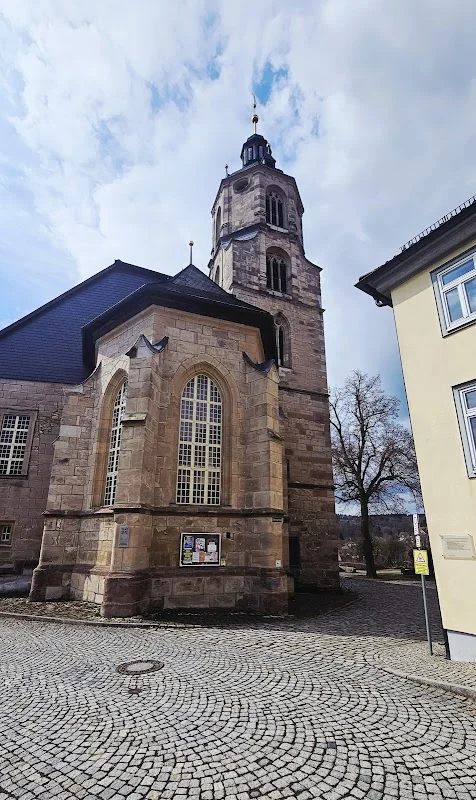
The St. Johannis Church in Schleusingen is more than just a religious place: it is a historical focal point of the city, a prominent building right next to Bertholdsburg Castle, and a space where almost eight centuries of local history, liturgical use, music, and memory overlap. The Protestant city church is located at Johanniskirchplatz 1; the parish office is at Johanniskirchplatz 6. The church is maintained by the Protestant parish of Schleusingen and today serves as a place of worship as well as a venue for church music, visits, and quiet reflection. Therefore, when one searches for St. Johannis Church Schleusingen, it refers not only to a building but to a piece of city identity: a structure that has preserved its late Gothic roots, was reshaped during the Baroque period, and continues to make visible how Schleusingen has developed over centuries. Particularly defining is its location in the historical center, the proximity to Bertholdsburg, and the combination of older building components, Baroque furnishings, and vibrant community life. ([kirchbau.de](https://www.kirchbau.de/300_datenblatt.php?id=7791&name=keiner))
History of St. Johannis Church in Schleusingen
The history of the Schleusingen Johanniskirche begins significantly earlier than the current building. According to the parish, a church is said to have stood at this site as early as 1235, possibly initially dedicated to Mother Mary and perhaps also to John the Baptist. The name St. Johannis is first documented in 1454. The church's new construction, which significantly shapes its current appearance, was completed at the end of the 15th century and consecrated in 1498. It was a Gothic hall church, whose tower is marked with the year 1483 as the beginning of construction. This early construction phase is important for understanding the church because it shows that St. Johannis did not emerge only in the Baroque period but is based on a long medieval development. The visible heritage of this epoch includes the tower, the choir, and the connection to the Ægidien Chapel. ([kirche-schleusingen.jimdofree.com](https://kirche-schleusingen.jimdofree.com/mehr/wissenswertes-zu-den-geb%C3%A4uden/st-johanniskirche/))
Several fires and renovations repeatedly changed the building. In 1353, the city burned down, and the church was likely affected. In the 17th century, the tower was raised in 1608; the transition from square to octagonal and the round-arched frieze mark the change from medieval to Baroque forms. The city chronicle mentions 1725 as the year of a major renovation of St. Johannis Church, during which the city church received its Baroque character. The parish describes the renovation of 1725/26 in more detail: The nave was completely rebuilt in blocks, the Gothic altar and choir were separated and continued to be used as a chapel, and the nave received three galleries. Later interventions followed in the 19th and 20th centuries, including the replacement of the damaged plaster ceiling with a flat wooden ceiling in 1880, restoration from 1989 to 1991, and further restoration of the organ from 2006 to 2009. Thus, the church remains readable as a developed architecture to this day. ([schleusingen.de](https://www.schleusingen.de/seite/527874/die-zeittafel.html))
For the city history of Schleusingen, the Johanniskirche is closely connected to the Henneberg Counts. The city chronicle names 1566 as the year when the Ægidien Chapel of St. Johannis Church became the burial place of the Henneberg Counts. The parish and historical literature describe this chapel as part of the entire ensemble and as a place where power, family, and city history visibly converge. Thus, the church is not only a sacred building but also a space of memory, where the Reformation period, the time of the Henneberg, and the later Saxon and Prussian administration have left their marks. This depth of layering makes St. Johannis Church interesting for visitors who want to see not just a beautiful church but a place with a long, well-readable history. Therefore, walking through the nave is not just an experience of a worship space but a historical document in architectural form. ([schleusingen.de](https://www.schleusingen.de/seite/527874/die-zeittafel.html))
For Schleusingen itself, the church is also a chronological reference point: The city chronicle mentions the Reformation in 1544, the burial site of the Henneberg in 1566, the death of Georg Ernst in 1583, the Saxon partition treaty in 1660, and the major Baroque renovation in 1725. This sequence makes visible how closely intertwined city and church history are. The Johanniskirche thus tells not only of construction phases but also of changes in power, confessional upheavals, and the slow transformation of a residence city into a place with a modern community structure. For visitors, this creates a particular appeal: one stands in a space that visibly showcases medieval origins, early modern transformations, and contemporary use at a glance. ([schleusingen.de](https://www.schleusingen.de/seite/527874/die-zeittafel.html))
Services, Church Music, and Events
The St. Johannis Church is still an active community space today. On the parish's website, it states that services usually take place bi-weekly in St. Johannis Church and that current service dates, church music offerings, and community events are published there. This makes the church a place that is not only visited historically but is also regularly used liturgically and musically. The current calendar also shows that services can take place regionally or at the community center depending on the period, while special holidays and festive services remain anchored in the Johanniskirche. For those looking for St. Johannis Church Schleusingen services or St. Johannis Church Schleusingen events, the official schedule page is therefore crucial. ([kirche-schleusingen.jimdofree.com](https://kirche-schleusingen.jimdofree.com/gottesdienste-kirchenmusik-termine/?utm_source=openai))
Church music also plays an important role in Schleusingen. The city reported in 2023 about an organ concert in the Schleusingen Johanniskirche and emphasized that the organ was rebuilt in 2009 after several years of work by the company Hey and with the support of the community and city. The parish publishes church music offerings on its own website; it is also evident that the offerings may change depending on the season. In practice, this means: those who want to experience concerts, organ music, or special spiritual evenings should not only keep an eye on the church space but also the ongoing event calendar. The term St. Johannis Church Schleusingen organ thus stands not only for an instrument but for a vibrant musical tradition that is still cultivated in the community today. ([schleusingen.de](https://www.schleusingen.de/news/1/845815/nachrichten/orgelkonzert-mit-frauenkirchenkantor-matthias-gr%C3%BCnert-in-der-schleusinger-johanniskirche.html))
Recurring occasions also include services on major holidays. The city of Schleusingen published a specific schedule for Christmas Eve 2023, including a nativity play, Christmas service, and service in St. Johannis Church. Such examples show that the church also retains a central role for special dates and festive days. It is thus both a local church and an event venue where church life, music, and community culture converge. For those seeking an impression of the atmosphere, the church should therefore not only be viewed as a monument but as a space that becomes audible and tangible on Sundays, holidays, and concert evenings. This connection of tradition and present is a key reason why St. Johannis Church Schleusingen is so prominent in local searches. ([schleusingen.de](https://www.schleusingen.de/news/1/895314/nachrichten/gottesdienste-heiligabend-schleusingen-und-ortsteile.html?utm_source=openai))
The event calendar shows that the church remains present throughout the year. The parish not only publishes regular service dates but also fixed times for special holidays, confirmations, and regionally coordinated celebrations. In the current information for 2026, for example, services for Easter, Pentecost, and regional occasions are listed, while the church music pages are continuously updated. This mix of scheduled basic dates and changing festive formats is typical for an active city church: it is not solely a monument but part of a reliable daily rhythm. Therefore, those searching for St. Johannis Church Schleusingen program, dates, or events will find not a rigid schedule like in an event hall but a lively community calendar that brings together liturgy, music, and local connection. ([kirche-schleusingen.jimdofree.com](https://kirche-schleusingen.jimdofree.com/gottesdienste-kirchenmusik-termine/?utm_source=openai))
Open Church, Address, and Directions
The most important practical data can be quickly mentioned: St. Johannis Church is located at Johanniskirchplatz 1 in 98553 Schleusingen. The Protestant parish office is at Johanniskirchplatz 6. The location is central, directly in the historical city center and in immediate proximity to Bertholdsburg. For visitors, this is an advantage because the church, castle, and old town can be experienced as a common tour. The parish describes St. Johannis Church with Ægidien Chapel as regularly open for visits and prayer during the summer months as part of the Open Church; the website also offers a virtual viewing option with a 360-degree view. This makes the church suitable not only for traditional worship visits but also for quiet individual visits, short tours, and initial orientation before a longer city walk. ([kirchbau.de](https://www.kirchbau.de/300_datenblatt.php?id=7791&name=keiner))
Regarding the search interest around St. Johannis Church Schleusingen directions and St. Johannis Church Schleusingen parking, it can be fairly said: a dedicated visitor parking area is not prominently indicated on the official pages. Because the church is located in the town center, one should plan a bit of buffer time for arrival and consider the location in the old town. Map materials show parking areas in the vicinity, including the parking lot at Schützenplatz and a park at Johanniskirche; this suggests that parking should be understood more as an inner-city theme rather than a classic large parking lot theme. Therefore, those coming by car should not aim for a separate event parking lot but rather orient themselves to the central location and the available spaces in the nearby environment. This assessment is a practical derivation from the location and map entries, not a separate commitment from the parish. ([kirchbau.de](https://www.kirchbau.de/300_datenblatt.php?id=7791&name=keiner))
The open church is another important aspect for visitor planning. The parish emphasizes that the Johanniskirche is regularly open during the summer months and that interested individuals can find information on-site or online. This is a plus for those looking for a quiet, culturally rich, and yet easily accessible church. Therefore, those wishing to visit the church should pay attention to the published calendar but also know that the parish intentionally keeps access low-threshold. Together with the central location, the proximity to the castle, and the possibility of a virtual tour, a very visitor-friendly overall picture emerges. This makes it clear why search terms like St. Johannis Church Schleusingen address, open church, and directions are closely related in practice. ([kirche-schleusingen.jimdofree.com](https://kirche-schleusingen.jimdofree.com/gemeindeleben/offene-kirche/?utm_source=openai))
Preparation is also worthwhile for an on-site visit, as the historical town center is compact and walkable. The church is only a few steps away from Bertholdsburg; therefore, the visit can be well combined with a city tour, a castle visit, or a detour into the old town. Those wishing to use the Open Church also have a virtual option if the visiting times do not fit. This is particularly practical for travelers who stop spontaneously: the church remains visible and informative even outside of traditional opening hours without losing its quiet atmosphere. This strengthens the search terms directions, address, and open church, as they describe not only logistics but also the threshold between city experience and church space. ([kirchbau.de](https://www.kirchbau.de/300_datenblatt.php?id=7791&name=keiner))
Ægidien Chapel, Furnishings, and Architectural Features
The architectural profile of St. Johannis Church is primarily determined by its juxtaposition of medieval remnants and Baroque renovations. The church construction description speaks of a tall hall church with a flat coffered ceiling and three-sided, three-story gallery; in addition, there is a low Baroque pulpit altar, the organ gallery behind it, and a choir side tower in Renaissance forms. The historical description of the parish adds to this picture with the information that during the renovation of 1725/26, the Gothic altar and choir were separated, and a smaller chapel with about 50 seats was created. This combination of a large nave and a smaller chapel creates a particularly unique spatial effect: the main room feels spacious and festive, while the older part possesses a distinctly more concentrated atmosphere. This is particularly exciting for visitors because different epochs do not overshadow each other here but stand visibly side by side. ([kirchbau.de](https://www.kirchbau.de/300_datenblatt.php?id=7791&name=keiner))
Among the notable furnishings are the Ægidien Chapel and the preserved Henneberg memorial sites within it. The chapel is separated from the church space by a wrought iron gate from the 16th century; according to historical records, it was the burial site of the Schleusingen line of the Counts of Henneberg. In the chapel, there are standing figures of the rulers and their wives, as well as four grave slabs in the floor. The church is explicitly connected to this dynastic memory in the city history, which elevates its significance far beyond the local service. Additionally, the historical representation mentions a stone crucifixion group, a copper baptismal font in flower chalice form, epitaphs on walls and pillars, as well as figures and reliefs in the chapel. Therefore, those searching for the term St. Johannis Church Schleusingen features will find plenty of substance here: not only a beautiful church interior but an ensemble with artworks, tombs, and traces of regional power history. ([de.wikipedia.org](https://de.wikipedia.org/wiki/St._Johannis_%28Schleusingen%29))
The furnishings also show how carefully older pieces and later renovations are connected. The tower, dated 1483, is one of the oldest preserved building elements. The bells were replaced in 1924 by cast iron bells after older bronze bells had to be given up. In the nave, the galleries shape the visual space and give the church its characteristic openness, while the Baroque order with pulpit altar and organ gallery creates a clear line of sight. This makes the space suitable for preaching, music, and festive services alike. In other words: St. Johannis Church is not only a monument but a well-composed interior, whose uniqueness lies precisely in the interplay of material, time, and function. ([de.wikipedia.org](https://de.wikipedia.org/wiki/St._Johannis_%28Schleusingen%29))
The artistic details are worth a closer look. The stone crucifixion group at the gallery staircase is among the oldest art treasures of the house; additionally, there is the copper baptismal font in the altar area, epitaphs on walls and pillars, as well as figures and reliefs in the chapel. Such pieces are not merely decoration but tell how piety, endowment, and memory culture interacted over centuries in a city church. Particularly the mixture of burial site, community church, and music space makes the Johanniskirche in Schleusingen a place where art history and local identity are practically inseparable. Therefore, when entering the building, one sees not only Baroque order but also traces of late medieval iconography and early modern memorial culture. ([de.wikipedia.org](https://de.wikipedia.org/wiki/St._Johannis_%28Schleusingen%29))
Seating, Organ, and Use of the Church Space
For many visitors, the question of seating and room size is particularly important. The parish states that the nave offers about 1,000 seats, while the separated chapel provides about 50 seats. This explains why St. Johannis Church is suitable not only for small devotions but also for larger services, festive days, and concert formats. The combination of a long nave, three galleries, and a separate chapel creates multiple usage zones that make the space flexible. In practice, this means: those searching for St. Johannis Church Schleusingen seating plan will not find a graphical hall plan like in a concert hall, but a very well-described room structure that facilitates orientation. Especially the three galleries and the clear separation between the nave and chapel make the seating arrangement comprehensible. ([kirche-schleusingen.jimdofree.com](https://kirche-schleusingen.jimdofree.com/mehr/wissenswertes-zu-den-geb%C3%A4uden/st-johanniskirche/))
The organ is a second key to understanding the church. The parish's website describes that there has been an organ since 1458 and that the current instrument was extensively renewed in 1940/41 according to plans by Rudolf Kühn. Between 2006 and 2009, a general restoration was carried out by the organ building company Hey, which amounted to a new construction. The current organ has three manuals, a pedal, 49 registers, and 3,074 pipes. This information is not only interesting for experts but also explains why the Johanniskirche is perceived as a place for organ concerts and church music. The church thus possesses a sound body that is appropriate for the historical space and musically continues the Baroque interior effect. ([kirche-schleusingen.jimdofree.com](https://kirche-schleusingen.jimdofree.com/mehr/wissenswertes-zu-den-geb%C3%A4uden/st-johanniskirche/))
The use of the space reflects this equipment. Services are held regularly, church music offerings are published, and the community uses the space for visits, prayer, and virtual tours. The church space is thus both a liturgical place, concert venue, and historical experience space. This is particularly strong in the interplay of organ, galleries, and pulpit altar: the view is focused, the space remains acoustically and visually spacious, and the Baroque order ensures a clear center. For a search query like St. Johannis Church Schleusingen organ or St. Johannis Church Schleusingen events, this is the decisive added value. The church is not only beautiful but functionally vibrant, well-documented, and open to visitors, the community, and music alike. ([kirche-schleusingen.jimdofree.com](https://kirche-schleusingen.jimdofree.com/gottesdienste-kirchenmusik-termine/?utm_source=openai))
The organ significantly contributes to the overall effect of the space. The historical depth of the instrument, the renovations in the 20th century, and the restoration between 2006 and 2009 show that here not only an old work has been preserved but a sounding center of the community has been maintained. The 49 registers and three manuals allow for both liturgical accompaniment and solo sound colors; the 3,074 pipes give the instrument a breadth that is particularly effective in a large church space with three galleries. The fact that the city highlighted an organ concert in 2023 further attests to this musical significance. For all those searching for church music, organ, or concert venue, the Johanniskirche is therefore a clear anchor point in the cultural offerings of Schleusingen. ([kirche-schleusingen.jimdofree.com](https://kirche-schleusingen.jimdofree.com/mehr/wissenswertes-zu-den-geb%C3%A4uden/st-johanniskirche/))
The seating situation complements this picture: around 1,000 seats in the nave and about 50 in the chapel make the church suitable for larger services and festive occasions without losing its core community essence. This mix of size and intimacy explains why the church functions both as a place for quiet reflection and as a space for major holidays. While other churches are often perceived only as monuments, the Schleusingen Johanniskirche thrives on its dual purpose: it preserves history while remaining open to the present, music, and community. ([kirche-schleusingen.jimdofree.com](https://kirche-schleusingen.jimdofree.com/mehr/wissenswertes-zu-den-geb%C3%A4uden/st-johanniskirche/))
Sources:
- Protestant Parish of Schleusingen - St. Johannis Church
- Protestant Parish of Schleusingen - Open Church
- Protestant Parish of Schleusingen - Services and Events
- City of Schleusingen - Protestant Church
- City of Schleusingen - Organ Concert in the Johanniskirche
- City of Schleusingen - Services Christmas Eve
Show moreShow less
St. Johannis Church Schleusingen | History & Services
The St. Johannis Church in Schleusingen is more than just a religious place: it is a historical focal point of the city, a prominent building right next to Bertholdsburg Castle, and a space where almost eight centuries of local history, liturgical use, music, and memory overlap. The Protestant city church is located at Johanniskirchplatz 1; the parish office is at Johanniskirchplatz 6. The church is maintained by the Protestant parish of Schleusingen and today serves as a place of worship as well as a venue for church music, visits, and quiet reflection. Therefore, when one searches for St. Johannis Church Schleusingen, it refers not only to a building but to a piece of city identity: a structure that has preserved its late Gothic roots, was reshaped during the Baroque period, and continues to make visible how Schleusingen has developed over centuries. Particularly defining is its location in the historical center, the proximity to Bertholdsburg, and the combination of older building components, Baroque furnishings, and vibrant community life. ([kirchbau.de](https://www.kirchbau.de/300_datenblatt.php?id=7791&name=keiner))
History of St. Johannis Church in Schleusingen
The history of the Schleusingen Johanniskirche begins significantly earlier than the current building. According to the parish, a church is said to have stood at this site as early as 1235, possibly initially dedicated to Mother Mary and perhaps also to John the Baptist. The name St. Johannis is first documented in 1454. The church's new construction, which significantly shapes its current appearance, was completed at the end of the 15th century and consecrated in 1498. It was a Gothic hall church, whose tower is marked with the year 1483 as the beginning of construction. This early construction phase is important for understanding the church because it shows that St. Johannis did not emerge only in the Baroque period but is based on a long medieval development. The visible heritage of this epoch includes the tower, the choir, and the connection to the Ægidien Chapel. ([kirche-schleusingen.jimdofree.com](https://kirche-schleusingen.jimdofree.com/mehr/wissenswertes-zu-den-geb%C3%A4uden/st-johanniskirche/))
Several fires and renovations repeatedly changed the building. In 1353, the city burned down, and the church was likely affected. In the 17th century, the tower was raised in 1608; the transition from square to octagonal and the round-arched frieze mark the change from medieval to Baroque forms. The city chronicle mentions 1725 as the year of a major renovation of St. Johannis Church, during which the city church received its Baroque character. The parish describes the renovation of 1725/26 in more detail: The nave was completely rebuilt in blocks, the Gothic altar and choir were separated and continued to be used as a chapel, and the nave received three galleries. Later interventions followed in the 19th and 20th centuries, including the replacement of the damaged plaster ceiling with a flat wooden ceiling in 1880, restoration from 1989 to 1991, and further restoration of the organ from 2006 to 2009. Thus, the church remains readable as a developed architecture to this day. ([schleusingen.de](https://www.schleusingen.de/seite/527874/die-zeittafel.html))
For the city history of Schleusingen, the Johanniskirche is closely connected to the Henneberg Counts. The city chronicle names 1566 as the year when the Ægidien Chapel of St. Johannis Church became the burial place of the Henneberg Counts. The parish and historical literature describe this chapel as part of the entire ensemble and as a place where power, family, and city history visibly converge. Thus, the church is not only a sacred building but also a space of memory, where the Reformation period, the time of the Henneberg, and the later Saxon and Prussian administration have left their marks. This depth of layering makes St. Johannis Church interesting for visitors who want to see not just a beautiful church but a place with a long, well-readable history. Therefore, walking through the nave is not just an experience of a worship space but a historical document in architectural form. ([schleusingen.de](https://www.schleusingen.de/seite/527874/die-zeittafel.html))
For Schleusingen itself, the church is also a chronological reference point: The city chronicle mentions the Reformation in 1544, the burial site of the Henneberg in 1566, the death of Georg Ernst in 1583, the Saxon partition treaty in 1660, and the major Baroque renovation in 1725. This sequence makes visible how closely intertwined city and church history are. The Johanniskirche thus tells not only of construction phases but also of changes in power, confessional upheavals, and the slow transformation of a residence city into a place with a modern community structure. For visitors, this creates a particular appeal: one stands in a space that visibly showcases medieval origins, early modern transformations, and contemporary use at a glance. ([schleusingen.de](https://www.schleusingen.de/seite/527874/die-zeittafel.html))
Services, Church Music, and Events
The St. Johannis Church is still an active community space today. On the parish's website, it states that services usually take place bi-weekly in St. Johannis Church and that current service dates, church music offerings, and community events are published there. This makes the church a place that is not only visited historically but is also regularly used liturgically and musically. The current calendar also shows that services can take place regionally or at the community center depending on the period, while special holidays and festive services remain anchored in the Johanniskirche. For those looking for St. Johannis Church Schleusingen services or St. Johannis Church Schleusingen events, the official schedule page is therefore crucial. ([kirche-schleusingen.jimdofree.com](https://kirche-schleusingen.jimdofree.com/gottesdienste-kirchenmusik-termine/?utm_source=openai))
Church music also plays an important role in Schleusingen. The city reported in 2023 about an organ concert in the Schleusingen Johanniskirche and emphasized that the organ was rebuilt in 2009 after several years of work by the company Hey and with the support of the community and city. The parish publishes church music offerings on its own website; it is also evident that the offerings may change depending on the season. In practice, this means: those who want to experience concerts, organ music, or special spiritual evenings should not only keep an eye on the church space but also the ongoing event calendar. The term St. Johannis Church Schleusingen organ thus stands not only for an instrument but for a vibrant musical tradition that is still cultivated in the community today. ([schleusingen.de](https://www.schleusingen.de/news/1/845815/nachrichten/orgelkonzert-mit-frauenkirchenkantor-matthias-gr%C3%BCnert-in-der-schleusinger-johanniskirche.html))
Recurring occasions also include services on major holidays. The city of Schleusingen published a specific schedule for Christmas Eve 2023, including a nativity play, Christmas service, and service in St. Johannis Church. Such examples show that the church also retains a central role for special dates and festive days. It is thus both a local church and an event venue where church life, music, and community culture converge. For those seeking an impression of the atmosphere, the church should therefore not only be viewed as a monument but as a space that becomes audible and tangible on Sundays, holidays, and concert evenings. This connection of tradition and present is a key reason why St. Johannis Church Schleusingen is so prominent in local searches. ([schleusingen.de](https://www.schleusingen.de/news/1/895314/nachrichten/gottesdienste-heiligabend-schleusingen-und-ortsteile.html?utm_source=openai))
The event calendar shows that the church remains present throughout the year. The parish not only publishes regular service dates but also fixed times for special holidays, confirmations, and regionally coordinated celebrations. In the current information for 2026, for example, services for Easter, Pentecost, and regional occasions are listed, while the church music pages are continuously updated. This mix of scheduled basic dates and changing festive formats is typical for an active city church: it is not solely a monument but part of a reliable daily rhythm. Therefore, those searching for St. Johannis Church Schleusingen program, dates, or events will find not a rigid schedule like in an event hall but a lively community calendar that brings together liturgy, music, and local connection. ([kirche-schleusingen.jimdofree.com](https://kirche-schleusingen.jimdofree.com/gottesdienste-kirchenmusik-termine/?utm_source=openai))
Open Church, Address, and Directions
The most important practical data can be quickly mentioned: St. Johannis Church is located at Johanniskirchplatz 1 in 98553 Schleusingen. The Protestant parish office is at Johanniskirchplatz 6. The location is central, directly in the historical city center and in immediate proximity to Bertholdsburg. For visitors, this is an advantage because the church, castle, and old town can be experienced as a common tour. The parish describes St. Johannis Church with Ægidien Chapel as regularly open for visits and prayer during the summer months as part of the Open Church; the website also offers a virtual viewing option with a 360-degree view. This makes the church suitable not only for traditional worship visits but also for quiet individual visits, short tours, and initial orientation before a longer city walk. ([kirchbau.de](https://www.kirchbau.de/300_datenblatt.php?id=7791&name=keiner))
Regarding the search interest around St. Johannis Church Schleusingen directions and St. Johannis Church Schleusingen parking, it can be fairly said: a dedicated visitor parking area is not prominently indicated on the official pages. Because the church is located in the town center, one should plan a bit of buffer time for arrival and consider the location in the old town. Map materials show parking areas in the vicinity, including the parking lot at Schützenplatz and a park at Johanniskirche; this suggests that parking should be understood more as an inner-city theme rather than a classic large parking lot theme. Therefore, those coming by car should not aim for a separate event parking lot but rather orient themselves to the central location and the available spaces in the nearby environment. This assessment is a practical derivation from the location and map entries, not a separate commitment from the parish. ([kirchbau.de](https://www.kirchbau.de/300_datenblatt.php?id=7791&name=keiner))
The open church is another important aspect for visitor planning. The parish emphasizes that the Johanniskirche is regularly open during the summer months and that interested individuals can find information on-site or online. This is a plus for those looking for a quiet, culturally rich, and yet easily accessible church. Therefore, those wishing to visit the church should pay attention to the published calendar but also know that the parish intentionally keeps access low-threshold. Together with the central location, the proximity to the castle, and the possibility of a virtual tour, a very visitor-friendly overall picture emerges. This makes it clear why search terms like St. Johannis Church Schleusingen address, open church, and directions are closely related in practice. ([kirche-schleusingen.jimdofree.com](https://kirche-schleusingen.jimdofree.com/gemeindeleben/offene-kirche/?utm_source=openai))
Preparation is also worthwhile for an on-site visit, as the historical town center is compact and walkable. The church is only a few steps away from Bertholdsburg; therefore, the visit can be well combined with a city tour, a castle visit, or a detour into the old town. Those wishing to use the Open Church also have a virtual option if the visiting times do not fit. This is particularly practical for travelers who stop spontaneously: the church remains visible and informative even outside of traditional opening hours without losing its quiet atmosphere. This strengthens the search terms directions, address, and open church, as they describe not only logistics but also the threshold between city experience and church space. ([kirchbau.de](https://www.kirchbau.de/300_datenblatt.php?id=7791&name=keiner))
Ægidien Chapel, Furnishings, and Architectural Features
The architectural profile of St. Johannis Church is primarily determined by its juxtaposition of medieval remnants and Baroque renovations. The church construction description speaks of a tall hall church with a flat coffered ceiling and three-sided, three-story gallery; in addition, there is a low Baroque pulpit altar, the organ gallery behind it, and a choir side tower in Renaissance forms. The historical description of the parish adds to this picture with the information that during the renovation of 1725/26, the Gothic altar and choir were separated, and a smaller chapel with about 50 seats was created. This combination of a large nave and a smaller chapel creates a particularly unique spatial effect: the main room feels spacious and festive, while the older part possesses a distinctly more concentrated atmosphere. This is particularly exciting for visitors because different epochs do not overshadow each other here but stand visibly side by side. ([kirchbau.de](https://www.kirchbau.de/300_datenblatt.php?id=7791&name=keiner))
Among the notable furnishings are the Ægidien Chapel and the preserved Henneberg memorial sites within it. The chapel is separated from the church space by a wrought iron gate from the 16th century; according to historical records, it was the burial site of the Schleusingen line of the Counts of Henneberg. In the chapel, there are standing figures of the rulers and their wives, as well as four grave slabs in the floor. The church is explicitly connected to this dynastic memory in the city history, which elevates its significance far beyond the local service. Additionally, the historical representation mentions a stone crucifixion group, a copper baptismal font in flower chalice form, epitaphs on walls and pillars, as well as figures and reliefs in the chapel. Therefore, those searching for the term St. Johannis Church Schleusingen features will find plenty of substance here: not only a beautiful church interior but an ensemble with artworks, tombs, and traces of regional power history. ([de.wikipedia.org](https://de.wikipedia.org/wiki/St._Johannis_%28Schleusingen%29))
The furnishings also show how carefully older pieces and later renovations are connected. The tower, dated 1483, is one of the oldest preserved building elements. The bells were replaced in 1924 by cast iron bells after older bronze bells had to be given up. In the nave, the galleries shape the visual space and give the church its characteristic openness, while the Baroque order with pulpit altar and organ gallery creates a clear line of sight. This makes the space suitable for preaching, music, and festive services alike. In other words: St. Johannis Church is not only a monument but a well-composed interior, whose uniqueness lies precisely in the interplay of material, time, and function. ([de.wikipedia.org](https://de.wikipedia.org/wiki/St._Johannis_%28Schleusingen%29))
The artistic details are worth a closer look. The stone crucifixion group at the gallery staircase is among the oldest art treasures of the house; additionally, there is the copper baptismal font in the altar area, epitaphs on walls and pillars, as well as figures and reliefs in the chapel. Such pieces are not merely decoration but tell how piety, endowment, and memory culture interacted over centuries in a city church. Particularly the mixture of burial site, community church, and music space makes the Johanniskirche in Schleusingen a place where art history and local identity are practically inseparable. Therefore, when entering the building, one sees not only Baroque order but also traces of late medieval iconography and early modern memorial culture. ([de.wikipedia.org](https://de.wikipedia.org/wiki/St._Johannis_%28Schleusingen%29))
Seating, Organ, and Use of the Church Space
For many visitors, the question of seating and room size is particularly important. The parish states that the nave offers about 1,000 seats, while the separated chapel provides about 50 seats. This explains why St. Johannis Church is suitable not only for small devotions but also for larger services, festive days, and concert formats. The combination of a long nave, three galleries, and a separate chapel creates multiple usage zones that make the space flexible. In practice, this means: those searching for St. Johannis Church Schleusingen seating plan will not find a graphical hall plan like in a concert hall, but a very well-described room structure that facilitates orientation. Especially the three galleries and the clear separation between the nave and chapel make the seating arrangement comprehensible. ([kirche-schleusingen.jimdofree.com](https://kirche-schleusingen.jimdofree.com/mehr/wissenswertes-zu-den-geb%C3%A4uden/st-johanniskirche/))
The organ is a second key to understanding the church. The parish's website describes that there has been an organ since 1458 and that the current instrument was extensively renewed in 1940/41 according to plans by Rudolf Kühn. Between 2006 and 2009, a general restoration was carried out by the organ building company Hey, which amounted to a new construction. The current organ has three manuals, a pedal, 49 registers, and 3,074 pipes. This information is not only interesting for experts but also explains why the Johanniskirche is perceived as a place for organ concerts and church music. The church thus possesses a sound body that is appropriate for the historical space and musically continues the Baroque interior effect. ([kirche-schleusingen.jimdofree.com](https://kirche-schleusingen.jimdofree.com/mehr/wissenswertes-zu-den-geb%C3%A4uden/st-johanniskirche/))
The use of the space reflects this equipment. Services are held regularly, church music offerings are published, and the community uses the space for visits, prayer, and virtual tours. The church space is thus both a liturgical place, concert venue, and historical experience space. This is particularly strong in the interplay of organ, galleries, and pulpit altar: the view is focused, the space remains acoustically and visually spacious, and the Baroque order ensures a clear center. For a search query like St. Johannis Church Schleusingen organ or St. Johannis Church Schleusingen events, this is the decisive added value. The church is not only beautiful but functionally vibrant, well-documented, and open to visitors, the community, and music alike. ([kirche-schleusingen.jimdofree.com](https://kirche-schleusingen.jimdofree.com/gottesdienste-kirchenmusik-termine/?utm_source=openai))
The organ significantly contributes to the overall effect of the space. The historical depth of the instrument, the renovations in the 20th century, and the restoration between 2006 and 2009 show that here not only an old work has been preserved but a sounding center of the community has been maintained. The 49 registers and three manuals allow for both liturgical accompaniment and solo sound colors; the 3,074 pipes give the instrument a breadth that is particularly effective in a large church space with three galleries. The fact that the city highlighted an organ concert in 2023 further attests to this musical significance. For all those searching for church music, organ, or concert venue, the Johanniskirche is therefore a clear anchor point in the cultural offerings of Schleusingen. ([kirche-schleusingen.jimdofree.com](https://kirche-schleusingen.jimdofree.com/mehr/wissenswertes-zu-den-geb%C3%A4uden/st-johanniskirche/))
The seating situation complements this picture: around 1,000 seats in the nave and about 50 in the chapel make the church suitable for larger services and festive occasions without losing its core community essence. This mix of size and intimacy explains why the church functions both as a place for quiet reflection and as a space for major holidays. While other churches are often perceived only as monuments, the Schleusingen Johanniskirche thrives on its dual purpose: it preserves history while remaining open to the present, music, and community. ([kirche-schleusingen.jimdofree.com](https://kirche-schleusingen.jimdofree.com/mehr/wissenswertes-zu-den-geb%C3%A4uden/st-johanniskirche/))
Sources:
- Protestant Parish of Schleusingen - St. Johannis Church
- Protestant Parish of Schleusingen - Open Church
- Protestant Parish of Schleusingen - Services and Events
- City of Schleusingen - Protestant Church
- City of Schleusingen - Organ Concert in the Johanniskirche
- City of Schleusingen - Services Christmas Eve
St. Johannis Church Schleusingen | History & Services
The St. Johannis Church in Schleusingen is more than just a religious place: it is a historical focal point of the city, a prominent building right next to Bertholdsburg Castle, and a space where almost eight centuries of local history, liturgical use, music, and memory overlap. The Protestant city church is located at Johanniskirchplatz 1; the parish office is at Johanniskirchplatz 6. The church is maintained by the Protestant parish of Schleusingen and today serves as a place of worship as well as a venue for church music, visits, and quiet reflection. Therefore, when one searches for St. Johannis Church Schleusingen, it refers not only to a building but to a piece of city identity: a structure that has preserved its late Gothic roots, was reshaped during the Baroque period, and continues to make visible how Schleusingen has developed over centuries. Particularly defining is its location in the historical center, the proximity to Bertholdsburg, and the combination of older building components, Baroque furnishings, and vibrant community life. ([kirchbau.de](https://www.kirchbau.de/300_datenblatt.php?id=7791&name=keiner))
History of St. Johannis Church in Schleusingen
The history of the Schleusingen Johanniskirche begins significantly earlier than the current building. According to the parish, a church is said to have stood at this site as early as 1235, possibly initially dedicated to Mother Mary and perhaps also to John the Baptist. The name St. Johannis is first documented in 1454. The church's new construction, which significantly shapes its current appearance, was completed at the end of the 15th century and consecrated in 1498. It was a Gothic hall church, whose tower is marked with the year 1483 as the beginning of construction. This early construction phase is important for understanding the church because it shows that St. Johannis did not emerge only in the Baroque period but is based on a long medieval development. The visible heritage of this epoch includes the tower, the choir, and the connection to the Ægidien Chapel. ([kirche-schleusingen.jimdofree.com](https://kirche-schleusingen.jimdofree.com/mehr/wissenswertes-zu-den-geb%C3%A4uden/st-johanniskirche/))
Several fires and renovations repeatedly changed the building. In 1353, the city burned down, and the church was likely affected. In the 17th century, the tower was raised in 1608; the transition from square to octagonal and the round-arched frieze mark the change from medieval to Baroque forms. The city chronicle mentions 1725 as the year of a major renovation of St. Johannis Church, during which the city church received its Baroque character. The parish describes the renovation of 1725/26 in more detail: The nave was completely rebuilt in blocks, the Gothic altar and choir were separated and continued to be used as a chapel, and the nave received three galleries. Later interventions followed in the 19th and 20th centuries, including the replacement of the damaged plaster ceiling with a flat wooden ceiling in 1880, restoration from 1989 to 1991, and further restoration of the organ from 2006 to 2009. Thus, the church remains readable as a developed architecture to this day. ([schleusingen.de](https://www.schleusingen.de/seite/527874/die-zeittafel.html))
For the city history of Schleusingen, the Johanniskirche is closely connected to the Henneberg Counts. The city chronicle names 1566 as the year when the Ægidien Chapel of St. Johannis Church became the burial place of the Henneberg Counts. The parish and historical literature describe this chapel as part of the entire ensemble and as a place where power, family, and city history visibly converge. Thus, the church is not only a sacred building but also a space of memory, where the Reformation period, the time of the Henneberg, and the later Saxon and Prussian administration have left their marks. This depth of layering makes St. Johannis Church interesting for visitors who want to see not just a beautiful church but a place with a long, well-readable history. Therefore, walking through the nave is not just an experience of a worship space but a historical document in architectural form. ([schleusingen.de](https://www.schleusingen.de/seite/527874/die-zeittafel.html))
For Schleusingen itself, the church is also a chronological reference point: The city chronicle mentions the Reformation in 1544, the burial site of the Henneberg in 1566, the death of Georg Ernst in 1583, the Saxon partition treaty in 1660, and the major Baroque renovation in 1725. This sequence makes visible how closely intertwined city and church history are. The Johanniskirche thus tells not only of construction phases but also of changes in power, confessional upheavals, and the slow transformation of a residence city into a place with a modern community structure. For visitors, this creates a particular appeal: one stands in a space that visibly showcases medieval origins, early modern transformations, and contemporary use at a glance. ([schleusingen.de](https://www.schleusingen.de/seite/527874/die-zeittafel.html))
Services, Church Music, and Events
The St. Johannis Church is still an active community space today. On the parish's website, it states that services usually take place bi-weekly in St. Johannis Church and that current service dates, church music offerings, and community events are published there. This makes the church a place that is not only visited historically but is also regularly used liturgically and musically. The current calendar also shows that services can take place regionally or at the community center depending on the period, while special holidays and festive services remain anchored in the Johanniskirche. For those looking for St. Johannis Church Schleusingen services or St. Johannis Church Schleusingen events, the official schedule page is therefore crucial. ([kirche-schleusingen.jimdofree.com](https://kirche-schleusingen.jimdofree.com/gottesdienste-kirchenmusik-termine/?utm_source=openai))
Church music also plays an important role in Schleusingen. The city reported in 2023 about an organ concert in the Schleusingen Johanniskirche and emphasized that the organ was rebuilt in 2009 after several years of work by the company Hey and with the support of the community and city. The parish publishes church music offerings on its own website; it is also evident that the offerings may change depending on the season. In practice, this means: those who want to experience concerts, organ music, or special spiritual evenings should not only keep an eye on the church space but also the ongoing event calendar. The term St. Johannis Church Schleusingen organ thus stands not only for an instrument but for a vibrant musical tradition that is still cultivated in the community today. ([schleusingen.de](https://www.schleusingen.de/news/1/845815/nachrichten/orgelkonzert-mit-frauenkirchenkantor-matthias-gr%C3%BCnert-in-der-schleusinger-johanniskirche.html))
Recurring occasions also include services on major holidays. The city of Schleusingen published a specific schedule for Christmas Eve 2023, including a nativity play, Christmas service, and service in St. Johannis Church. Such examples show that the church also retains a central role for special dates and festive days. It is thus both a local church and an event venue where church life, music, and community culture converge. For those seeking an impression of the atmosphere, the church should therefore not only be viewed as a monument but as a space that becomes audible and tangible on Sundays, holidays, and concert evenings. This connection of tradition and present is a key reason why St. Johannis Church Schleusingen is so prominent in local searches. ([schleusingen.de](https://www.schleusingen.de/news/1/895314/nachrichten/gottesdienste-heiligabend-schleusingen-und-ortsteile.html?utm_source=openai))
The event calendar shows that the church remains present throughout the year. The parish not only publishes regular service dates but also fixed times for special holidays, confirmations, and regionally coordinated celebrations. In the current information for 2026, for example, services for Easter, Pentecost, and regional occasions are listed, while the church music pages are continuously updated. This mix of scheduled basic dates and changing festive formats is typical for an active city church: it is not solely a monument but part of a reliable daily rhythm. Therefore, those searching for St. Johannis Church Schleusingen program, dates, or events will find not a rigid schedule like in an event hall but a lively community calendar that brings together liturgy, music, and local connection. ([kirche-schleusingen.jimdofree.com](https://kirche-schleusingen.jimdofree.com/gottesdienste-kirchenmusik-termine/?utm_source=openai))
Open Church, Address, and Directions
The most important practical data can be quickly mentioned: St. Johannis Church is located at Johanniskirchplatz 1 in 98553 Schleusingen. The Protestant parish office is at Johanniskirchplatz 6. The location is central, directly in the historical city center and in immediate proximity to Bertholdsburg. For visitors, this is an advantage because the church, castle, and old town can be experienced as a common tour. The parish describes St. Johannis Church with Ægidien Chapel as regularly open for visits and prayer during the summer months as part of the Open Church; the website also offers a virtual viewing option with a 360-degree view. This makes the church suitable not only for traditional worship visits but also for quiet individual visits, short tours, and initial orientation before a longer city walk. ([kirchbau.de](https://www.kirchbau.de/300_datenblatt.php?id=7791&name=keiner))
Regarding the search interest around St. Johannis Church Schleusingen directions and St. Johannis Church Schleusingen parking, it can be fairly said: a dedicated visitor parking area is not prominently indicated on the official pages. Because the church is located in the town center, one should plan a bit of buffer time for arrival and consider the location in the old town. Map materials show parking areas in the vicinity, including the parking lot at Schützenplatz and a park at Johanniskirche; this suggests that parking should be understood more as an inner-city theme rather than a classic large parking lot theme. Therefore, those coming by car should not aim for a separate event parking lot but rather orient themselves to the central location and the available spaces in the nearby environment. This assessment is a practical derivation from the location and map entries, not a separate commitment from the parish. ([kirchbau.de](https://www.kirchbau.de/300_datenblatt.php?id=7791&name=keiner))
The open church is another important aspect for visitor planning. The parish emphasizes that the Johanniskirche is regularly open during the summer months and that interested individuals can find information on-site or online. This is a plus for those looking for a quiet, culturally rich, and yet easily accessible church. Therefore, those wishing to visit the church should pay attention to the published calendar but also know that the parish intentionally keeps access low-threshold. Together with the central location, the proximity to the castle, and the possibility of a virtual tour, a very visitor-friendly overall picture emerges. This makes it clear why search terms like St. Johannis Church Schleusingen address, open church, and directions are closely related in practice. ([kirche-schleusingen.jimdofree.com](https://kirche-schleusingen.jimdofree.com/gemeindeleben/offene-kirche/?utm_source=openai))
Preparation is also worthwhile for an on-site visit, as the historical town center is compact and walkable. The church is only a few steps away from Bertholdsburg; therefore, the visit can be well combined with a city tour, a castle visit, or a detour into the old town. Those wishing to use the Open Church also have a virtual option if the visiting times do not fit. This is particularly practical for travelers who stop spontaneously: the church remains visible and informative even outside of traditional opening hours without losing its quiet atmosphere. This strengthens the search terms directions, address, and open church, as they describe not only logistics but also the threshold between city experience and church space. ([kirchbau.de](https://www.kirchbau.de/300_datenblatt.php?id=7791&name=keiner))
Ægidien Chapel, Furnishings, and Architectural Features
The architectural profile of St. Johannis Church is primarily determined by its juxtaposition of medieval remnants and Baroque renovations. The church construction description speaks of a tall hall church with a flat coffered ceiling and three-sided, three-story gallery; in addition, there is a low Baroque pulpit altar, the organ gallery behind it, and a choir side tower in Renaissance forms. The historical description of the parish adds to this picture with the information that during the renovation of 1725/26, the Gothic altar and choir were separated, and a smaller chapel with about 50 seats was created. This combination of a large nave and a smaller chapel creates a particularly unique spatial effect: the main room feels spacious and festive, while the older part possesses a distinctly more concentrated atmosphere. This is particularly exciting for visitors because different epochs do not overshadow each other here but stand visibly side by side. ([kirchbau.de](https://www.kirchbau.de/300_datenblatt.php?id=7791&name=keiner))
Among the notable furnishings are the Ægidien Chapel and the preserved Henneberg memorial sites within it. The chapel is separated from the church space by a wrought iron gate from the 16th century; according to historical records, it was the burial site of the Schleusingen line of the Counts of Henneberg. In the chapel, there are standing figures of the rulers and their wives, as well as four grave slabs in the floor. The church is explicitly connected to this dynastic memory in the city history, which elevates its significance far beyond the local service. Additionally, the historical representation mentions a stone crucifixion group, a copper baptismal font in flower chalice form, epitaphs on walls and pillars, as well as figures and reliefs in the chapel. Therefore, those searching for the term St. Johannis Church Schleusingen features will find plenty of substance here: not only a beautiful church interior but an ensemble with artworks, tombs, and traces of regional power history. ([de.wikipedia.org](https://de.wikipedia.org/wiki/St._Johannis_%28Schleusingen%29))
The furnishings also show how carefully older pieces and later renovations are connected. The tower, dated 1483, is one of the oldest preserved building elements. The bells were replaced in 1924 by cast iron bells after older bronze bells had to be given up. In the nave, the galleries shape the visual space and give the church its characteristic openness, while the Baroque order with pulpit altar and organ gallery creates a clear line of sight. This makes the space suitable for preaching, music, and festive services alike. In other words: St. Johannis Church is not only a monument but a well-composed interior, whose uniqueness lies precisely in the interplay of material, time, and function. ([de.wikipedia.org](https://de.wikipedia.org/wiki/St._Johannis_%28Schleusingen%29))
The artistic details are worth a closer look. The stone crucifixion group at the gallery staircase is among the oldest art treasures of the house; additionally, there is the copper baptismal font in the altar area, epitaphs on walls and pillars, as well as figures and reliefs in the chapel. Such pieces are not merely decoration but tell how piety, endowment, and memory culture interacted over centuries in a city church. Particularly the mixture of burial site, community church, and music space makes the Johanniskirche in Schleusingen a place where art history and local identity are practically inseparable. Therefore, when entering the building, one sees not only Baroque order but also traces of late medieval iconography and early modern memorial culture. ([de.wikipedia.org](https://de.wikipedia.org/wiki/St._Johannis_%28Schleusingen%29))
Seating, Organ, and Use of the Church Space
For many visitors, the question of seating and room size is particularly important. The parish states that the nave offers about 1,000 seats, while the separated chapel provides about 50 seats. This explains why St. Johannis Church is suitable not only for small devotions but also for larger services, festive days, and concert formats. The combination of a long nave, three galleries, and a separate chapel creates multiple usage zones that make the space flexible. In practice, this means: those searching for St. Johannis Church Schleusingen seating plan will not find a graphical hall plan like in a concert hall, but a very well-described room structure that facilitates orientation. Especially the three galleries and the clear separation between the nave and chapel make the seating arrangement comprehensible. ([kirche-schleusingen.jimdofree.com](https://kirche-schleusingen.jimdofree.com/mehr/wissenswertes-zu-den-geb%C3%A4uden/st-johanniskirche/))
The organ is a second key to understanding the church. The parish's website describes that there has been an organ since 1458 and that the current instrument was extensively renewed in 1940/41 according to plans by Rudolf Kühn. Between 2006 and 2009, a general restoration was carried out by the organ building company Hey, which amounted to a new construction. The current organ has three manuals, a pedal, 49 registers, and 3,074 pipes. This information is not only interesting for experts but also explains why the Johanniskirche is perceived as a place for organ concerts and church music. The church thus possesses a sound body that is appropriate for the historical space and musically continues the Baroque interior effect. ([kirche-schleusingen.jimdofree.com](https://kirche-schleusingen.jimdofree.com/mehr/wissenswertes-zu-den-geb%C3%A4uden/st-johanniskirche/))
The use of the space reflects this equipment. Services are held regularly, church music offerings are published, and the community uses the space for visits, prayer, and virtual tours. The church space is thus both a liturgical place, concert venue, and historical experience space. This is particularly strong in the interplay of organ, galleries, and pulpit altar: the view is focused, the space remains acoustically and visually spacious, and the Baroque order ensures a clear center. For a search query like St. Johannis Church Schleusingen organ or St. Johannis Church Schleusingen events, this is the decisive added value. The church is not only beautiful but functionally vibrant, well-documented, and open to visitors, the community, and music alike. ([kirche-schleusingen.jimdofree.com](https://kirche-schleusingen.jimdofree.com/gottesdienste-kirchenmusik-termine/?utm_source=openai))
The organ significantly contributes to the overall effect of the space. The historical depth of the instrument, the renovations in the 20th century, and the restoration between 2006 and 2009 show that here not only an old work has been preserved but a sounding center of the community has been maintained. The 49 registers and three manuals allow for both liturgical accompaniment and solo sound colors; the 3,074 pipes give the instrument a breadth that is particularly effective in a large church space with three galleries. The fact that the city highlighted an organ concert in 2023 further attests to this musical significance. For all those searching for church music, organ, or concert venue, the Johanniskirche is therefore a clear anchor point in the cultural offerings of Schleusingen. ([kirche-schleusingen.jimdofree.com](https://kirche-schleusingen.jimdofree.com/mehr/wissenswertes-zu-den-geb%C3%A4uden/st-johanniskirche/))
The seating situation complements this picture: around 1,000 seats in the nave and about 50 in the chapel make the church suitable for larger services and festive occasions without losing its core community essence. This mix of size and intimacy explains why the church functions both as a place for quiet reflection and as a space for major holidays. While other churches are often perceived only as monuments, the Schleusingen Johanniskirche thrives on its dual purpose: it preserves history while remaining open to the present, music, and community. ([kirche-schleusingen.jimdofree.com](https://kirche-schleusingen.jimdofree.com/mehr/wissenswertes-zu-den-geb%C3%A4uden/st-johanniskirche/))
Sources:
- Protestant Parish of Schleusingen - St. Johannis Church
- Protestant Parish of Schleusingen - Open Church
- Protestant Parish of Schleusingen - Services and Events
- City of Schleusingen - Protestant Church
- City of Schleusingen - Organ Concert in the Johanniskirche
- City of Schleusingen - Services Christmas Eve
Upcoming Events
No events found
Frequently Asked Questions
Reviews
Sabine Hamann-koch
7. April 2019
I personally didn't like it
Giovanni
17. May 2023
Church used for political events. 🤮
Markus Heckert
17. July 2023
Worthseeing church
فارس علوش
2. June 2017
التراس التراس
Patrice Kaiser
4. April 2026
Simple but worthseeing church, the inscriptions on the portals are interesting.