Cultural Education in Suhl: Participation and Future
Cultural Education & Societal Discourse in Suhl: Roadmap for the Coming Years
What the Coming Years Are About
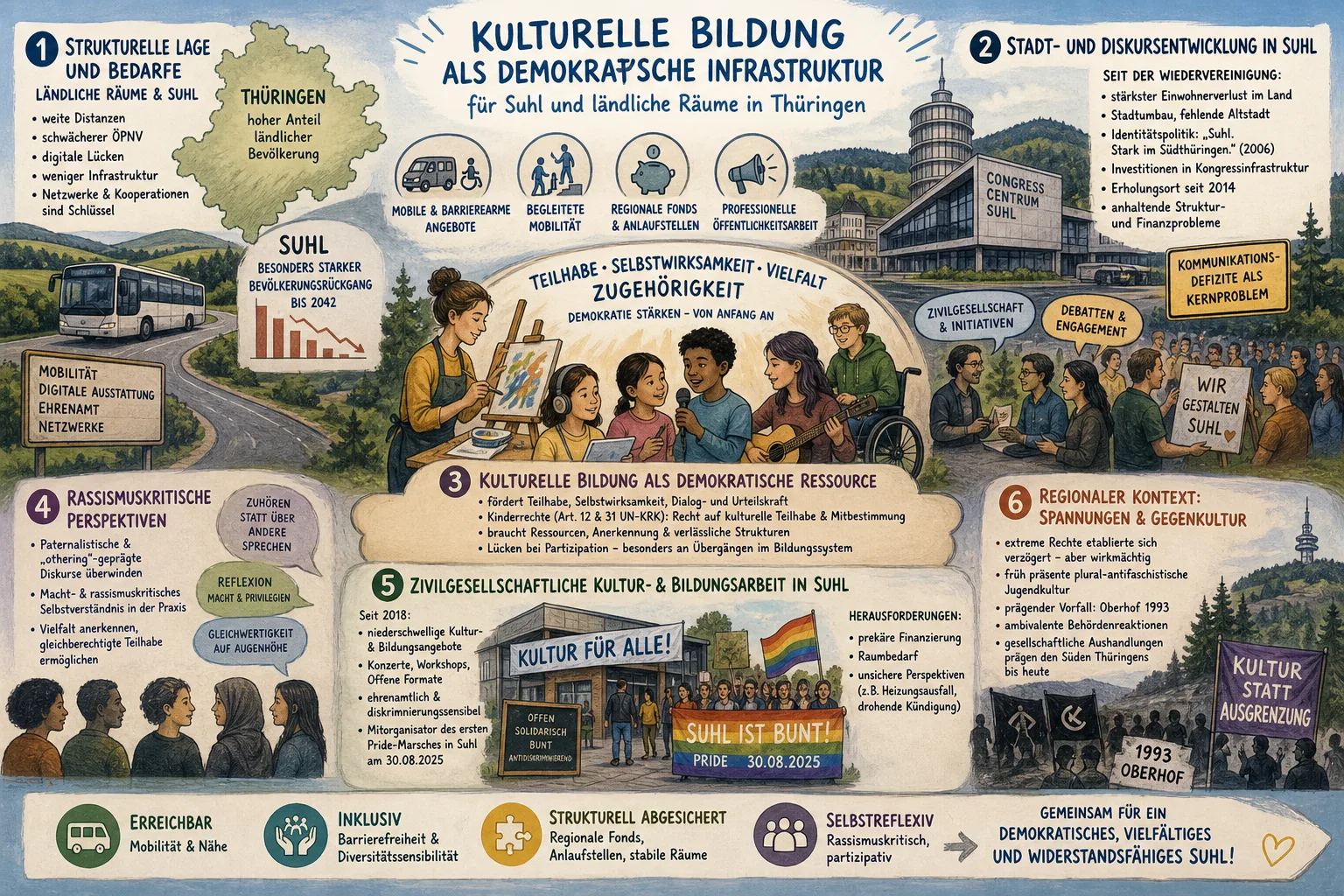
Suhl faces the task of securing social cohesion and quality of life in a city that will continue to change. Cultural education can become a democratic infrastructure: it creates spaces for learning and encounters where people develop skills for dialogue, critique, creativity, and participation—practically, accessibly, and across age groups.
For the next few years, two guiding questions are crucial:
- Enable participation: How can cultural offerings reach children, young people, and adults regardless of income, background, mobility, or disability?
- Strengthen discourse: How can places and formats be established where controversial topics can be discussed respectfully, critically of racism, and solution-oriented?
Framework Conditions 2026–2029: Accessibility, Networks, Reliability
For an effective strategy in the coming years, measures should be planned to address three typical hurdles simultaneously: routes & times (mobility), access (barrier-free & digital participation), and stability (spaces, staff, funding).
Fields of Action to Be Prioritized from 2026
- Reliable structures instead of short-termism: Multi-year funding routines (e.g., 24–36 months) with clear quality criteria and simple application processes.
- Accessibility: Combined solutions of events in neighborhoods, cooperation with schools/youth facilities, and accompanying/shuttle options for selected dates.
- Inclusion & Accessibility: Low-barrier venues, plain language, variable participation fees (e.g., solidarity pricing), and a planning routine that includes the needs of people with disabilities early on.
- Networks: Reliable coordination between culture, education, youth services, civil society, and administration so that offerings work together, not just side by side.
Cultural Education as Democratic Infrastructure: Goals from 2026
If cultural education in Suhl is planned as democratic infrastructure in the coming years, the goals should be measurable, close to everyday life, and socially just. The basis for this includes the right of children to participation and international guidelines for cultural participation.
Which Competencies Should Be Especially Strengthened 2026–2029
- Self-expression & Self-efficacy: Artistically working on one's own topics (e.g., music, theater, film, comics, photography, creative writing).
- Judgment & Media Literacy: Evaluating sources, changing perspectives, classifying conflicts; creative media production as a training field for responsibility.
- Dialogue Skills: Joint projects that do not conceal differences but make them manageable in a structured way (moderation, feedback culture, clear rules).
- Participation Design: Formats developed "with" instead of "for" people—including participation in program planning, public relations, and decision-making processes.
Quality Principles for Anti-Racist and Inclusive Practice
- Make participation binding: For projects involving target groups, advisory boards, co-moderation, or paid positions for those affected are planned.
- Protection concepts: Clear codes of conduct, complaint procedures, and awareness structures for events and open spaces.
- Language and image policy: Communication without othering; clear, respectful address; diversity in images and program content.
- Barrier check before each season: Access, sanitation, orientation, noise and lighting conditions, information in plain language.
Concrete Implementation Roadmap for Suhl (2026–2029)
The following steps are designed as a future program. They describe what can be started and consolidated in Suhl in the coming years so that cultural education becomes plannable—and does not depend on individual coincidences.
Phase 1 (2026): Start & Safeguarding
- Establish Coordination Circle for Cultural Education Suhl: Regular meetings, fixed contacts, transparent agenda; participation of schools, youth work, cultural actors, initiatives, and city administration.
- Secure spaces & usage windows: Binding weekly times in public buildings (e.g., library/school rooms/multi-purpose rooms) and clear rules for keys, technology, liability.
- Simplify funding logic: A local micro-funding pot for quick, low-threshold projects (workshops, materials, fees, travel costs).
- Annual calendar “Open Workshops”: Monthly open dates (e.g., print workshop, music lab, writing workshop, media lab) that can be attended without prior knowledge.
Phase 2 (2027): Expand & Connect
- Establish school–culture cooperation routes: At least one reliable cultural partnership per school (e.g., theater/film/music/design) with binding time slots in the school year.
- Test mobile formats: Pop-up studio, mobile recording studio, or reading lounge at changing locations to reach people without secure mobility.
- Start training series: Anti-racist, inclusive, and trauma-sensitive practice for pedagogy, cultural work, and administration (including moderation in conflict situations).
- Establish dialogue formats: Moderated discussion evenings on local future issues (housing, coexistence, youth perspectives) with clear conversation rules and documentation.
Phase 3 (2028–2029): Consolidate & Evaluate
- Introduce multi-year core funding: For central venues/teams with proven impact, including staff, operating costs, barrier adaptation.
- Citywide participation formats: An annual youth and culture forum with the right to propose budgets for parts of cultural funding.
- Impact monitoring: Simple key figures (participant structure, barrier access, cooperation density, return rate) plus qualitative feedback (interviews/feedback rounds).
- Transparency report: Public summary of results and adjustments for the following year to foster trust and a learning culture.
Local Implementation: How Places, People, and Formats in Suhl Become Future-Proof
For cultural education in Suhl to have a stable effect in the coming years, it should take place in locations that are accessible in everyday life—and in formats that appeal to both beginners and committed participants. What matters is a mix of open offerings, long-term groups, and project-based productions.
Places & Formats That Can Be Planned from 2026
- Open culture times: Regular, free or very low-cost offerings without registration (e.g., “Open Studio on Wednesdays”).
- Project labs: 8–12 week series with final presentation (e.g., short film, exhibition, performance) that make self-efficacy visible.
- Peer-to-peer approach: Young people are qualified as co-leaders (fees/credits) so that participation is not just claimed but lived.
- Low-barrier cultural production: Offerings with assistance options, flexible time formats, and accessible communication.
- Connecting discourse & art: Conversation spaces as part of artistic formats (e.g., post-discussions, workshop talks, community editorial).
Building Trust: Transparency, Safety, Reliability
In the coming years, every institution and project should fulfill a visible minimum of trust technology: clear responsibilities, comprehensible decisions, respectful rules in the space, and transparent handling of complaints. This way, cultural education becomes not just an “offering” but a reliable public space.
Risks in the Coming Years—and How Suhl Can Prevent Them
- Overload due to volunteer work: Countermeasure: fee budgets, coordination, substitute models, and realistic time planning.
- Spaces become scarce: Countermeasure: municipal usage agreements, fixed weekly slots, central booking logic, basic technical equipment.
- Participation remains socially selective: Countermeasure: travel cost funds, free entry-level formats, cooperation with schools/youth services, low-barrier communication.
- Discourses escalate: Countermeasure: moderation standards, awareness, protection concepts, clear rules, qualified training.
Sources & Orientation (for Planning 2026–2029)
- UNICEF – Convention on the Rights of the Child (CRC) — Guiding principles on children's rights, participation, and cultural participation (accessed 2026-08-26)
- UNESCO – Culture & Cultural Participation — International orientation on the role of culture in society and development (accessed 2026-08-26)
- Federal Association for Cultural Child and Youth Education (BKJ) — Quality and practical knowledge on cultural education and participation (accessed 2026-08-26)
- Federal Government Commissioner for Culture and the Media (BKM) — Framework information on cultural funding and cultural policy guidelines (accessed 2026-08-26)