Churches & Monasteries in Suhl: Peace and History
Churches & Monasteries in Suhl: Places of Peace & History
If you are planning a break in the Thuringian Forest for the coming weeks or months, it is worth setting a conscious destination away from the classic to-dos: Sacred places in Suhl. Church spaces and former monastic traces are deliberately used by many travelers as quiet stopovers – for a few minutes of peace, for music, for architecture, or as a fixed point on a hiking or cycling tour.
This article helps you plan your future visit so that it is respectful, practical, and eventful – without requiring any specialist knowledge.
How to Plan Your Future Visit (2026 and Beyond)
For your visit to be successful, it is less about “a packed program” and more about good timing and appropriate expectations. Churches and church institutions often publish opening hours and event calendars at short notice (e.g., depending on the season, volunteer staffing, or rehearsal schedules).
Practical Steps for Your Next Trip
- Check opening hours in advance: Shortly before your arrival, check the official websites of the parish or the local tourism portal.
- Choose quiet visiting windows: If you are seeking peace, plan your visit consciously outside typical service times or directly before/after them.
- Clarify accessibility specifically: If step-free access or suitable seating is important, inform yourself in advance (details vary depending on the building).
- Use music dates as travel anchors: Organ and choir concerts, musical devotions, or open rehearsals are common reasons to deliberately include a church in your day’s plan.
- Respectful visit: Quiet conversations, muted smartphone sounds, and restrained photography (only if allowed) help keep the space usable for everyone.
Why Church Spaces in Suhl Can Be Especially Effective as “Places of Peace” in the Future
Those who want to escape everyday life often look for a combination of few stimuli and tangible atmosphere. That is exactly what church spaces often offer: subdued light, clear spatial axes, seating options, and acoustics that automatically slow you down.
- Silence & Reflection: Even without religious affiliation, a church space can provide a short mental break.
- Experience architecture: Proportions, galleries, pulpit areas, glass, and wood have a different effect on site than in photos.
- Culture in the right setting: If you attend a concert or reading in a sacred space in the future, the space itself contributes to the experience.
For an upcoming trip to Suhl, this is an advantage: You can combine nature experiences in the Thuringian Forest with quiet interiors – as a contrast program that requires neither much time nor long distances.
The Kreuzkirche in Suhl as a Central Point for Your Next City Walk
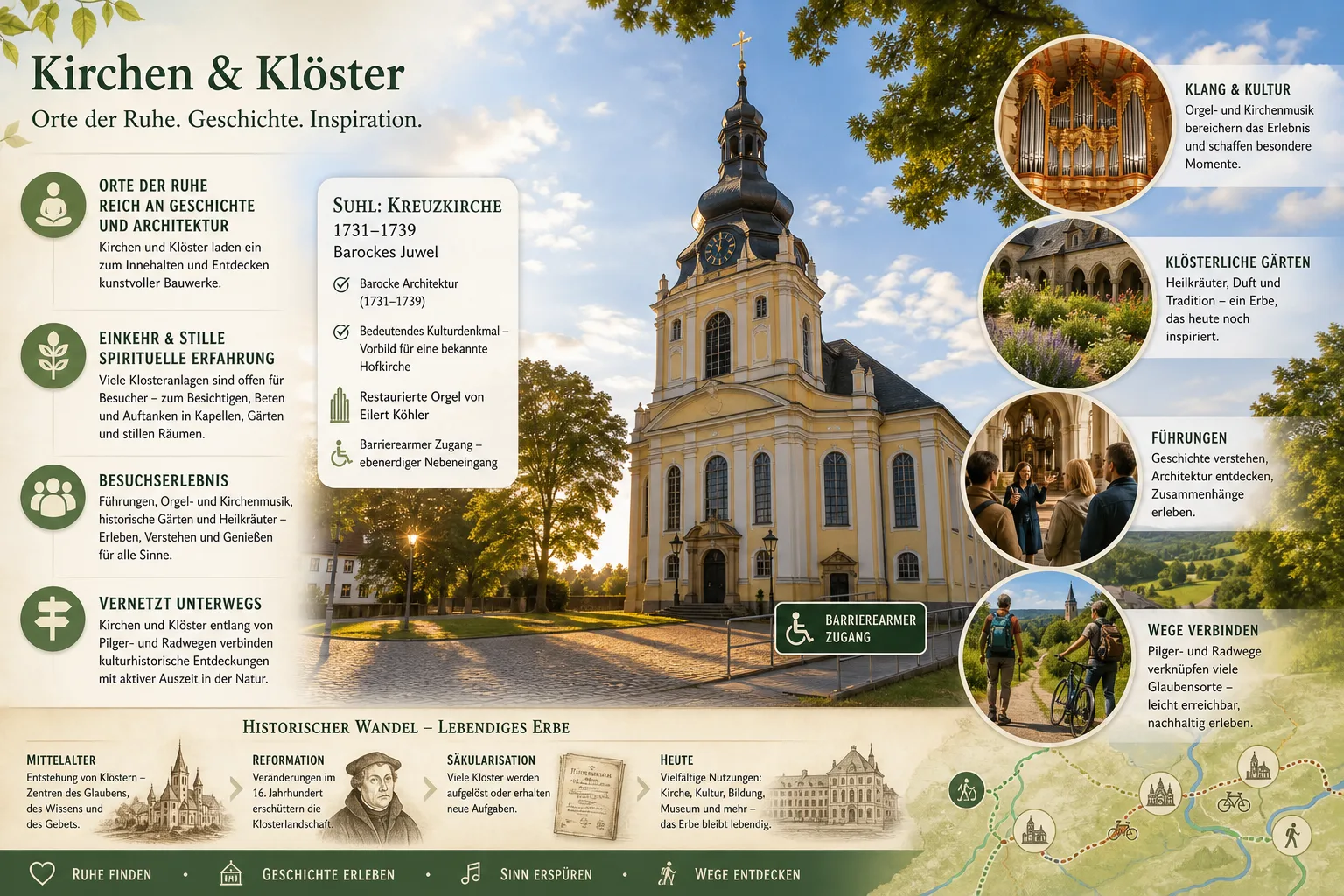
If you are looking for a clear point of orientation in the city area during your next stay, the Kreuzkirche is a particularly obvious starting or stopping point. For many visitors, it is a place where three things can be well combined: a short moment of peace, an eye for design, and – depending on the schedule – a musical experience.
What to Pay Attention to During Your Next Visit
- Spatial effect: Consciously take 5–10 minutes to let the interior “work on you” without any task (not just walk through, but sit).
- Sound & acoustics: If a rehearsal, musical devotion, or concert takes place during your stay, the special acoustics of the room become tangible.
- Access & comfort: Pay attention to signposted entrances and notices on site; many churches are increasingly striving for good accessibility and clear visitor information.
If you visit Suhl in the future with family, as a couple, or alone: church spaces are suitable as a “break without the need to consume” between café, museum, shopping, or hiking stage.
Churches Along the Way: How to Cleverly Combine Your Next Tours in the Thuringian Forest
For your future travel planning, it is especially helpful not to see church visits as a single destination, but as a reliable stopover on a route. Suhl is suitable as a starting point to integrate nature and cultural moments into a day tour.
This Is How the Combination Works in Practice
- Start with a quiet interior: Begin the day with a short church visit – many people find this a “mental arrival.”
- Then movement: Plan a hike or bike ride afterwards; the change from interior to landscape enhances the recovery effect.
- Return in the afternoon/evening: If a cultural event fits (e.g., music), the day can end on a rounded note in a church space.
Important for the future: Since openings, supervision, and program points in many places depend on volunteers and the season, a quick check the day before is often the best “travel hack” for stress-free planning.
Music, Guided Tours, and Education: What You Can Expect at Upcoming Events
Sacred places are expected to continue to be used not only religiously but also culturally in the coming years: through concerts, choir projects, exhibitions, lectures, or thematic tours. For visitors, this is attractive because content is often conveyed in a low-threshold way there.
How to Recognize Suitable Offers in the Calendar
- “Organ”, “Choir”, “Kantorei”: Terms indicating musical events.
- “Open Church”, “Church Open”: Indications of planned visiting times.
- “Guided Tour” / “City Walk”: Offers that can link architecture, symbolism, and local perspectives.
If you attend a future event, it is worth arriving early: You get better seats, more peace – and often the opportunity to briefly ask questions before the start (e.g., about photo rules or the procedure).
Good Manners in Church Spaces: So That Your Next Visit Remains Pleasant for Everyone
Precisely because church spaces can in future simultaneously fulfill spiritual, cultural, and tourist functions, a short “code of conduct” helps:
- Stay quiet and give others space – especially when people are praying or sitting.
- Observe notices (e.g., restricted areas, photo rules, seating areas).
- Appropriate clothing is usually uncomplicated: clean, respectful, not provocative – especially at events.
- Donation boxes are voluntary: A small contribution can help with future maintenance and opening, but is not an entry requirement.