Tech Meetups & Hackathon Events in Suhl
Tech Meetups & Hackathons in Suhl: How Technology Connects People
In Suhl and the surrounding area, new opportunities are emerging where people from administration, business, education, and civil society work together on digital ideas: from open tech meetups to hackathons (short, intensive development formats with a clear problem statement). This article shows which formats are particularly suitable from , how to find suitable dates, and how Suhl can gradually build its own events.
What is a Hackathon (and what is it not)?
A hackathon is a time-limited event (typically: 1–3 days) in which teams work on a clear challenge. At the end, there is usually a short demo or presentation. Important: A hackathon is not a finished product release, but an accelerated test run for ideas.
Typical Process
- Kick-off: Problem statement, rules, schedule, tools.
- Team formation: Teams form around ideas or challenges.
- Build phase: Prototyping, design, data work, concept, tests.
- Mentoring: Feedback on user needs, technology, data protection, pitch.
- Demo Day: Presentation, Q&A, possibly prizes or follow-up program.
Who Can Participate?
Not just developers. People with domain knowledge are especially valuable: administrative practice, club work, education, health, mobility, tourism, production, trade. A strong team combines technology, expertise, and communication.
How to Find Suitable Events (Online & On-site) from Now On
If you are looking for hackathons or tech meetups from , these methods work reliably:
- Community platforms: Meetup, Eventbrite, and LinkedIn Events (search for “Hackathon”, “Civic Tech”, “Open Data”, “AI”, “Web”, “Python”, “DevOps”, “UX” plus “Thuringia”, “Erfurt”, “Suhl”, “Ilmenau”, “Jena”).
- Universities & Research: Event calendars of regional universities (e.g., computer science, data science, or entrepreneurship fields).
- Public sponsors: Digitization and open data initiatives at state or federal level often announce participation formats online.
- Hackathon directories: International lists (e.g., Devpost) – filterable by “online” and time period.
Tip for Suhl: If you are unsure whether a format is reputable, check before registering: organizer’s imprint, terms of participation, data protection information, schedule, mentors/jury, and whether there is a clear topic or a comprehensible challenge list.
Participation and Civic Tech Hackathons: Making Administration More User-Friendly
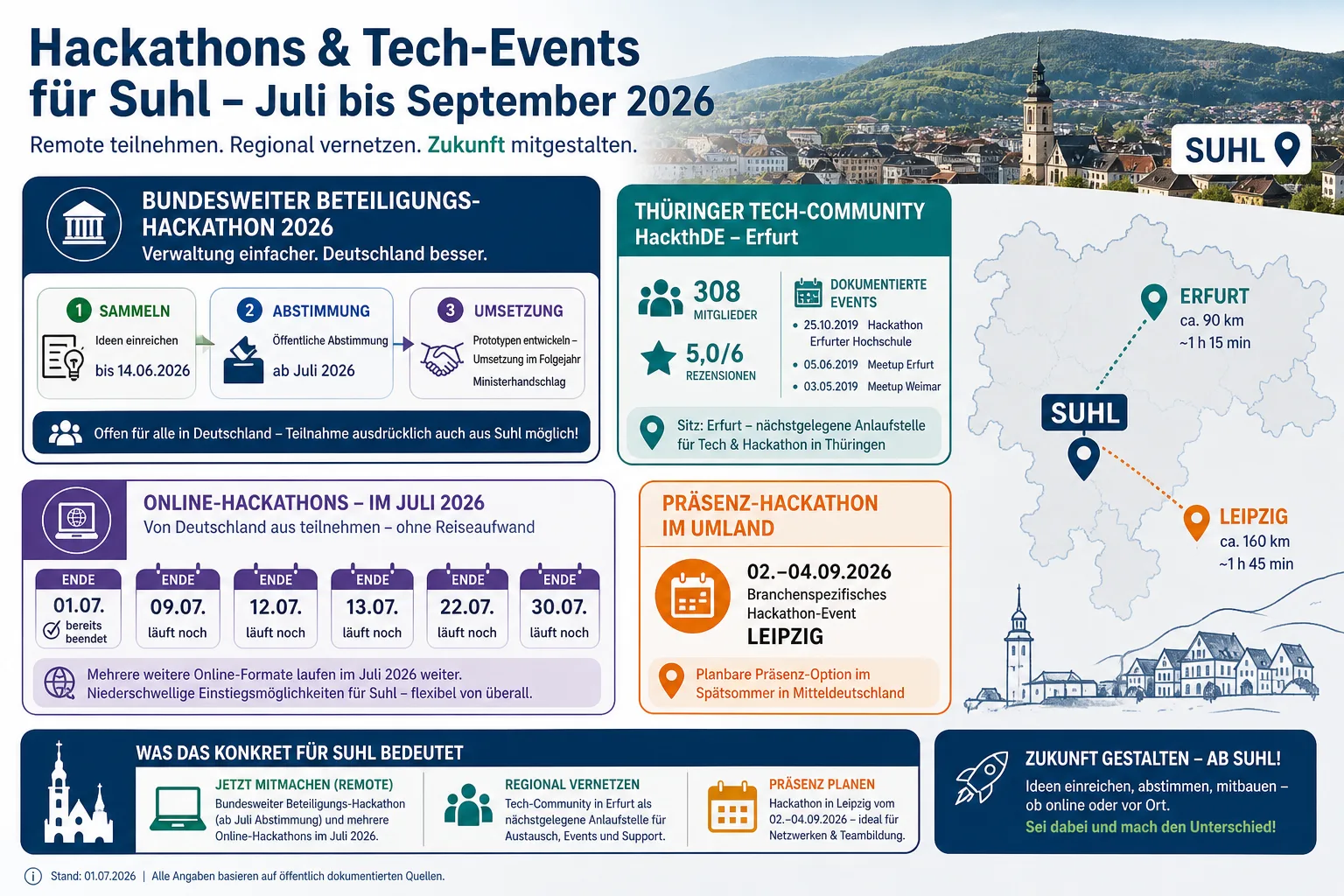
For Suhl, formats that address real everyday problems in contact with authorities, forms, and services are particularly interesting. Such “Civic Tech” or participation hackathons are often possible as online participation – ideal if you don’t want to travel or only have time in the evenings and on weekends.
What is typically sought after:
- Service improvements: clearer steps, shorter paths, better digital user guidance.
- Process ideas: fewer media disruptions, clear responsibilities, better status transparency.
- Data and information access: open data analyses, understandable dashboards, search and help functions.
“The greatest leverage often does not come from a new app, but from clear processes, understandable language, and early user feedback.”
This is how you bring Suhl perspectives in: Collect 3–5 concrete “pain points” in advance (e.g., “Which documents are often missing?”, “Which steps take unnecessarily long?”, “Where is language unclear?”). In hackathons, these details are often more valuable than a perfect code base.
Regional Connections in Thuringia (Erfurt, Weimar & Co.)
Even if not every event takes place in Suhl itself, it is worth looking at the Thuringian community landscape: In larger cities, there are more frequent meetups, labs, and initiatives around software development, open data, and digital participation. These groups are often open to guests from the surrounding area and welcome new co-organizers.
For Suhl, this means: You don’t have to start from scratch. Often it is enough to plan a “spin-off evening” with 2–3 people from an existing community – e.g., a lecture evening with subsequent idea collection or a mini-sprint (4–6 hours) on a local topic.
Good Formats for Getting Started
- Lightning Talks: 5–10 minutes per topic, very low-threshold.
- Show & Tell: small demos (even imperfect), focus on learning.
- Problem Safari: joint collection of local challenges, then prioritization.
- Co-working session: working together on own projects with mutual support.
Practical Plan: How Suhl Can Build Its Own Tech Meetups & Hackathons
If you want to build a sustainable format in Suhl, a clear, realistic process helps. This plan is deliberately designed to work with small resources.
Step 1: Establish a Recurring Meetup (4–8 Weeks)
- Frequency: monthly or every 6 weeks.
- Duration: 90 minutes (e.g., 2 short talks + exchange).
- Target group: technology, design, administration, clubs, students, vocational training/study.
- Rule: “Bring a problem or an idea” – that creates relevance.
Step 2: Mini-Sprint Instead of “Big Hackathon” (1 Day)
Before you plan a weekend with overnight stay, a one-day sprint is easier: define challenges in the morning, prototype in the afternoon, demos in the evening. This way you quickly learn what works on site (room, Wi-Fi, moderation, schedule).
Step 3: Topics That Typically Fit Well in Suhl
- City Center & Visitor Experience: information paths, events, orientation, accessibility.
- Mobility & Travel Chains: understandable information, interfaces, user guidance.
- Volunteering & Clubs: simple digital processes (registration, communication, appointment organization).
- SME Digitization: small, measurable improvements (e.g., data quality, simple automations).
Step 4: Ensure Follow-Up (So Results Don’t Fizzle Out)
A hackathon only has a long-term effect if there is a follow-up routine: a follow-up date in 2–3 weeks, a clear framework of responsibility (who does what?), and a realistic goal (e.g., gather user feedback, test a small pilot, complete documentation). This increases the credibility of the scene and motivates participants to return.
Outlook: Suhl Between Tradition and Digital Future
From the second half of , online and regional formats offer a good opportunity to make new contacts, build skills, and translate local topics into modern development and participation formats. Those who start small and regularly in Suhl can build a visible, reliable community within a few months.
In the end, it’s not just about technology. It’s about collaboration: people who would otherwise hardly meet work together on concrete improvements for everyday life, work, and city life. It is often from this that the ideas that last are born.
Sources & Further Links
- Federal DigitalService — Examples and principles of user-centered digital administration (accessed 2026-07-01)
- Code for Germany — Civic tech network, local initiatives and formats (accessed 2026-07-01)
- UK Government Digital Service: Service Manual — proven guidelines for user-centered digital services (accessed 2026-07-01)
- Devpost — Directory for hackathons (filter by online/time period possible) (accessed 2026-07-01)