
Orchester
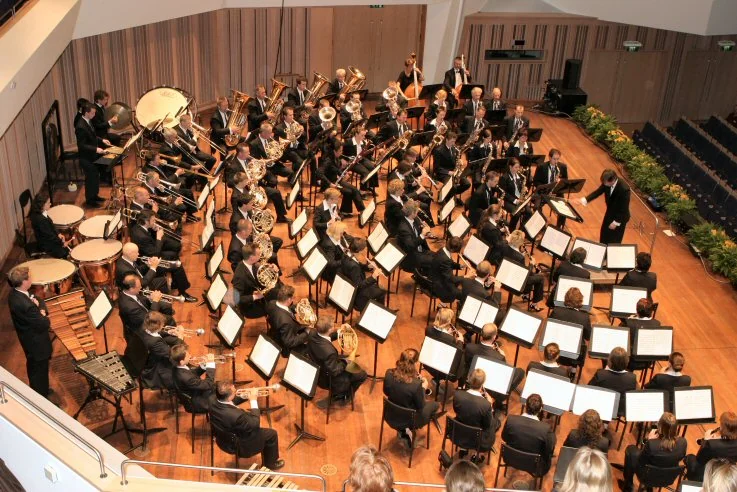
Image from Wikipedia
Image from Wikipedia
Orchestra – the great sound laboratory of music history
An ensemble that transforms sound into architecture
The orchestra has represented the grand form of organized sound art for centuries: an instrumental ensemble where multiple parts are often filled in a choral manner, combining to create a rich, colorful overall sound. In Western musical thought, it is the central stage for symphonic music, opera, concert, and film music, but also for specialized formations like chamber orchestras, string orchestras, wind orchestras, plucked string orchestras, or accordion orchestras. The term also refers to a long tradition in which musical balance, sound transparency, and precise coordination become the essence of the art. (en.wikipedia.org)
Historical roots and musical significance
The origin of the word lies in Greek and initially referred to the dance area in front of a theater stage. From this spatial center, the term evolved throughout music history to represent one of the most complex sound entities. Particularly in European art music, the orchestra became a decisive medium for shaping form, dynamics, contrast, and emotional depth. Even historical overviews emphasize how the modern orchestra developed over centuries from the traditions of opera and instrumental music. (en.wikisource.org)
From accompaniment to an independent art form
In earlier epochs, the orchestra often primarily served the accompaniment of song, dance, or theater. However, with the development of the symphony and the concert forms, it became the center of musical expression itself. The art now consisted not only in the use of individual soloists but in the clever organization of entire groups of instruments, whose interplay creates its own dramaturgy. The orchestra thus became a model of collective precision and aesthetic diversity. (en.wikipedia.org)
Symphony orchestras, chamber orchestras, and specialized ensembles
Classical music primarily distinguishes between the large symphony orchestra and the smaller chamber orchestra. Additionally, there are formations that are organized by instrument groups and possess a very distinct character. A string orchestra relies on the warm, unified sound of strings; a wind orchestra focuses on energy and brilliance; a plucked string orchestra emphasizes rhythmic precision and transparency. This diversity makes the orchestra one of the most flexible forms of musical organization. (en.wikipedia.org)
The career of an institution: how the orchestra finds its role
Although an orchestra does not possess an individual artist biography in the strict sense, its development can be read as a career: from courtly and opera-bound ensembles to an independent concert body. With the emergence of the conductor's profession, the standardization of instrument groups, and the professionalization of rehearsal work, the orchestra gained artistic authority. The stage grew larger, the repertoire requirements became more complex, and the sound language more differentiated. (en.wikipedia.org)
Collaboration as an artistic discipline
The true strength of an orchestra lies in the organization of tension. Woodwinds, brass, strings, and percussion together form an orchestral language that ranges from chamber music finesse to monumental force. This is precisely where the fascination lies: the orchestra combines individual virtuosity with collective discipline, transforming many voices into a single, resonant dramaturgy. For music lovers, this is not just sound but lived coordination at the highest level. (en.wikipedia.org)
The role of the conductor and inner balance
In modern performance practice, the conductor is central to coordination, but the quality of an orchestra also arises from the self-responsibility of the individual groups. Intonation, articulation, tempo, and phrasing must be considered simultaneously for the overall picture to shine. This balance is not mere technique but the core of orchestrational aesthetics. A strong orchestra sounds not only cohesive but organic and breathing. (oxfordspires.anthemtrust.uk)
Discography, repertoire, and reception
As a genre, the orchestra does not have a classical discography in the sense of a single artist with albums and singles. Instead, the repertoire is at the center: symphonies, concertos, overtures, opera versions, ballet music, film music, and contemporary commissioned works. Thus, musical reception is not measured by charts but by recordings, premieres, performance traditions, and the critical evaluation of individual programs or conducting styles. (en.wikipedia.org)
Critical reception between tradition and modernity
Orchestras are often judged in the music press based on their sound, stylistic fidelity, interpretative flexibility, and recording quality. In classical music, it matters not only what is played, but how an ensemble shapes sound spaces, sharpens contrasts, and designs transitions. Orchestras that combine historical performance practice, modern precision, and emotional directness are particularly valued. This creates artistic authority that extends far beyond a single concert. (en.wikipedia.org)
Cultural influence beyond music
The orchestra not only shapes the concert hall but also cinema, media culture, and public perception of music. Few other formations symbolize size, dramaturgy, and collective excellence as much. At the same time, the orchestra conveys an image of cultural continuity: it connects historical masterpieces with new music and shows how alive tradition can be when reformed in professional ensembles. (en.wikipedia.org)
Current projects and contemporary presence
For the general keyword “orchestra,” no specific current publications or projects can be substantiated in the sense of an artist career, as it is a genre designation and not an easily identifiable ensemble. In the present, however, the orchestra remains highly active: seasonal programs, premieres, educational projects, and digital concert formats keep the form relevant. The search results exemplify how orchestras today evolve their role through repertoire maintenance, concert series, and new media. (d3c80vss50ue25.cloudfront.net)
Orchestra as a living institution
Especially in today's cultural landscape, the orchestra is more than a traditional sound ideal. It works project-based, produces recordings, develops education formats, and maintains a close relationship with the audience. This makes its cultural function particularly exciting: it not only preserves a heritage but continuously produces new interpretations. In this dual role lies its enduring relevance. (orchester.ch)
Voices of the fans
For the general keyword “orchestra,” no clearly verified official social media profiles could be identified as a unified artist or brand account. Therefore, this section is deliberately omitted, and no fan quotes or commentary voices are fabricated. The genre orchestra is represented on many channels by individual ensembles, but the sought generic profile remains unconnected. (ndr.de)
Conclusion: Why the orchestra continues to fascinate today
The orchestra is a masterpiece of collective art: technically precise, sonically rich, and historically deeply rooted. It combines composition, arrangement, interpretation, and stage presence in a form that can carry both intimate chamber music and monumental symphonies. Those who experience the energy of a large orchestra live hear not just music, but the breath of an entire tradition in motion. (en.wikipedia.org)
Official channels of Orchestra:
- Instagram: No official profile found
- Facebook: No official profile found
- YouTube: No official profile found
- Spotify: No official profile found
- TikTok: No official profile found
Sources:
- Wikipedia – Orchestra
- Wikipedia – Orchestra
- Oxford Learner’s Dictionaries – orchestra
- Oxford Academic – The Concept of Music, Orchestra
- miz.org – NDR Elbphilharmonie Orchester
- NDR – The NDR Elbphilharmonie Orchestra on Social Networks
- Deutsche Radio Philharmonie – Social Media
- Das Neue Orchester Aachen – Repertoire
- Neues Mannheimer Orchester – Official Website
- Max Raabe & Palast Orchester – Biography
Upcoming Events
O sole mio in Amerang: Opera Arias and Neapolitan Melodies in the Castle
Mediterranean sound colors in Amerang Castle: O sole mio brings opera arias and Neapolitan flair to Chiemgau. 08.08.2026, from 14 €. #LiveMusic
Late Summer Festival: Dresden Residence Orchestra
A summer evening full of sound and Italian joie de vivre at Magdalenenplatz in Plattling: The Dresden Residence Orchestra plays open-air under the Magdalen roof. 08/28/2026, 8:00 PM. #Plattling #Classics
Musical Saturday with Salon Orchestra Melange - Hofstatt
Wasserburg sounds of summer and salon music: Salon Orchestra Melange plays for free in the Hofstatt. Open Air, historic old town, August 29, 2026, 10:30 AM. #Wasserburg #LiveMusic
Coffee Concert in the Castle Courtyard of Bertholdsburg with the Mandolin Orchestra Eisfeld
Mandolin Magic in the Castle: The coffee concert with the Mandolin Orchestra Eisfeld combines historical scenery, coffee, and fine plucked music. #Schleusingen #Live
1st Symphony Concert
Join us as the Philharmonic Orchestra Erfurt opens its new Symphony Concert season. A musical highlight awaits you.
1st Symphony Concert at the Erfurt Theater
Enjoy the season opening concert with classical works by Barber, Liszt, and Beethoven. Join us at the Erfurt Theater!
1st Symphony Concert with Barber, Liszt & Beethoven
The Philharmonic Orchestra of Erfurt presents works by Barber, Liszt, and Beethoven. An evening full of musical masterpieces awaits you.
Concert of the Accordion Orchestra
Visit the unforgettable concert of the accordion orchestra in the Kaufmannskirche, Erfurt. An experience for music lovers!
Concert: Rock Orchestra Ruhrgebeat
On September 5th, the Rock Orchestra Ruhrgebeat takes over the Gelsenkirchen Amphitheater. Look forward to an energetic evening!
MDR Concert: Freischütz in Suhl
Romanticism, choral power, and orchestral colors at the Congress Centrum Suhl: The MDR Concert Freischütz brings Weber to the stage in a great live atmosphere. #Suhl #Classical