
Suhl
98694 Suhl-Schmiedefeld am Rennsteig, Deutschland
Redeemer Church Schmiedefeld | History & Directions
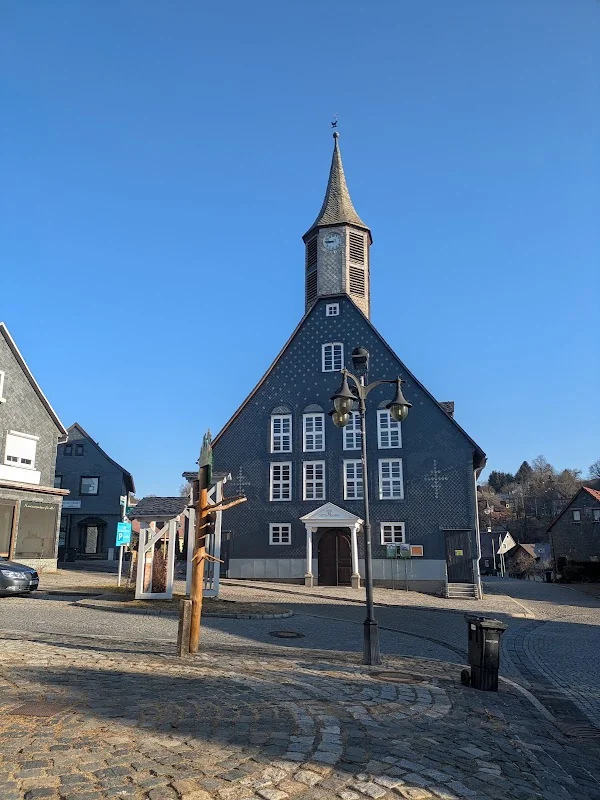
The Redeemer Church in Schmiedefeld am Rennsteig is a place where local history, faith, and landscape meet in a very direct way. Those searching for the church are often looking for more than just a building, but a piece of identity of the high-altitude location in the Thuringian Forest. The Protestant parish describes the Redeemer Church as a half-timbered church in its current form since 1706; at the same time, it belongs to a place whose development is closely linked to mining, craftsmanship, glass industry, musical instrument making, and later tourism. This very mix creates a special charm: Here, there is no large city church in the center of a tight neighborhood, but a historic house of worship in a place that thrives on nature, openness, and regional self-awareness. Schmiedefeld is located directly on the Rennsteig, and thus at an address that many hikers, day-trippers, and those seeking relaxation already know. For visitors, the Redeemer Church is therefore not only religiously interesting but also a very typical symbol of the culture of the Thuringian Forest. ([schmiedefeld.de](https://www.schmiedefeld.de/kirche.php))
The integration into the community is also important: The Schmiedefeld parish consists of Schmiedefeld am Rennsteig and Vesser; the parish area is called Schmiedefeld-Frauenwald. So, anyone searching for the Redeemer Church also finds themselves in a small ecclesiastical network of places, paths, and local references that are crucial for life in the area. Schmiedefeld itself is today a state-recognized resort in the midst of the Thuringian Forest Biosphere Reserve, and the district is explicitly described on the official Suhl website as being located directly on the Rennsteig. Thus, the Redeemer Church is not only a religious building but also a prominent point in a landscape characterized by hiking, winter activities, and excursion traffic. Therefore, anyone searching for history, directions, services, or the peculiarities of a half-timbered church will find here an address with a clear regional imprint and strong authenticity. ([schmiedefeld.de](https://www.schmiedefeld.de/kirche.php))
History of the Redeemer Church in Schmiedefeld am Rennsteig
The history of the Redeemer Church does not begin with the construction of 1706, but much earlier. According to the parish, there was already a simple wooden church at this site since 1572. This early church fell victim to a fire at the end of the 17th century, which places the emergence of the current half-timbered church in a very concrete historical tension: reconstruction after loss, adaptation to the possibilities of the place, and at the same time a new architectural expression. The fact that the current form has existed since 1706 gives the building a remarkable continuity. It is thus a testament to how strongly small church locations carry their history over centuries with their few but significant buildings. For Schmiedefeld, the church is therefore much more than a monument; it is part of the collective memory of the place. The official local history complements this picture: Schmiedefeld was first mentioned in a document in 1406 and owes its development initially to iron ore mining, later to the glass industry and the production of musical instruments. The Redeemer Church stands in the midst of a place that has repeatedly had to respond to change. ([schmiedefeld.de](https://www.schmiedefeld.de/kirche.php))
This very change explains why the church in Schmiedefeld is so strongly connected to local identity. As mining lost significance, the place gained new perspectives through other economic sectors, particularly through glass production and the tradition of instrument making. The official history of the place emphasizes that the production of organs, violins, and zithers was an important source of income for more than 150 years. This is particularly exciting for the Redeemer Church because it connects the sacred space with the craftsmanship culture of the region. A church in a place with such a music and craftsmanship tradition is never just a static building; it is always part of a cultural ecosystem. The fact that Schmiedefeld already attracted its first holidaymakers around the turn of the century and counted many vacation guests in the 1930s also shows how early the place was perceived touristically. The Redeemer Church is therefore a historical focal point in a space that has developed from a mining location to a craft place and now to a resort and excursion destination. ([schmiedefeld.de](https://www.schmiedefeld.de/geschichte-schmiedefeld.php))
Half-timbered Church, Organ, and Architectural Features
The architectural impact of the Redeemer Church lies in its clarity and its integration into the building culture of the Thuringian Forest. The parish explicitly describes it as a half-timbered church, and this form defines its character: not a monumental large building, but a structure that is crafted, regional, and functional. Half-timbering here does not stand for romance in a superficial sense, but for a construction method that is oriented towards climate, material, and available skills. The fact that the church has existed in its current form since 1706 shows that this construction method was not chosen randomly in Schmiedefeld but was sustainably viable. The church is thus a beautiful example of how regional sacred architecture in Thuringia often remains deliberately simple and thereby radiates dignity. Visitors looking for a church landmark with history do not experience a museum-like stagnation here but a living building that still has its place in the community today. Especially in a place that thrives on nature and wide views, this construction method appears harmonious and unpretentious. ([schmiedefeld.de](https://www.schmiedefeld.de/kirche.php))
A remarkable detail is the organ. The parish states that the prospectus was taken from the Dresden Kreuzkirche and that the local organ builders Michael and Johannes Wagner created the instrument. This is noteworthy for two reasons. First, it shows the connection between a regional village church and a supra-regional cultural reference point like the Kreuzkirche in Dresden. Second, it points to the craftsmanship quality of the Schmiedefeld workshop tradition, which is explicitly mentioned in local history. It states that the production of musical instruments such as organs, violins, and zithers was an important source of income for many decades. Thus, the Redeemer Church stands not only for faith but also for music, sound, and local mastery. Anyone searching for the organ as a keyword thus lands on a very concrete regional heritage. Especially in small churches, such furnishing details are often crucial for the character of a space. The organ here is not just an accompaniment for the service but a visible sign that the church stands in a place that was familiar with the construction of musical instruments and could make craftsmanship quality visible. ([schmiedefeld.de](https://www.schmiedefeld.de/kirche.php))
Directions to the Redeemer Church: How to Reach Schmiedefeld am Rennsteig
Those wishing to visit the Redeemer Church will find a clear and very practical set of directions on the official page. From the south, the route leads via Suhl towards Ilmenau, with the page mentioning about ten kilometers uphill. From the north via Gotha, the journey is described via the A4, the Gotha exit, Ohrdruf, and Oberhof, further towards Schmücke and Schmiedefeld until the B4 intersection, and then right on the B4 to Schmiedefeld. For travelers from the north or from Erfurt, Dresden, or Berlin, the parish mentions the A4 to the Erfurter Kreuz, then the A71 to Ilmenau West with the Schmiedefeld am Rennsteig exit, and then the B4 to the place. This is unusually helpful because the page not only names the place itself but also the most important access routes in a region with many high ridges and excursion routes. So anyone searching for directions gets a useful orientation here without wandering in the dark for long. ([schmiedefeld.de](https://www.schmiedefeld.de/anfahrt.php))
For the topic of parking, what the official page does not say is important. It refers to a route map, a route planner, and the local map of Schmiedefeld am Rennsteig as a PDF but does not mention a separate list of visitor parking spaces directly at the church. From this, one can cautiously conclude that while access is clearly regulated, the parking issue is rather resolved through the local structure and individual planning than through a separate, prominently marked church parking area. This is not unusual for a church in a small district. It is therefore sensible to check the route in advance and to consider the town center, the tourist information, and the local paths when visiting. The official page is very consistent at this point: it does not aim to be spectacular but reliable. This is exactly what is valuable for visitors coming from Suhl, Ilmenau, Oberhof, or from the wider Thuringian Forest. The access via B4, A4, and A71 makes the Redeemer Church easily accessible for day-trippers, even though it is located in a very quiet landscape. ([schmiedefeld.de](https://www.schmiedefeld.de/anfahrt.php))
Service, Parish, and Current Community Life
The Redeemer Church is not an isolated monument but part of an active parish. The official website of the Schmiedefeld parish lists the parish office at Marktstraße 1 in Suhl OT Schmiedefeld and points out that the parish consists of Schmiedefeld am Rennsteig and Vesser. It belongs to the parish area Schmiedefeld-Frauenwald. For visitors looking for services, community life, or contact information, this is crucial because the church is thus embedded in a clear ecclesiastical structure. The parish also points out that the next services and further information can be found in the parish newsletter. This is a very typical and reliable way for a rural community to publish current dates. So anyone asking for the event calendar should not assume a classic ticket or schedule logic but rather a lively community life with established ecclesiastical communication channels. ([schmiedefeld.de](https://www.schmiedefeld.de/kirche.php))
The regional embedding of the parish is also important. Schmiedefeld is not only attractive in terms of landscape but also in an area where church, tourism, and everyday life are closely intertwined. On the official local page, topics such as the information center of the biosphere reserve, tourist information, weekly guided hikes, winter offers, and sports equipment rental are mentioned for Schmiedefeld. This shows that visitors in Schmiedefeld do not only see a sacred building but enter a whole network of services and meeting places. For the Redeemer Church, this means: it is part of a village where ecclesiastical, tourist, and cultural paths coexist. Those visiting the church can also learn to understand the place itself. Especially in smaller communities, this is often the real charm: one does not experience church as an enclosed space but as a place of conversation, remembrance, and coming together that is anchored in the village. The Redeemer Church fits very well with search queries about community, services, history, and visits because all these topics are indeed interconnected in Schmiedefeld. ([schmiedefeld.de](https://www.schmiedefeld.de/veranstaltungen.php))
Schmiedefeld am Rennsteig between Rennsteig, Vessertal, and Resort
To truly understand the Redeemer Church, one must also consider Schmiedefeld am Rennsteig as a place. The official city page describes the district as located on the ridge of the Thuringian Forest, directly on Germany's oldest long-distance hiking trail, the Rennsteig. Furthermore, Schmiedefeld is referred to as a state-recognized resort in the midst of the Thuringian Forest Biosphere Reserve. These are not mere image words but formative location factors. For visitors, this means that the church stands in a landscape characterized by nature experiences, tranquility, and movement. Those arriving here usually do not pass by by chance but consciously: as hikers, day-trippers, vacationers, or as someone wanting to get to know the cultural side of the Rennsteig area. The Redeemer Church is a soothing counterpoint to pure nature experiences in this environment and at the same time a sign that even small places possess a long cultural depth. ([suhl.eu](https://www.suhl.eu/ortsteile))
The history of the place enhances this attractiveness. Schmiedefeld was first mentioned in a document in 1406 and initially developed through iron ore mining, which was particularly important for weapon manufacturing in Suhl. Later, the glass industry and musical instrument making were added before tourism gained importance. The local history emphasizes that the first holidaymakers arrived around the turn of the century and that by the mid-1930s, more than 3000 vacation guests had already been counted. This aligns with today's tourist orientation with hiking, Nordic walking, Rennsteig run, and winter offers. The Redeemer Church thus stands in a place that has learned to respond to changing needs over centuries. This also explains why many people today come across the church through search terms like history, Rennsteig, resort, tourist information, or Vesser. It is not only a religious destination but part of a landscape that has historically grown and is well-utilized for tourism. Those staying in Schmiedefeld therefore experience nature, local history, and church architecture in a very harmonious connection within a short distance. ([schmiedefeld.de](https://www.schmiedefeld.de/geschichte-schmiedefeld.php))
Visiting, Surroundings, and Practical Tips for Your Visit
For practical planning, the Redeemer Church is a good address if you are looking for a quiet, culturally rich place in Thuringia. Those planning a visit should keep an eye on the church times and, if in doubt, use the information from the parish, as the official information about services and other dates is communicated through the parish newsletter. This is particularly sensible if you do not just want to pass by the church briefly but want to combine the visit with a walk or a stay in the place. Since Schmiedefeld is located directly on the Rennsteig, the church can be easily integrated into an excursion between the town center, hiking trails, and scenic points. The proximity to the biosphere reserve and the tourist offers of the place make the Redeemer Church attractive for day visitors and hikers without losing its quiet character. This mixture of accessibility and tranquility is a plus point. ([schmiedefeld.de](https://www.schmiedefeld.de/kirche.php))
The surroundings are also interesting for visitors looking for reliable orientation. According to the official local page, Schmiedefeld offers hiking opportunities, Nordic walking, the Rennsteig run, and winter options. Thus, the Redeemer Church serves as a starting or ending point for a small round trip through a place where nature and village culture do not displace each other but complement each other. For people searching for a church with history, this is the decisive added value: you not only get a building but a whole environment with origins, paths, and lively use. Those coming from Suhl, Ilmenau, or the wider Thuringian Forest find clear orientation through the routes described in the directions. Those staying longer can connect the church with local history, the Rennsteig, and the tourist offers. This is precisely what makes the charm of the Redeemer Church in Schmiedefeld am Rennsteig: it is small enough to feel personal and yet rich enough to fulfill multiple search intentions simultaneously in history, architecture, community, and landscape. ([schmiedefeld.de](https://www.schmiedefeld.de/anfahrt.php))
Sources:
Mehr anzeigenWeniger anzeigen
Redeemer Church Schmiedefeld | History & Directions
The Redeemer Church in Schmiedefeld am Rennsteig is a place where local history, faith, and landscape meet in a very direct way. Those searching for the church are often looking for more than just a building, but a piece of identity of the high-altitude location in the Thuringian Forest. The Protestant parish describes the Redeemer Church as a half-timbered church in its current form since 1706; at the same time, it belongs to a place whose development is closely linked to mining, craftsmanship, glass industry, musical instrument making, and later tourism. This very mix creates a special charm: Here, there is no large city church in the center of a tight neighborhood, but a historic house of worship in a place that thrives on nature, openness, and regional self-awareness. Schmiedefeld is located directly on the Rennsteig, and thus at an address that many hikers, day-trippers, and those seeking relaxation already know. For visitors, the Redeemer Church is therefore not only religiously interesting but also a very typical symbol of the culture of the Thuringian Forest. ([schmiedefeld.de](https://www.schmiedefeld.de/kirche.php))
The integration into the community is also important: The Schmiedefeld parish consists of Schmiedefeld am Rennsteig and Vesser; the parish area is called Schmiedefeld-Frauenwald. So, anyone searching for the Redeemer Church also finds themselves in a small ecclesiastical network of places, paths, and local references that are crucial for life in the area. Schmiedefeld itself is today a state-recognized resort in the midst of the Thuringian Forest Biosphere Reserve, and the district is explicitly described on the official Suhl website as being located directly on the Rennsteig. Thus, the Redeemer Church is not only a religious building but also a prominent point in a landscape characterized by hiking, winter activities, and excursion traffic. Therefore, anyone searching for history, directions, services, or the peculiarities of a half-timbered church will find here an address with a clear regional imprint and strong authenticity. ([schmiedefeld.de](https://www.schmiedefeld.de/kirche.php))
History of the Redeemer Church in Schmiedefeld am Rennsteig
The history of the Redeemer Church does not begin with the construction of 1706, but much earlier. According to the parish, there was already a simple wooden church at this site since 1572. This early church fell victim to a fire at the end of the 17th century, which places the emergence of the current half-timbered church in a very concrete historical tension: reconstruction after loss, adaptation to the possibilities of the place, and at the same time a new architectural expression. The fact that the current form has existed since 1706 gives the building a remarkable continuity. It is thus a testament to how strongly small church locations carry their history over centuries with their few but significant buildings. For Schmiedefeld, the church is therefore much more than a monument; it is part of the collective memory of the place. The official local history complements this picture: Schmiedefeld was first mentioned in a document in 1406 and owes its development initially to iron ore mining, later to the glass industry and the production of musical instruments. The Redeemer Church stands in the midst of a place that has repeatedly had to respond to change. ([schmiedefeld.de](https://www.schmiedefeld.de/kirche.php))
This very change explains why the church in Schmiedefeld is so strongly connected to local identity. As mining lost significance, the place gained new perspectives through other economic sectors, particularly through glass production and the tradition of instrument making. The official history of the place emphasizes that the production of organs, violins, and zithers was an important source of income for more than 150 years. This is particularly exciting for the Redeemer Church because it connects the sacred space with the craftsmanship culture of the region. A church in a place with such a music and craftsmanship tradition is never just a static building; it is always part of a cultural ecosystem. The fact that Schmiedefeld already attracted its first holidaymakers around the turn of the century and counted many vacation guests in the 1930s also shows how early the place was perceived touristically. The Redeemer Church is therefore a historical focal point in a space that has developed from a mining location to a craft place and now to a resort and excursion destination. ([schmiedefeld.de](https://www.schmiedefeld.de/geschichte-schmiedefeld.php))
Half-timbered Church, Organ, and Architectural Features
The architectural impact of the Redeemer Church lies in its clarity and its integration into the building culture of the Thuringian Forest. The parish explicitly describes it as a half-timbered church, and this form defines its character: not a monumental large building, but a structure that is crafted, regional, and functional. Half-timbering here does not stand for romance in a superficial sense, but for a construction method that is oriented towards climate, material, and available skills. The fact that the church has existed in its current form since 1706 shows that this construction method was not chosen randomly in Schmiedefeld but was sustainably viable. The church is thus a beautiful example of how regional sacred architecture in Thuringia often remains deliberately simple and thereby radiates dignity. Visitors looking for a church landmark with history do not experience a museum-like stagnation here but a living building that still has its place in the community today. Especially in a place that thrives on nature and wide views, this construction method appears harmonious and unpretentious. ([schmiedefeld.de](https://www.schmiedefeld.de/kirche.php))
A remarkable detail is the organ. The parish states that the prospectus was taken from the Dresden Kreuzkirche and that the local organ builders Michael and Johannes Wagner created the instrument. This is noteworthy for two reasons. First, it shows the connection between a regional village church and a supra-regional cultural reference point like the Kreuzkirche in Dresden. Second, it points to the craftsmanship quality of the Schmiedefeld workshop tradition, which is explicitly mentioned in local history. It states that the production of musical instruments such as organs, violins, and zithers was an important source of income for many decades. Thus, the Redeemer Church stands not only for faith but also for music, sound, and local mastery. Anyone searching for the organ as a keyword thus lands on a very concrete regional heritage. Especially in small churches, such furnishing details are often crucial for the character of a space. The organ here is not just an accompaniment for the service but a visible sign that the church stands in a place that was familiar with the construction of musical instruments and could make craftsmanship quality visible. ([schmiedefeld.de](https://www.schmiedefeld.de/kirche.php))
Directions to the Redeemer Church: How to Reach Schmiedefeld am Rennsteig
Those wishing to visit the Redeemer Church will find a clear and very practical set of directions on the official page. From the south, the route leads via Suhl towards Ilmenau, with the page mentioning about ten kilometers uphill. From the north via Gotha, the journey is described via the A4, the Gotha exit, Ohrdruf, and Oberhof, further towards Schmücke and Schmiedefeld until the B4 intersection, and then right on the B4 to Schmiedefeld. For travelers from the north or from Erfurt, Dresden, or Berlin, the parish mentions the A4 to the Erfurter Kreuz, then the A71 to Ilmenau West with the Schmiedefeld am Rennsteig exit, and then the B4 to the place. This is unusually helpful because the page not only names the place itself but also the most important access routes in a region with many high ridges and excursion routes. So anyone searching for directions gets a useful orientation here without wandering in the dark for long. ([schmiedefeld.de](https://www.schmiedefeld.de/anfahrt.php))
For the topic of parking, what the official page does not say is important. It refers to a route map, a route planner, and the local map of Schmiedefeld am Rennsteig as a PDF but does not mention a separate list of visitor parking spaces directly at the church. From this, one can cautiously conclude that while access is clearly regulated, the parking issue is rather resolved through the local structure and individual planning than through a separate, prominently marked church parking area. This is not unusual for a church in a small district. It is therefore sensible to check the route in advance and to consider the town center, the tourist information, and the local paths when visiting. The official page is very consistent at this point: it does not aim to be spectacular but reliable. This is exactly what is valuable for visitors coming from Suhl, Ilmenau, Oberhof, or from the wider Thuringian Forest. The access via B4, A4, and A71 makes the Redeemer Church easily accessible for day-trippers, even though it is located in a very quiet landscape. ([schmiedefeld.de](https://www.schmiedefeld.de/anfahrt.php))
Service, Parish, and Current Community Life
The Redeemer Church is not an isolated monument but part of an active parish. The official website of the Schmiedefeld parish lists the parish office at Marktstraße 1 in Suhl OT Schmiedefeld and points out that the parish consists of Schmiedefeld am Rennsteig and Vesser. It belongs to the parish area Schmiedefeld-Frauenwald. For visitors looking for services, community life, or contact information, this is crucial because the church is thus embedded in a clear ecclesiastical structure. The parish also points out that the next services and further information can be found in the parish newsletter. This is a very typical and reliable way for a rural community to publish current dates. So anyone asking for the event calendar should not assume a classic ticket or schedule logic but rather a lively community life with established ecclesiastical communication channels. ([schmiedefeld.de](https://www.schmiedefeld.de/kirche.php))
The regional embedding of the parish is also important. Schmiedefeld is not only attractive in terms of landscape but also in an area where church, tourism, and everyday life are closely intertwined. On the official local page, topics such as the information center of the biosphere reserve, tourist information, weekly guided hikes, winter offers, and sports equipment rental are mentioned for Schmiedefeld. This shows that visitors in Schmiedefeld do not only see a sacred building but enter a whole network of services and meeting places. For the Redeemer Church, this means: it is part of a village where ecclesiastical, tourist, and cultural paths coexist. Those visiting the church can also learn to understand the place itself. Especially in smaller communities, this is often the real charm: one does not experience church as an enclosed space but as a place of conversation, remembrance, and coming together that is anchored in the village. The Redeemer Church fits very well with search queries about community, services, history, and visits because all these topics are indeed interconnected in Schmiedefeld. ([schmiedefeld.de](https://www.schmiedefeld.de/veranstaltungen.php))
Schmiedefeld am Rennsteig between Rennsteig, Vessertal, and Resort
To truly understand the Redeemer Church, one must also consider Schmiedefeld am Rennsteig as a place. The official city page describes the district as located on the ridge of the Thuringian Forest, directly on Germany's oldest long-distance hiking trail, the Rennsteig. Furthermore, Schmiedefeld is referred to as a state-recognized resort in the midst of the Thuringian Forest Biosphere Reserve. These are not mere image words but formative location factors. For visitors, this means that the church stands in a landscape characterized by nature experiences, tranquility, and movement. Those arriving here usually do not pass by by chance but consciously: as hikers, day-trippers, vacationers, or as someone wanting to get to know the cultural side of the Rennsteig area. The Redeemer Church is a soothing counterpoint to pure nature experiences in this environment and at the same time a sign that even small places possess a long cultural depth. ([suhl.eu](https://www.suhl.eu/ortsteile))
The history of the place enhances this attractiveness. Schmiedefeld was first mentioned in a document in 1406 and initially developed through iron ore mining, which was particularly important for weapon manufacturing in Suhl. Later, the glass industry and musical instrument making were added before tourism gained importance. The local history emphasizes that the first holidaymakers arrived around the turn of the century and that by the mid-1930s, more than 3000 vacation guests had already been counted. This aligns with today's tourist orientation with hiking, Nordic walking, Rennsteig run, and winter offers. The Redeemer Church thus stands in a place that has learned to respond to changing needs over centuries. This also explains why many people today come across the church through search terms like history, Rennsteig, resort, tourist information, or Vesser. It is not only a religious destination but part of a landscape that has historically grown and is well-utilized for tourism. Those staying in Schmiedefeld therefore experience nature, local history, and church architecture in a very harmonious connection within a short distance. ([schmiedefeld.de](https://www.schmiedefeld.de/geschichte-schmiedefeld.php))
Visiting, Surroundings, and Practical Tips for Your Visit
For practical planning, the Redeemer Church is a good address if you are looking for a quiet, culturally rich place in Thuringia. Those planning a visit should keep an eye on the church times and, if in doubt, use the information from the parish, as the official information about services and other dates is communicated through the parish newsletter. This is particularly sensible if you do not just want to pass by the church briefly but want to combine the visit with a walk or a stay in the place. Since Schmiedefeld is located directly on the Rennsteig, the church can be easily integrated into an excursion between the town center, hiking trails, and scenic points. The proximity to the biosphere reserve and the tourist offers of the place make the Redeemer Church attractive for day visitors and hikers without losing its quiet character. This mixture of accessibility and tranquility is a plus point. ([schmiedefeld.de](https://www.schmiedefeld.de/kirche.php))
The surroundings are also interesting for visitors looking for reliable orientation. According to the official local page, Schmiedefeld offers hiking opportunities, Nordic walking, the Rennsteig run, and winter options. Thus, the Redeemer Church serves as a starting or ending point for a small round trip through a place where nature and village culture do not displace each other but complement each other. For people searching for a church with history, this is the decisive added value: you not only get a building but a whole environment with origins, paths, and lively use. Those coming from Suhl, Ilmenau, or the wider Thuringian Forest find clear orientation through the routes described in the directions. Those staying longer can connect the church with local history, the Rennsteig, and the tourist offers. This is precisely what makes the charm of the Redeemer Church in Schmiedefeld am Rennsteig: it is small enough to feel personal and yet rich enough to fulfill multiple search intentions simultaneously in history, architecture, community, and landscape. ([schmiedefeld.de](https://www.schmiedefeld.de/anfahrt.php))
Sources:
Redeemer Church Schmiedefeld | History & Directions
The Redeemer Church in Schmiedefeld am Rennsteig is a place where local history, faith, and landscape meet in a very direct way. Those searching for the church are often looking for more than just a building, but a piece of identity of the high-altitude location in the Thuringian Forest. The Protestant parish describes the Redeemer Church as a half-timbered church in its current form since 1706; at the same time, it belongs to a place whose development is closely linked to mining, craftsmanship, glass industry, musical instrument making, and later tourism. This very mix creates a special charm: Here, there is no large city church in the center of a tight neighborhood, but a historic house of worship in a place that thrives on nature, openness, and regional self-awareness. Schmiedefeld is located directly on the Rennsteig, and thus at an address that many hikers, day-trippers, and those seeking relaxation already know. For visitors, the Redeemer Church is therefore not only religiously interesting but also a very typical symbol of the culture of the Thuringian Forest. ([schmiedefeld.de](https://www.schmiedefeld.de/kirche.php))
The integration into the community is also important: The Schmiedefeld parish consists of Schmiedefeld am Rennsteig and Vesser; the parish area is called Schmiedefeld-Frauenwald. So, anyone searching for the Redeemer Church also finds themselves in a small ecclesiastical network of places, paths, and local references that are crucial for life in the area. Schmiedefeld itself is today a state-recognized resort in the midst of the Thuringian Forest Biosphere Reserve, and the district is explicitly described on the official Suhl website as being located directly on the Rennsteig. Thus, the Redeemer Church is not only a religious building but also a prominent point in a landscape characterized by hiking, winter activities, and excursion traffic. Therefore, anyone searching for history, directions, services, or the peculiarities of a half-timbered church will find here an address with a clear regional imprint and strong authenticity. ([schmiedefeld.de](https://www.schmiedefeld.de/kirche.php))
History of the Redeemer Church in Schmiedefeld am Rennsteig
The history of the Redeemer Church does not begin with the construction of 1706, but much earlier. According to the parish, there was already a simple wooden church at this site since 1572. This early church fell victim to a fire at the end of the 17th century, which places the emergence of the current half-timbered church in a very concrete historical tension: reconstruction after loss, adaptation to the possibilities of the place, and at the same time a new architectural expression. The fact that the current form has existed since 1706 gives the building a remarkable continuity. It is thus a testament to how strongly small church locations carry their history over centuries with their few but significant buildings. For Schmiedefeld, the church is therefore much more than a monument; it is part of the collective memory of the place. The official local history complements this picture: Schmiedefeld was first mentioned in a document in 1406 and owes its development initially to iron ore mining, later to the glass industry and the production of musical instruments. The Redeemer Church stands in the midst of a place that has repeatedly had to respond to change. ([schmiedefeld.de](https://www.schmiedefeld.de/kirche.php))
This very change explains why the church in Schmiedefeld is so strongly connected to local identity. As mining lost significance, the place gained new perspectives through other economic sectors, particularly through glass production and the tradition of instrument making. The official history of the place emphasizes that the production of organs, violins, and zithers was an important source of income for more than 150 years. This is particularly exciting for the Redeemer Church because it connects the sacred space with the craftsmanship culture of the region. A church in a place with such a music and craftsmanship tradition is never just a static building; it is always part of a cultural ecosystem. The fact that Schmiedefeld already attracted its first holidaymakers around the turn of the century and counted many vacation guests in the 1930s also shows how early the place was perceived touristically. The Redeemer Church is therefore a historical focal point in a space that has developed from a mining location to a craft place and now to a resort and excursion destination. ([schmiedefeld.de](https://www.schmiedefeld.de/geschichte-schmiedefeld.php))
Half-timbered Church, Organ, and Architectural Features
The architectural impact of the Redeemer Church lies in its clarity and its integration into the building culture of the Thuringian Forest. The parish explicitly describes it as a half-timbered church, and this form defines its character: not a monumental large building, but a structure that is crafted, regional, and functional. Half-timbering here does not stand for romance in a superficial sense, but for a construction method that is oriented towards climate, material, and available skills. The fact that the church has existed in its current form since 1706 shows that this construction method was not chosen randomly in Schmiedefeld but was sustainably viable. The church is thus a beautiful example of how regional sacred architecture in Thuringia often remains deliberately simple and thereby radiates dignity. Visitors looking for a church landmark with history do not experience a museum-like stagnation here but a living building that still has its place in the community today. Especially in a place that thrives on nature and wide views, this construction method appears harmonious and unpretentious. ([schmiedefeld.de](https://www.schmiedefeld.de/kirche.php))
A remarkable detail is the organ. The parish states that the prospectus was taken from the Dresden Kreuzkirche and that the local organ builders Michael and Johannes Wagner created the instrument. This is noteworthy for two reasons. First, it shows the connection between a regional village church and a supra-regional cultural reference point like the Kreuzkirche in Dresden. Second, it points to the craftsmanship quality of the Schmiedefeld workshop tradition, which is explicitly mentioned in local history. It states that the production of musical instruments such as organs, violins, and zithers was an important source of income for many decades. Thus, the Redeemer Church stands not only for faith but also for music, sound, and local mastery. Anyone searching for the organ as a keyword thus lands on a very concrete regional heritage. Especially in small churches, such furnishing details are often crucial for the character of a space. The organ here is not just an accompaniment for the service but a visible sign that the church stands in a place that was familiar with the construction of musical instruments and could make craftsmanship quality visible. ([schmiedefeld.de](https://www.schmiedefeld.de/kirche.php))
Directions to the Redeemer Church: How to Reach Schmiedefeld am Rennsteig
Those wishing to visit the Redeemer Church will find a clear and very practical set of directions on the official page. From the south, the route leads via Suhl towards Ilmenau, with the page mentioning about ten kilometers uphill. From the north via Gotha, the journey is described via the A4, the Gotha exit, Ohrdruf, and Oberhof, further towards Schmücke and Schmiedefeld until the B4 intersection, and then right on the B4 to Schmiedefeld. For travelers from the north or from Erfurt, Dresden, or Berlin, the parish mentions the A4 to the Erfurter Kreuz, then the A71 to Ilmenau West with the Schmiedefeld am Rennsteig exit, and then the B4 to the place. This is unusually helpful because the page not only names the place itself but also the most important access routes in a region with many high ridges and excursion routes. So anyone searching for directions gets a useful orientation here without wandering in the dark for long. ([schmiedefeld.de](https://www.schmiedefeld.de/anfahrt.php))
For the topic of parking, what the official page does not say is important. It refers to a route map, a route planner, and the local map of Schmiedefeld am Rennsteig as a PDF but does not mention a separate list of visitor parking spaces directly at the church. From this, one can cautiously conclude that while access is clearly regulated, the parking issue is rather resolved through the local structure and individual planning than through a separate, prominently marked church parking area. This is not unusual for a church in a small district. It is therefore sensible to check the route in advance and to consider the town center, the tourist information, and the local paths when visiting. The official page is very consistent at this point: it does not aim to be spectacular but reliable. This is exactly what is valuable for visitors coming from Suhl, Ilmenau, Oberhof, or from the wider Thuringian Forest. The access via B4, A4, and A71 makes the Redeemer Church easily accessible for day-trippers, even though it is located in a very quiet landscape. ([schmiedefeld.de](https://www.schmiedefeld.de/anfahrt.php))
Service, Parish, and Current Community Life
The Redeemer Church is not an isolated monument but part of an active parish. The official website of the Schmiedefeld parish lists the parish office at Marktstraße 1 in Suhl OT Schmiedefeld and points out that the parish consists of Schmiedefeld am Rennsteig and Vesser. It belongs to the parish area Schmiedefeld-Frauenwald. For visitors looking for services, community life, or contact information, this is crucial because the church is thus embedded in a clear ecclesiastical structure. The parish also points out that the next services and further information can be found in the parish newsletter. This is a very typical and reliable way for a rural community to publish current dates. So anyone asking for the event calendar should not assume a classic ticket or schedule logic but rather a lively community life with established ecclesiastical communication channels. ([schmiedefeld.de](https://www.schmiedefeld.de/kirche.php))
The regional embedding of the parish is also important. Schmiedefeld is not only attractive in terms of landscape but also in an area where church, tourism, and everyday life are closely intertwined. On the official local page, topics such as the information center of the biosphere reserve, tourist information, weekly guided hikes, winter offers, and sports equipment rental are mentioned for Schmiedefeld. This shows that visitors in Schmiedefeld do not only see a sacred building but enter a whole network of services and meeting places. For the Redeemer Church, this means: it is part of a village where ecclesiastical, tourist, and cultural paths coexist. Those visiting the church can also learn to understand the place itself. Especially in smaller communities, this is often the real charm: one does not experience church as an enclosed space but as a place of conversation, remembrance, and coming together that is anchored in the village. The Redeemer Church fits very well with search queries about community, services, history, and visits because all these topics are indeed interconnected in Schmiedefeld. ([schmiedefeld.de](https://www.schmiedefeld.de/veranstaltungen.php))
Schmiedefeld am Rennsteig between Rennsteig, Vessertal, and Resort
To truly understand the Redeemer Church, one must also consider Schmiedefeld am Rennsteig as a place. The official city page describes the district as located on the ridge of the Thuringian Forest, directly on Germany's oldest long-distance hiking trail, the Rennsteig. Furthermore, Schmiedefeld is referred to as a state-recognized resort in the midst of the Thuringian Forest Biosphere Reserve. These are not mere image words but formative location factors. For visitors, this means that the church stands in a landscape characterized by nature experiences, tranquility, and movement. Those arriving here usually do not pass by by chance but consciously: as hikers, day-trippers, vacationers, or as someone wanting to get to know the cultural side of the Rennsteig area. The Redeemer Church is a soothing counterpoint to pure nature experiences in this environment and at the same time a sign that even small places possess a long cultural depth. ([suhl.eu](https://www.suhl.eu/ortsteile))
The history of the place enhances this attractiveness. Schmiedefeld was first mentioned in a document in 1406 and initially developed through iron ore mining, which was particularly important for weapon manufacturing in Suhl. Later, the glass industry and musical instrument making were added before tourism gained importance. The local history emphasizes that the first holidaymakers arrived around the turn of the century and that by the mid-1930s, more than 3000 vacation guests had already been counted. This aligns with today's tourist orientation with hiking, Nordic walking, Rennsteig run, and winter offers. The Redeemer Church thus stands in a place that has learned to respond to changing needs over centuries. This also explains why many people today come across the church through search terms like history, Rennsteig, resort, tourist information, or Vesser. It is not only a religious destination but part of a landscape that has historically grown and is well-utilized for tourism. Those staying in Schmiedefeld therefore experience nature, local history, and church architecture in a very harmonious connection within a short distance. ([schmiedefeld.de](https://www.schmiedefeld.de/geschichte-schmiedefeld.php))
Visiting, Surroundings, and Practical Tips for Your Visit
For practical planning, the Redeemer Church is a good address if you are looking for a quiet, culturally rich place in Thuringia. Those planning a visit should keep an eye on the church times and, if in doubt, use the information from the parish, as the official information about services and other dates is communicated through the parish newsletter. This is particularly sensible if you do not just want to pass by the church briefly but want to combine the visit with a walk or a stay in the place. Since Schmiedefeld is located directly on the Rennsteig, the church can be easily integrated into an excursion between the town center, hiking trails, and scenic points. The proximity to the biosphere reserve and the tourist offers of the place make the Redeemer Church attractive for day visitors and hikers without losing its quiet character. This mixture of accessibility and tranquility is a plus point. ([schmiedefeld.de](https://www.schmiedefeld.de/kirche.php))
The surroundings are also interesting for visitors looking for reliable orientation. According to the official local page, Schmiedefeld offers hiking opportunities, Nordic walking, the Rennsteig run, and winter options. Thus, the Redeemer Church serves as a starting or ending point for a small round trip through a place where nature and village culture do not displace each other but complement each other. For people searching for a church with history, this is the decisive added value: you not only get a building but a whole environment with origins, paths, and lively use. Those coming from Suhl, Ilmenau, or the wider Thuringian Forest find clear orientation through the routes described in the directions. Those staying longer can connect the church with local history, the Rennsteig, and the tourist offers. This is precisely what makes the charm of the Redeemer Church in Schmiedefeld am Rennsteig: it is small enough to feel personal and yet rich enough to fulfill multiple search intentions simultaneously in history, architecture, community, and landscape. ([schmiedefeld.de](https://www.schmiedefeld.de/anfahrt.php))
Sources:
Frequently Asked Questions
Reviews
No reviews found