
Zella-Mehlis
Kirchengemeinde, Hauptstraße 5, 98544 Zella-Mehlis, Deutschland
Magdalenenkirche in Mehlis | History & Services
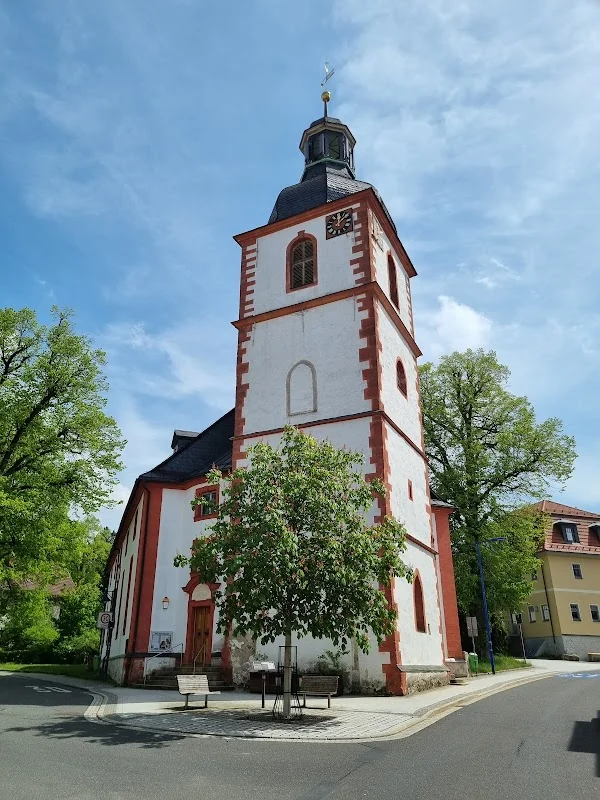
The Magdalenenkirche in Mehlis is one of the defining places of Protestant life in Zella-Mehlis and is also a strong example of how historical building substance and vibrant community work can interact. Those searching for the church will not find a representative large building, but rather a deliberately simple house of worship with a clear impact, a distinctive tower, and a location that intrudes into the everyday life of the town. This mixture of restraint, history, and presence makes it particularly interesting for visitors. The church is not only fascinating for people interested in sacred architecture but also for anyone looking for an authentic place with regional identity, church tradition, and a noticeably open community life. The Magdalenenkirche thus serves as a place for the search for history as well as for the search for peace, music, and encounters. Additionally, it is closely linked to the development of Mehlis and the later town of Zella-Mehlis, as the current community continues the history of two places and still maintains ties to both ecclesiastical reference points. Therefore, the Magdalenenkirche represents not just a building but an ongoing piece of local and faith history that continues to unfold in stone, music, and regular events to this day. ([evangelische-kirche-zella-mehlis.de](https://www.evangelische-kirche-zella-mehlis.de/unsere-kirchen/magdalenenkirche/))
History, Architectural History, and Early Roots in Mehlis
The history of the Magdalenenkirche begins well before the baroque church nave that shapes the townscape today. According to tradition, the region already had a church almost everywhere around 1190; although no direct entry is mentioned for Mehlis, the preserved altar space on the ground floor of the tower is considered the oldest visible witness of an early house of worship. This core structure is dated to the late 12th to early 13th century, making the church one of the rare places where early sacred history can still be directly read. Particularly noteworthy is that this part of the tower is not only interesting archaeologically or architecturally but has preserved a genuine memory of the place to this day. According to the community, it was once even possible for foreign monks or the Benedictines from Zella St. Blasii to proclaim the word of God to the people of Mehlis here. This points to an early ecclesiastical history in which Mehlis was already integrated into a regional religious network. Between 1621 and 1623, a new building was erected in place of the older church, which was consecrated on October 17, 1623; it was two stories high, constructed of solid stone below and half-timbered with clay above. As the community grew and the building became dilapidated, another new beginning began: On June 29, 1734, the foundation stone for the current church nave was laid, the shell construction with a slate roof was completed the following year, and the consecration took place on Palm Sunday 1741. The old building was then demolished, while the tower had already been raised in 1730 to accommodate the current bell chamber and received its baroque dome with lantern. Even later, the church remained a building in motion: During the renovation in 1929/30, the altar space in the tower was uncovered again, and more recently, the tower, roof, outer walls, northeast wall, and heating were gradually renewed. Thus, the Magdalenenkirche shows a rarely clear sequence of early times, reconstruction, baroque form, and careful restoration that remains readable to this day. ([evangelische-kirche-zella-mehlis.de](https://www.evangelische-kirche-zella-mehlis.de/unsere-kirchen/magdalenenkirche/))
Services, Community Life, and Opening Hours
The Magdalenenkirche is still an active community space and not a decommissioned monument. The official profile page of the Protestant Church in Central Germany explicitly states that services are held regularly here, and the current page of the community shows how broadly life around the church is organized. A particularly accessible offering is the weekly opening hours: Every Wednesday from 10 a.m. to 12 p.m., the church opens its doors, allowing visitors to experience the space in peace. During this time, a small exhibition by the Zella-Mehlis art circle can be viewed, and the sound of the organ can be heard. This is more than just a pure sightseeing opportunity because the visit immediately gains a cultural and spiritual dimension. Therefore, those looking for a date such as service, program, or opening hours will find not only architecture here but also a concretely experienceable rhythm of community life. The community also continuously publishes dates for devotions, musical services, and special celebrations in the Magdalenenkirche, such as communion vespers or festive services. Church music also plays an important role: The choir of the community shapes services on major holidays and special occasions and regularly gives concerts. Thus, the Magdalenenkirche does not appear as a closed space of remembrance but as a place where faith, music, and community actually take place. For visitors, this is a great advantage, as one can not only look at the church but also experience it in the sound of its organ, in the atmosphere of a service, or within the framework of an exhibition with a suitable appointment. This openness makes the Magdalenenkirche particularly relevant for many inquiries about events, services, and church community. ([ekmd.de](https://www.ekmd.de/kirche/kirchenkreise/meiningen/zella-mehlis-oberhof/zella-mehlis/magdalenenkirche-in-mehlis?utm_source=openai))
Address, Location, and Directions to the Magdalenenkirche
Those wishing to visit the Magdalenenkirche in Mehlis will find it very straightforward: The official profile page states the address Hauptstraße 5, 98544 Zella-Mehlis, and describes the location directly on the main road of Mehlis. This is important for orientation because the church remains well perceivable in the everyday and townscape and is suitable for both a short stop and a planned visit. The location on a central traffic axis also explains why the Magdalenenkirche is perceived by many as a distinctive reference point in the historical part of the town. It is not hidden at the edge but right in the area where everyday life, local history, and ecclesiastical identity meet. The EKM profile page also points out a public toilet within 100 meters, which is particularly pleasant for families, older visitors, or guests on a tour. Those traveling with a group, by bicycle, or as part of a small city exploration thus have a reliable reference point for planning. Specific parking information is not highlighted in detail on the found official pages, so for larger groups or events, a quick call to the parish office is the safest solution if precise travel planning is desired. Regardless, the address remains easy to remember and the location easy to find. A look at community development is also helpful: Zella-Mehlis was formed in 1919 from the two independent places Zella and Mehlis, and the Magdalenenkirche, together with the St. Blasii church, remains one of the two ecclesiastical reference points of the town to this day. Therefore, those searching for address, directions, or Mehlis will find a clearly located and historically grown place here. ([ekmd.de](https://www.ekmd.de/kirche/kirchenkreise/meiningen/zella-mehlis-oberhof/zella-mehlis/magdalenenkirche-in-mehlis?utm_source=openai))
Organ, Interior, and Listed Equipment
Architecturally, the Magdalenenkirche thrives on deliberate simplicity. The community page describes it as an outwardly sober building without much ornamentation, whose white walls and long black slate roof create a serious, clear impression. This is precisely where its strength lies: The church does not aim to impress through overload but through form, proportion, and history. The tower rises broad and powerful from the town's roofline, giving the building a silhouette that is immediately recognizable. Inside, the space opens up with galleries that lead the eye to the altar and further to the organ. Particularly striking is the carved, colored organ prospect that harmoniously integrates into the nave and the vaulted ceiling. An interesting detail is that the central part of this prospect still comes from the predecessor organ, thus preserving a material connection between the construction phases. The current organ was built in 1885 by Guido Knauf from Gotha, has been modified several times since, and now has 30 speaking stops on two manuals and pedals. For music lovers, this is an important note, as the Magdalenenkirche thus holds significance not only as a monument but also as a sounding space. The church is also an example of how careful maintenance keeps historical buildings alive. In recent years, the church tower has been secured and restored; afterward, the roof and outer walls received thorough renewal, the northeast wall was redesigned, and a heating system was added. Thus, the building does not remain in a state of mere preservation but is functionally reused. Visitors therefore experience a space where historical substance, preservation work, and church life visibly come together. The combination of a calm interior, clear exterior, and musical equipment makes the Magdalenenkirche particularly relevant for inquiries about organ, interior, and special equipment. ([evangelische-kirche-zella-mehlis.de](https://www.evangelische-kirche-zella-mehlis.de/unsere-kirchen/magdalenenkirche/))
Guided Tours, Exhibitions, and Special Events
Those who wish to not only see the Magdalenenkirche but truly understand it have good opportunities to do so. The EKM profile explicitly mentions visits upon request, a printed church guide, as well as special events such as concerts or exhibitions. This means the church is not limited to a single form of use but offers different access points for different visitor groups. Those interested in architectural history can thus learn more specifically; those coming from a cultural interest can experience the church in the context of an exhibition or concert; and those seeking a spiritual visit will find the space in a service or devotion. The current community page beautifully shows what this looks like in practice: Every Wednesday from 10 a.m. to 12 p.m., the church is open, during which time one can view a small exhibition by the Zella-Mehlis art circle and listen to the organ. This is a strong argument for spontaneous visitors, as it provides an easy, direct access without much organizational effort. Additionally, the community continuously lists special dates in the Magdalenenkirche, including communion vespers, musical devotions, and services with choir participation. For the search terms events, program, or church music, this is particularly relevant, as the church regularly appears in the community calendar. Even for visitors with little time, the Magdalenenkirche is interesting: Even a short stay conveys an impression of space, sound, and history. Those who bring more time can discover the details of the tower, the baroque construction phase, the organ, and the later renovation in peace one after the other. The combination of guided tours, exhibitions, and musical use ensures that the Magdalenenkirche does not have to be described merely as a historical object but as a living place that can be experienced anew time and again. This openness makes it attractive for guests from the region and for travelers seeking an authentic church visit. ([ekmd.de](https://www.ekmd.de/kirche/kirchenkreise/meiningen/zella-mehlis-oberhof/zella-mehlis/magdalenenkirche-in-mehlis?utm_source=openai))
Church Community Zella-Mehlis, Contact, and Visiting Tips
The Magdalenenkirche is closely connected to the Zella-Mehlis church community, which was formed in 1972 from the previously independent congregations. To this day, the Magdalenenkirche in Mehlis and the St. Blasii church in Zella remain the two central reference points of this community. This is useful for visitors because the ecclesiastical identity is not reduced to a single building but remains visible as a common context. Those with a query or who wish to plan a visit more precisely will find the contact details of the parish office, including phone number, email, and office hours, on the official pages. This is particularly helpful for groups, for people traveling from afar, or for guests who want to know if there is a guided tour, service, or musical event on a specific date. At the same time, a visit is worthwhile even if one looks at the church without prior registration: The clear outer form, the historic tower, the inner organ, and the quiet location on the main street already make a short stay worthwhile. Those who plan a bit more time can read the church space as a historical document while also experiencing it as a contemporary place of faith. Particularly interesting is that despite its long history, the Magdalenenkirche has not become a closed museum space. It remains open for devotions, exhibitions, music, and community activity, showing how a listed building continues to live on in everyday life. For inquiries about church community, contact, opening hours, or services, this is a strong added value, as the church offers not just an address but a functioning ecclesiastical center. Therefore, those planning a visit should keep an eye on the community calendar and contact the parish office if necessary to choose the right moment for a quiet, informative, or musical visit. ([evangelische-kirche-zella-mehlis.de](https://www.evangelische-kirche-zella-mehlis.de/kirchengemeinde/))
Sources:
Mehr anzeigenWeniger anzeigen
Magdalenenkirche in Mehlis | History & Services
The Magdalenenkirche in Mehlis is one of the defining places of Protestant life in Zella-Mehlis and is also a strong example of how historical building substance and vibrant community work can interact. Those searching for the church will not find a representative large building, but rather a deliberately simple house of worship with a clear impact, a distinctive tower, and a location that intrudes into the everyday life of the town. This mixture of restraint, history, and presence makes it particularly interesting for visitors. The church is not only fascinating for people interested in sacred architecture but also for anyone looking for an authentic place with regional identity, church tradition, and a noticeably open community life. The Magdalenenkirche thus serves as a place for the search for history as well as for the search for peace, music, and encounters. Additionally, it is closely linked to the development of Mehlis and the later town of Zella-Mehlis, as the current community continues the history of two places and still maintains ties to both ecclesiastical reference points. Therefore, the Magdalenenkirche represents not just a building but an ongoing piece of local and faith history that continues to unfold in stone, music, and regular events to this day. ([evangelische-kirche-zella-mehlis.de](https://www.evangelische-kirche-zella-mehlis.de/unsere-kirchen/magdalenenkirche/))
History, Architectural History, and Early Roots in Mehlis
The history of the Magdalenenkirche begins well before the baroque church nave that shapes the townscape today. According to tradition, the region already had a church almost everywhere around 1190; although no direct entry is mentioned for Mehlis, the preserved altar space on the ground floor of the tower is considered the oldest visible witness of an early house of worship. This core structure is dated to the late 12th to early 13th century, making the church one of the rare places where early sacred history can still be directly read. Particularly noteworthy is that this part of the tower is not only interesting archaeologically or architecturally but has preserved a genuine memory of the place to this day. According to the community, it was once even possible for foreign monks or the Benedictines from Zella St. Blasii to proclaim the word of God to the people of Mehlis here. This points to an early ecclesiastical history in which Mehlis was already integrated into a regional religious network. Between 1621 and 1623, a new building was erected in place of the older church, which was consecrated on October 17, 1623; it was two stories high, constructed of solid stone below and half-timbered with clay above. As the community grew and the building became dilapidated, another new beginning began: On June 29, 1734, the foundation stone for the current church nave was laid, the shell construction with a slate roof was completed the following year, and the consecration took place on Palm Sunday 1741. The old building was then demolished, while the tower had already been raised in 1730 to accommodate the current bell chamber and received its baroque dome with lantern. Even later, the church remained a building in motion: During the renovation in 1929/30, the altar space in the tower was uncovered again, and more recently, the tower, roof, outer walls, northeast wall, and heating were gradually renewed. Thus, the Magdalenenkirche shows a rarely clear sequence of early times, reconstruction, baroque form, and careful restoration that remains readable to this day. ([evangelische-kirche-zella-mehlis.de](https://www.evangelische-kirche-zella-mehlis.de/unsere-kirchen/magdalenenkirche/))
Services, Community Life, and Opening Hours
The Magdalenenkirche is still an active community space and not a decommissioned monument. The official profile page of the Protestant Church in Central Germany explicitly states that services are held regularly here, and the current page of the community shows how broadly life around the church is organized. A particularly accessible offering is the weekly opening hours: Every Wednesday from 10 a.m. to 12 p.m., the church opens its doors, allowing visitors to experience the space in peace. During this time, a small exhibition by the Zella-Mehlis art circle can be viewed, and the sound of the organ can be heard. This is more than just a pure sightseeing opportunity because the visit immediately gains a cultural and spiritual dimension. Therefore, those looking for a date such as service, program, or opening hours will find not only architecture here but also a concretely experienceable rhythm of community life. The community also continuously publishes dates for devotions, musical services, and special celebrations in the Magdalenenkirche, such as communion vespers or festive services. Church music also plays an important role: The choir of the community shapes services on major holidays and special occasions and regularly gives concerts. Thus, the Magdalenenkirche does not appear as a closed space of remembrance but as a place where faith, music, and community actually take place. For visitors, this is a great advantage, as one can not only look at the church but also experience it in the sound of its organ, in the atmosphere of a service, or within the framework of an exhibition with a suitable appointment. This openness makes the Magdalenenkirche particularly relevant for many inquiries about events, services, and church community. ([ekmd.de](https://www.ekmd.de/kirche/kirchenkreise/meiningen/zella-mehlis-oberhof/zella-mehlis/magdalenenkirche-in-mehlis?utm_source=openai))
Address, Location, and Directions to the Magdalenenkirche
Those wishing to visit the Magdalenenkirche in Mehlis will find it very straightforward: The official profile page states the address Hauptstraße 5, 98544 Zella-Mehlis, and describes the location directly on the main road of Mehlis. This is important for orientation because the church remains well perceivable in the everyday and townscape and is suitable for both a short stop and a planned visit. The location on a central traffic axis also explains why the Magdalenenkirche is perceived by many as a distinctive reference point in the historical part of the town. It is not hidden at the edge but right in the area where everyday life, local history, and ecclesiastical identity meet. The EKM profile page also points out a public toilet within 100 meters, which is particularly pleasant for families, older visitors, or guests on a tour. Those traveling with a group, by bicycle, or as part of a small city exploration thus have a reliable reference point for planning. Specific parking information is not highlighted in detail on the found official pages, so for larger groups or events, a quick call to the parish office is the safest solution if precise travel planning is desired. Regardless, the address remains easy to remember and the location easy to find. A look at community development is also helpful: Zella-Mehlis was formed in 1919 from the two independent places Zella and Mehlis, and the Magdalenenkirche, together with the St. Blasii church, remains one of the two ecclesiastical reference points of the town to this day. Therefore, those searching for address, directions, or Mehlis will find a clearly located and historically grown place here. ([ekmd.de](https://www.ekmd.de/kirche/kirchenkreise/meiningen/zella-mehlis-oberhof/zella-mehlis/magdalenenkirche-in-mehlis?utm_source=openai))
Organ, Interior, and Listed Equipment
Architecturally, the Magdalenenkirche thrives on deliberate simplicity. The community page describes it as an outwardly sober building without much ornamentation, whose white walls and long black slate roof create a serious, clear impression. This is precisely where its strength lies: The church does not aim to impress through overload but through form, proportion, and history. The tower rises broad and powerful from the town's roofline, giving the building a silhouette that is immediately recognizable. Inside, the space opens up with galleries that lead the eye to the altar and further to the organ. Particularly striking is the carved, colored organ prospect that harmoniously integrates into the nave and the vaulted ceiling. An interesting detail is that the central part of this prospect still comes from the predecessor organ, thus preserving a material connection between the construction phases. The current organ was built in 1885 by Guido Knauf from Gotha, has been modified several times since, and now has 30 speaking stops on two manuals and pedals. For music lovers, this is an important note, as the Magdalenenkirche thus holds significance not only as a monument but also as a sounding space. The church is also an example of how careful maintenance keeps historical buildings alive. In recent years, the church tower has been secured and restored; afterward, the roof and outer walls received thorough renewal, the northeast wall was redesigned, and a heating system was added. Thus, the building does not remain in a state of mere preservation but is functionally reused. Visitors therefore experience a space where historical substance, preservation work, and church life visibly come together. The combination of a calm interior, clear exterior, and musical equipment makes the Magdalenenkirche particularly relevant for inquiries about organ, interior, and special equipment. ([evangelische-kirche-zella-mehlis.de](https://www.evangelische-kirche-zella-mehlis.de/unsere-kirchen/magdalenenkirche/))
Guided Tours, Exhibitions, and Special Events
Those who wish to not only see the Magdalenenkirche but truly understand it have good opportunities to do so. The EKM profile explicitly mentions visits upon request, a printed church guide, as well as special events such as concerts or exhibitions. This means the church is not limited to a single form of use but offers different access points for different visitor groups. Those interested in architectural history can thus learn more specifically; those coming from a cultural interest can experience the church in the context of an exhibition or concert; and those seeking a spiritual visit will find the space in a service or devotion. The current community page beautifully shows what this looks like in practice: Every Wednesday from 10 a.m. to 12 p.m., the church is open, during which time one can view a small exhibition by the Zella-Mehlis art circle and listen to the organ. This is a strong argument for spontaneous visitors, as it provides an easy, direct access without much organizational effort. Additionally, the community continuously lists special dates in the Magdalenenkirche, including communion vespers, musical devotions, and services with choir participation. For the search terms events, program, or church music, this is particularly relevant, as the church regularly appears in the community calendar. Even for visitors with little time, the Magdalenenkirche is interesting: Even a short stay conveys an impression of space, sound, and history. Those who bring more time can discover the details of the tower, the baroque construction phase, the organ, and the later renovation in peace one after the other. The combination of guided tours, exhibitions, and musical use ensures that the Magdalenenkirche does not have to be described merely as a historical object but as a living place that can be experienced anew time and again. This openness makes it attractive for guests from the region and for travelers seeking an authentic church visit. ([ekmd.de](https://www.ekmd.de/kirche/kirchenkreise/meiningen/zella-mehlis-oberhof/zella-mehlis/magdalenenkirche-in-mehlis?utm_source=openai))
Church Community Zella-Mehlis, Contact, and Visiting Tips
The Magdalenenkirche is closely connected to the Zella-Mehlis church community, which was formed in 1972 from the previously independent congregations. To this day, the Magdalenenkirche in Mehlis and the St. Blasii church in Zella remain the two central reference points of this community. This is useful for visitors because the ecclesiastical identity is not reduced to a single building but remains visible as a common context. Those with a query or who wish to plan a visit more precisely will find the contact details of the parish office, including phone number, email, and office hours, on the official pages. This is particularly helpful for groups, for people traveling from afar, or for guests who want to know if there is a guided tour, service, or musical event on a specific date. At the same time, a visit is worthwhile even if one looks at the church without prior registration: The clear outer form, the historic tower, the inner organ, and the quiet location on the main street already make a short stay worthwhile. Those who plan a bit more time can read the church space as a historical document while also experiencing it as a contemporary place of faith. Particularly interesting is that despite its long history, the Magdalenenkirche has not become a closed museum space. It remains open for devotions, exhibitions, music, and community activity, showing how a listed building continues to live on in everyday life. For inquiries about church community, contact, opening hours, or services, this is a strong added value, as the church offers not just an address but a functioning ecclesiastical center. Therefore, those planning a visit should keep an eye on the community calendar and contact the parish office if necessary to choose the right moment for a quiet, informative, or musical visit. ([evangelische-kirche-zella-mehlis.de](https://www.evangelische-kirche-zella-mehlis.de/kirchengemeinde/))
Sources:
Magdalenenkirche in Mehlis | History & Services
The Magdalenenkirche in Mehlis is one of the defining places of Protestant life in Zella-Mehlis and is also a strong example of how historical building substance and vibrant community work can interact. Those searching for the church will not find a representative large building, but rather a deliberately simple house of worship with a clear impact, a distinctive tower, and a location that intrudes into the everyday life of the town. This mixture of restraint, history, and presence makes it particularly interesting for visitors. The church is not only fascinating for people interested in sacred architecture but also for anyone looking for an authentic place with regional identity, church tradition, and a noticeably open community life. The Magdalenenkirche thus serves as a place for the search for history as well as for the search for peace, music, and encounters. Additionally, it is closely linked to the development of Mehlis and the later town of Zella-Mehlis, as the current community continues the history of two places and still maintains ties to both ecclesiastical reference points. Therefore, the Magdalenenkirche represents not just a building but an ongoing piece of local and faith history that continues to unfold in stone, music, and regular events to this day. ([evangelische-kirche-zella-mehlis.de](https://www.evangelische-kirche-zella-mehlis.de/unsere-kirchen/magdalenenkirche/))
History, Architectural History, and Early Roots in Mehlis
The history of the Magdalenenkirche begins well before the baroque church nave that shapes the townscape today. According to tradition, the region already had a church almost everywhere around 1190; although no direct entry is mentioned for Mehlis, the preserved altar space on the ground floor of the tower is considered the oldest visible witness of an early house of worship. This core structure is dated to the late 12th to early 13th century, making the church one of the rare places where early sacred history can still be directly read. Particularly noteworthy is that this part of the tower is not only interesting archaeologically or architecturally but has preserved a genuine memory of the place to this day. According to the community, it was once even possible for foreign monks or the Benedictines from Zella St. Blasii to proclaim the word of God to the people of Mehlis here. This points to an early ecclesiastical history in which Mehlis was already integrated into a regional religious network. Between 1621 and 1623, a new building was erected in place of the older church, which was consecrated on October 17, 1623; it was two stories high, constructed of solid stone below and half-timbered with clay above. As the community grew and the building became dilapidated, another new beginning began: On June 29, 1734, the foundation stone for the current church nave was laid, the shell construction with a slate roof was completed the following year, and the consecration took place on Palm Sunday 1741. The old building was then demolished, while the tower had already been raised in 1730 to accommodate the current bell chamber and received its baroque dome with lantern. Even later, the church remained a building in motion: During the renovation in 1929/30, the altar space in the tower was uncovered again, and more recently, the tower, roof, outer walls, northeast wall, and heating were gradually renewed. Thus, the Magdalenenkirche shows a rarely clear sequence of early times, reconstruction, baroque form, and careful restoration that remains readable to this day. ([evangelische-kirche-zella-mehlis.de](https://www.evangelische-kirche-zella-mehlis.de/unsere-kirchen/magdalenenkirche/))
Services, Community Life, and Opening Hours
The Magdalenenkirche is still an active community space and not a decommissioned monument. The official profile page of the Protestant Church in Central Germany explicitly states that services are held regularly here, and the current page of the community shows how broadly life around the church is organized. A particularly accessible offering is the weekly opening hours: Every Wednesday from 10 a.m. to 12 p.m., the church opens its doors, allowing visitors to experience the space in peace. During this time, a small exhibition by the Zella-Mehlis art circle can be viewed, and the sound of the organ can be heard. This is more than just a pure sightseeing opportunity because the visit immediately gains a cultural and spiritual dimension. Therefore, those looking for a date such as service, program, or opening hours will find not only architecture here but also a concretely experienceable rhythm of community life. The community also continuously publishes dates for devotions, musical services, and special celebrations in the Magdalenenkirche, such as communion vespers or festive services. Church music also plays an important role: The choir of the community shapes services on major holidays and special occasions and regularly gives concerts. Thus, the Magdalenenkirche does not appear as a closed space of remembrance but as a place where faith, music, and community actually take place. For visitors, this is a great advantage, as one can not only look at the church but also experience it in the sound of its organ, in the atmosphere of a service, or within the framework of an exhibition with a suitable appointment. This openness makes the Magdalenenkirche particularly relevant for many inquiries about events, services, and church community. ([ekmd.de](https://www.ekmd.de/kirche/kirchenkreise/meiningen/zella-mehlis-oberhof/zella-mehlis/magdalenenkirche-in-mehlis?utm_source=openai))
Address, Location, and Directions to the Magdalenenkirche
Those wishing to visit the Magdalenenkirche in Mehlis will find it very straightforward: The official profile page states the address Hauptstraße 5, 98544 Zella-Mehlis, and describes the location directly on the main road of Mehlis. This is important for orientation because the church remains well perceivable in the everyday and townscape and is suitable for both a short stop and a planned visit. The location on a central traffic axis also explains why the Magdalenenkirche is perceived by many as a distinctive reference point in the historical part of the town. It is not hidden at the edge but right in the area where everyday life, local history, and ecclesiastical identity meet. The EKM profile page also points out a public toilet within 100 meters, which is particularly pleasant for families, older visitors, or guests on a tour. Those traveling with a group, by bicycle, or as part of a small city exploration thus have a reliable reference point for planning. Specific parking information is not highlighted in detail on the found official pages, so for larger groups or events, a quick call to the parish office is the safest solution if precise travel planning is desired. Regardless, the address remains easy to remember and the location easy to find. A look at community development is also helpful: Zella-Mehlis was formed in 1919 from the two independent places Zella and Mehlis, and the Magdalenenkirche, together with the St. Blasii church, remains one of the two ecclesiastical reference points of the town to this day. Therefore, those searching for address, directions, or Mehlis will find a clearly located and historically grown place here. ([ekmd.de](https://www.ekmd.de/kirche/kirchenkreise/meiningen/zella-mehlis-oberhof/zella-mehlis/magdalenenkirche-in-mehlis?utm_source=openai))
Organ, Interior, and Listed Equipment
Architecturally, the Magdalenenkirche thrives on deliberate simplicity. The community page describes it as an outwardly sober building without much ornamentation, whose white walls and long black slate roof create a serious, clear impression. This is precisely where its strength lies: The church does not aim to impress through overload but through form, proportion, and history. The tower rises broad and powerful from the town's roofline, giving the building a silhouette that is immediately recognizable. Inside, the space opens up with galleries that lead the eye to the altar and further to the organ. Particularly striking is the carved, colored organ prospect that harmoniously integrates into the nave and the vaulted ceiling. An interesting detail is that the central part of this prospect still comes from the predecessor organ, thus preserving a material connection between the construction phases. The current organ was built in 1885 by Guido Knauf from Gotha, has been modified several times since, and now has 30 speaking stops on two manuals and pedals. For music lovers, this is an important note, as the Magdalenenkirche thus holds significance not only as a monument but also as a sounding space. The church is also an example of how careful maintenance keeps historical buildings alive. In recent years, the church tower has been secured and restored; afterward, the roof and outer walls received thorough renewal, the northeast wall was redesigned, and a heating system was added. Thus, the building does not remain in a state of mere preservation but is functionally reused. Visitors therefore experience a space where historical substance, preservation work, and church life visibly come together. The combination of a calm interior, clear exterior, and musical equipment makes the Magdalenenkirche particularly relevant for inquiries about organ, interior, and special equipment. ([evangelische-kirche-zella-mehlis.de](https://www.evangelische-kirche-zella-mehlis.de/unsere-kirchen/magdalenenkirche/))
Guided Tours, Exhibitions, and Special Events
Those who wish to not only see the Magdalenenkirche but truly understand it have good opportunities to do so. The EKM profile explicitly mentions visits upon request, a printed church guide, as well as special events such as concerts or exhibitions. This means the church is not limited to a single form of use but offers different access points for different visitor groups. Those interested in architectural history can thus learn more specifically; those coming from a cultural interest can experience the church in the context of an exhibition or concert; and those seeking a spiritual visit will find the space in a service or devotion. The current community page beautifully shows what this looks like in practice: Every Wednesday from 10 a.m. to 12 p.m., the church is open, during which time one can view a small exhibition by the Zella-Mehlis art circle and listen to the organ. This is a strong argument for spontaneous visitors, as it provides an easy, direct access without much organizational effort. Additionally, the community continuously lists special dates in the Magdalenenkirche, including communion vespers, musical devotions, and services with choir participation. For the search terms events, program, or church music, this is particularly relevant, as the church regularly appears in the community calendar. Even for visitors with little time, the Magdalenenkirche is interesting: Even a short stay conveys an impression of space, sound, and history. Those who bring more time can discover the details of the tower, the baroque construction phase, the organ, and the later renovation in peace one after the other. The combination of guided tours, exhibitions, and musical use ensures that the Magdalenenkirche does not have to be described merely as a historical object but as a living place that can be experienced anew time and again. This openness makes it attractive for guests from the region and for travelers seeking an authentic church visit. ([ekmd.de](https://www.ekmd.de/kirche/kirchenkreise/meiningen/zella-mehlis-oberhof/zella-mehlis/magdalenenkirche-in-mehlis?utm_source=openai))
Church Community Zella-Mehlis, Contact, and Visiting Tips
The Magdalenenkirche is closely connected to the Zella-Mehlis church community, which was formed in 1972 from the previously independent congregations. To this day, the Magdalenenkirche in Mehlis and the St. Blasii church in Zella remain the two central reference points of this community. This is useful for visitors because the ecclesiastical identity is not reduced to a single building but remains visible as a common context. Those with a query or who wish to plan a visit more precisely will find the contact details of the parish office, including phone number, email, and office hours, on the official pages. This is particularly helpful for groups, for people traveling from afar, or for guests who want to know if there is a guided tour, service, or musical event on a specific date. At the same time, a visit is worthwhile even if one looks at the church without prior registration: The clear outer form, the historic tower, the inner organ, and the quiet location on the main street already make a short stay worthwhile. Those who plan a bit more time can read the church space as a historical document while also experiencing it as a contemporary place of faith. Particularly interesting is that despite its long history, the Magdalenenkirche has not become a closed museum space. It remains open for devotions, exhibitions, music, and community activity, showing how a listed building continues to live on in everyday life. For inquiries about church community, contact, opening hours, or services, this is a strong added value, as the church offers not just an address but a functioning ecclesiastical center. Therefore, those planning a visit should keep an eye on the community calendar and contact the parish office if necessary to choose the right moment for a quiet, informative, or musical visit. ([evangelische-kirche-zella-mehlis.de](https://www.evangelische-kirche-zella-mehlis.de/kirchengemeinde/))
Sources:
Upcoming Events
No events found
Frequently Asked Questions
Reviews
Michal
13. January 2025
Church
Rene Weck
22. July 2019
Very beautiful, especially the ancient chapel
Anke Hirschberger
28. December 2019
Very beautiful church
Christian “Rhinewalker”
30. August 2023
No comment
Steffen
7. December 2025
No comment